Court Agrees General Counsel Was Fired for Whistle-Blowing; Upholds $8 Million Verdict

A federal appeals court upheld about $8 million in damages Tuesday to the former general counsel of a Bay Area laboratory who was fired after telling company officials about possible bribery and records falsification by the lab’s employees in China, according to the San Francisco Chronicle.

Bio-Rad Laboratories fired general counsel Sanford Wadler in 2013, claiming poor performance. The company also claimed it found no evidence of wrongdoing by its employees.

The Ninth U.S. Circuit Court of Appeals on Tuesday found evidence to support the 2017 verdict by a federal court jury in San Francisco that Wadler had acted as a whistle-blower and was dismissed in retaliation for reporting conduct that he “reasonably believed” to be illegal, according to the Chronicle‘s Bob Egelko.

Read the SF Chronicle article.


Elon Musk Defiant As Judge Orders Him to Explain Tesla Tweets

A federal judge has ordered Tesla chief Elon Musk to explain by March 11 why he should not be held in contempt for what the Securities and Exchange Commission described as a violation of a settlement deal last year, reports the San Francisco Chronicle.

“Musk tweeted Feb. 19 that Tesla would make around 500,000 cars in 2019,” writes the Chronicle‘s Melia Russell. “Later that day, he sent a follow-up tweet saying that number represented Tesla’s ‘annualized production rate at end of 2019’ and it would only roll about 400,000 cars off the manufacturing line this year.”

Bloomberg explains that Tesla’s internal system to have an in-house lawyer vet Musk’s tweets didn’t work in this case because his “social-media minder didn’t bless” the Feb. 19 post:

The sitter — whose official title at Tesla is alternately Disclosure Counsel or Designated Securities Counsel — did step in after seeing the offending tweet and arranged to meet Musk to draft a clarifying post.

Read the SF Chronicle article.


Law Firm Sues Associate Who Quit After 1 Year

Above the Law reports on a law firm’s breach-of-contract lawsuit against an associate who wants to leave the firm.

Senior editor Kathryn Rubino describes the suit filed by the Preis PLC law firm:

The firm recently sued Jane “Megan” Daily, a soon-to-be former associate leaving after a year at the firm. The petition alleges a breach of contract and damages — the firm says it lost $10,000 by training Daily for the year because “more experienced attorneys must take time away from other tasks to supervise and mentor new hires, further costing the firm significant lost billing time.”

Read the Above the Law article.


Download: Contract Management Software Selection Guide

ContractWorks has published “The Contract Management Software Selection Guide” and made it available for downloading at no charge.

“As corporate counsel, it’s important that you understand the capabilities – and limitations – of contract management software,” the company says on its website. “This guide will help you determine if you need a solution and, if so, which option makes the most sense.”

The new guide discusses:

  • If it’s time to upgrade your contract management system
  • Which features you actually need to manage your contracts
  • What to take into consideration before making a decision
  • How to select contract management software
  • How to choose the best solution for your company

Download the guide.


Michael Best Adds Litigator Victoria Lovato to Denver Office

Michael Best announced that Victoria Lovato has joined the firm’s Litigation Practice Group as senior counsel in Denver. Lovato will focus her practice representing business, health care, and legal professionals in administrative and general litigation matters, specifically those involving licensing, regulatory, and disciplinary action.

“The Denver market is a growing epicenter for healthcare and wellness companies and organizations, and will remain a sector focus for our firm well into the future,” said Sarah Ehrhardt, Co-Managing Partner of Michael Best’s Denver Office. “We’re excited to have Victoria’s subject-matter expertise on our bench of talented litigators to help us navigate client’s concerns doing business here.”

Prior to joining Michael Best, Lovato was a Director at S&D Law, a position she held since January 2007. She also worked as general counsel to the Colorado Medical Board through the Colorado Attorney General’s Office earlier in her career.

Outside her practice, Lovato participates in several professional organizations, including as a Commissioner on the Denver Latino Commission and a member of the Colorado Bar Association’s Ethics Committee. She also serves on the Board of Directors for Goodwill Industries, and as a member of the Colorado, Denver, Colorado Hispanic and Colorado Women’s Bar Associations. In 2005, she served as President of the Colorado Hispanic Bar Association.

Lovato received her J.D., cum laude, from the Arizona State University College of Law, where she was Managing Editor of the Arizona State Law Journal, and earned her B.A. in Mathematics from Colorado College.


Littler Adds Chris Gokturk in Northern Virginia

Chris Gokturk has joined Littler as a principal in its Tysons Corner, Va., office. Gokturk has more than 20 years of experience in compliance, enterprise risk management and statistical analyses.

“Chris brings a unique skillset in conducting risk assessments, analyzing employment data and advising on compliance with requirements enforced by the U.S. Department of Labor’s Office of Federal Contract Compliance Programs (OFCCP),” said Michael McIntosh, Littler’s office managing shareholder in Tysons Corner. “Her experience and insights will be invaluable for our clients, including those pursuing government contracts as they navigate an ever-evolving landscape of affirmative action regulations and anti-discrimination laws.”

Gokturk is a non-attorney consultant who specializes in helping employers understand and mitigate their systemic discrimination risks, and also in the development, implementation and defense of compliant and data-driven affirmative action programs. She consults on OFCCP compliance review process, implementation of applicant tracking and human resources information systems, talent acquisition, analyses of compensation data, performance management, diversity and inclusion metrics, workforce planning and restructuring, as well as the systems utilized to manage these functions, the firm said in a release.

“Chris has a strong technical understanding of the systems companies use to manage employees and how those systems communicate with each other,” said Littler shareholder Lance Gibbons, who previously worked with Gokturk. “She’s highly respected by her peers and clients, and her extensive experience advising on OFCCP matters, risk management and analyses of employment data compliments our OFCCP attorneys’ work and will further strengthen our capabilities in this area.”

“Littler’s leading role in leveraging technology and data-driven insights to help employers better manage their workforces, as well as its depth of experience counseling government contractors on affirmative action and OFCCP compliance issues, was a perfect fit for me,” Gokturk said. “I’m excited about the opportunity Littler’s platform offers in risk assessments, pay equity audits and statistical analyses of employment data.”


Sports Industry Executive Bobby Sharma Joins Foley

Foley & Lardner LLP announced that Bobby Sharma has joined the firm as special adviser to its Sports Industry Team. He will be based in the New York office.

In a release, the firm said Sharma joins Foley with nearly 20 years of sports industry experience, including serving as VP & General Counsel of the NBA Development League, as well as SVP, Global Head of Basketball & Strategic Initiatives at IMG. His work in the sports, media and entertainment sectors has involved professional sports development and management, finance, data and technology. Sharma is chairman of Blue Devil Holdings, an international sports, media and entertainment investment company, and recently co-founded the market-leading esports advisory firm Electronic Sports Group in partnership with esports pioneer Mike Sepso and former HBO Sports president Ken Hershman. ESG helps investment and business leaders navigate and operate in the burgeoning billion-dollar esports industry. Sharma is also partner at GACP Sports, a private equity firm focused on high-growth sports and entertainment assets, including in European football.

“Bobby and I were previously colleagues at the NBA, where we worked together to help establish and grow the NBA’s minor league system, including the evolution of its league and team structures, and their insertion points with NBA business and basketball operations,” said Jon Israel, vice chair of Foley’s Sports Industry Team. “As a highly-respected member of the sports business and legal communities, he is a valuable addition to Foley, and I’m excited to be working with him again.” Foley business partner, and former president and chief operating officer of Major League Baseball Bob DuPuy, added “Bobby’s unique and extensive global experience, in both traditional sports and esports, make him an impact player in the sports, media, and entertainment industry today. Our firm and Sports Industry Team clients will greatly benefit from his involvement and advice on their projects and issues.”

While at IMG, Sharma led the growth of strategic business interests around the world, including the creation, development and management of basketball, soccer and cricket properties – from grassroots programs and academies, to national teams and professional leagues in major emerging markets such as India, Brazil, China, Turkey, Africa and Asia-Pacific. He also managed IMG Media’s global sales and distribution business for Euroleague and FIBA basketball properties.

During his time at the NBA Development League, Sharma helped lead the establishment of the NBA’s first minor league. He had management responsibility for all league and team businesses, operations and legal matters, including franchise administration, broadcast, digital media, sponsorship, marketing, licensing, tickets, arenas, employment, anti-doping and security. Sharma was also responsible for all league and team agreements, rules, policies and procedures, as well as the integration of the minor league into the NBA Collective Bargaining Agreement. He handled a variety of corporate transactional matters for the NBA, WNBA and the NBA Development League, including joint ventures and other innovative sports transactions relating to the acquisition, financing and operation of franchises. Sharma also led the creation of the NBA’s first international league consulting business unit, according to the firm’s release.

In his role at Foley, Sharma will provide services to organizations, teams, leagues and other stakeholders across all professional and amateur sports on a range of subjects, such as league development and governance, team sales and acquisitions, media, sponsorship, licensing, data use and privacy, and technology, the firm said. His work will include a focus on the rapidly evolving business and legal issues in esports, involving its broad and complex range of stakeholders – including leagues and teams, game publishers, technology and software developers, investors, media distributors, sponsors, and merchandisers.




Peter Lando Named Co-Chair Of Licensing Executives Society’s Boston Chapter

Peter C. Lando of Lando & Anastasi, LLP has been named co-chair of the Boston Chapter of the Licensing Executives Society (LES).

The Boston Chapter’s first event for 2019 will be a program on Licensing Technology from Universities and Non-Profits, to be held on March 13, 2019 in Cambridge, MA.

LES is a professional organization providing a forum for education and idea exchange on topics relevant to technology transfer and licensing. The Boston Chapter is one of more than 35 LES Chapters located in the USA & Canada.


UBS Lawyers Played Hardball With French Enforcers, Failed Spectacularly

Switzerland’s biggest bank hoped to settle a tax evasion case with French authorities for $204 millions. But when enforcers dismissed UBS Group’s offer, the bank’s legal team decided to play hardball, pushing the case to trial in the hope of wringing out a smaller penalty, according to a Bloomberg report. That effort failed spectacularly.

The bank has been ordered to pay more than $5 billion in the tax-evasion case — matching what was sought by prosecutors, reports Bloomberg’s Gaspard Sebag.

The article quotes Stephane Bonifassi, a Paris criminal lawyer not involved in the case: “It’s too early to draw any definitive conclusions given the appeals have just begun, but they took a risk in thinking they had a solid case and it’s clear now the strategy didn’t pay off.”

Read the Bloomberg article.


Supreme Court Limits Police Powers to Seize Private Property

The Supreme Court has ruled that the Constitution places limits on the ability of states and localities to take and keep cash, cars, houses and other private property used to commit crimes, reports The New York Times.

Reporters Adam Liptak and Shaila Dewan explains that the practice, known as civil forfeiture, “is a popular way to raise revenue and is easily abused, and it has been the subject of widespread criticism across the political spectrum. The court’s decision will open the door to new legal arguments when the value of the property seized was out of proportion to the crimes involved.”

All nine justices found that the Excessive Fines Clause applies to the states under the 14th Amendment. Justice Ruth Bader Ginsburg wrote that the historical and logical case for the conclusion is overwhelming.

Read the NY Times article.


U.S. Supreme Court Asked to Review Zero Emissions Credit Schemes

High power - electric- gridIn two related cases, petitioners are asking the U.S. Supreme Court to strike down state generator subsidies that petitioners argue distort competitive wholesale power markets that are under the exclusive jurisdiction of the Federal Energy Regulatory Commission under the Federal Power Act, reports Verrill Dana in its Energy Law Update.

Associate Brian Marshall of Portland, Maine, explains:

Both cases concern “zero emission credits” (ZEC) schemes, one in Illinois and one in New York, that subsidize nuclear power plants. These ZEC subsidies allow otherwise uncompetitive nuclear plants to stay profitable and continue to operate, even if they fail to receive sufficient compensation in wholesale power auctions. Both the Second and Seventh Circuits have upheld the ZEC nuclear power subsidies.

Read the article.


Contracting to Avoid Tort-Based Punitive Damages Awards

While the rule denying the award of “punitive” or “exemplary” damages for breach of contract is subject to certain limited exceptions, it appears to enjoy wide-spread acceptance in most states and in virtually all common-law countries, according to Glenn West, writing in Weil, Gotshal & Manges’ Global Private Equity Watch.

But one of the well-recognized exceptions that can sometimes threaten to swallow the rule is that which permits punitive or exemplary damages anytime ‘the conduct constituting the breach is also a tort for which punitive damages are recoverable.’ And a ‘dog’s breakfast of tort-based fraud claims can frequently accompany a breach of contract claim.” West writes.

He discusses the case of Bombardier Aerospace Corp. v. SPEP Aircraft Holdings, LLC, in which the Texas Supreme Court upheld the liability-limiting provisions waiving punitive damages, even for fraud.

Read the article.


International Contracts and Why What You Think ‘Can’t Hurt’ Usually Does Hurt

International lawyers are often pushed by clients from common law countries (even more often by their in-house lawyers) to include common broilerplate contract provisions even in countries where they make no sense, writes Dan Harris for Harris Bricken’s China Law Blog.

He explains: “These people/lawyers are simply uncomfortable with contracts that do not include such terms. When we tell them that such provisions are not needed, their response is often, ‘well, it can’t hurt.’ But it can hurt.”

He discusses such Western-style contract staples as representations and warranties, effective date, counterparts, complete agreement, no oral modifications, good faith, headings and titles, third-party beneficiaries, and severability.

The article explains the potential drawbacks of using these clauses in contracts outside common law countries.

Read the article.


Turbulence on Breach of Employment Agreement, Trade Secret Misappropriation

Addressing a bench trial decision concerning a former employee’s retention of confidential information and violation of a non-compete provision, the U.S. Court of Appeals for the Fourth Circuit found no abandonment of the employer’s breach claims, and concluded that while certain flowcharts contained protectable trade secrets, there was no breach of the non-compete.

In an article for McDermott Will & Emery, posted at JDSupra.com, Mary Hallerman describes the case of an employee who was subject to an employment agreement requiring him to return to his employer all work documents upon leaving the company. The former employee breached his agreement by retaining these documents after he left the company and misappropriated trade secrets, the plaintiff company alleged.

The Fourth Circuit found that the ex-employee had not breached the non-compete clause because his role at his new employer was not sufficiently similar to constitute a breach.

Read the article.


The KonMari Method to Effective Law Firm Marketing

Legal marketers can take a cue from Japanese organizing consultant Marie Kondo, whose KonMari method essentially boils down to taking stock of everything you own and then eliminating whatever fails to bring you joy, writes Bruce Vincent of Muse Communications.

That means figuring out what you’re using to do your job and getting rid of anything that doesn’t help you accomplish your firm’s marketing goals.

He begins by extolling the virtues of lists, especially contact lists. He offers some tips about how to organize and maintain those lists of contacts for maximum efficiency.

The article also discusses the value of — and methods — of organizing and maintaining digital files. It ends with a plea for avoiding distracting clutter in an office, an approach Marie Kondo would heartily endorse.

Read the article.


$43M Awarded to Intellectual Ventures I LLC in Patent Infringement Trial

A Texas jury awarded $43 million to Intellectual Ventures I LLC after finding telecom heavyweights T-Mobile and Ericsson Inc. infringed on the company’s patents used for wireless services for the LTE network. The jury awarded $34 million against T-Mobile and $9 million against Ericsson, according to a post on the website of Androvett Legal Media & Marketing.

The jury also determined T-Mobile and Ericsson failed to provide convincing evidence that Intellectual Ventures’ claims involving the patents were invalid. The case was decided on Feb. 8 following a one-week trial in the U.S. District Court for the Eastern District of Texas in Marshall.

“We are grateful for the jurors’ attention in this case and their decision in favor of our client,” said Johnny Ward of Ward, Smith & Hill PLLC, who represented Intellectual Ventures. “This verdict shows you can’t infringe on another company’s patents and expect to get away with it.”

The patents-in-suit trial included U.S. Patent Nos. 6,628,629, 7,412,517 and RE46,206 owned by Intellectual Ventures for wireless transmissions. Bellevue, Washington-based Intellectual Ventures is a global invention and investment business that creates, incubates, and commercializes impactful inventions.

Also representing Intellectual Ventures were Ward, Smith & Hill partners Claire Abernathy Henry and Andrea Fair, along with co-counsel Martin J. Black and Kevin M. Flannery of Dechert LLP.

The case is Intellectual Ventures I LLC v. T-Mobile USA, Inc., T-Mobile US, Inc., Ericsson Inc., Telefonaktiebolaget LM Ericsson, case number 2:17-cv-577, in the U.S. District Court for the Eastern District of Texas.


Federal Prosecutors Broke Law in Hedge Fund Manager’s Plead Deal; Current Labor Secretary Led Them

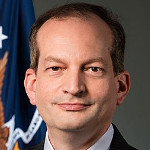
Labor Secretary Alex Acosta

Federal prosecutors, under former Miami U.S. Attorney Alex Acosta, broke the law when they concealed a plea agreement from more than 30 underage victims who had been sexually abused by wealthy New York hedge fund manager Jeffrey Epstein, a federal judge ruled Thursday.

The Miami Herald reports that the federal judge stopped short of overturning Epstein’s plea deal, or issuing an order resolving the case.

The judge said prosecutors not only violated the Crime Victims’ Rights Act by not informing the victims, they also misled the girls into believing that the FBI’s sex trafficking case against Epstein was still ongoing — when in fact, prosecutors had secretly closed it after sealing the plea bargain from the public record, according to the Herald‘s Julie K. Brown.

Acosta now serves as U.S. Labor Secretary. A White House spokeswoman said the administration is looking into the plea deal.

Read the Miami Herald article.


Firings and Lawsuits Follow Discovery of Secret Bugging Devices at Law Firm; ‘Very John Grisham’

The discovery of hidden cameras, microphones and recording equipment in a Florida law firm has led to firings, lawsuits and the departure of a name partner, according to The Palm Beach Post.

It all started when a staffer at Steinger, Iscoe & Greene in Palm Beach County found drywall debris in her office. That discovery led to wires connected to the surveillance equipment. After police were called, it was discovered that some wires had been cut and a video recording device was missing, according to a lawyer representing the firm in an invasion of privacy lawsuit.

Two associates who were fired have sued the firm, and name partner Gary Iscoe, who reportedly received an undisclosed amount of money as part of a confidential agreement, has resigned.

“It’s very John Grisham,” said attorney Michael Pike, who is representing the firm in the lawsuit aimed at finding out who the spies were.

Read the Palm Beach Post article.


Dallas Won’t Release Police Files on Slaying of Prominent Lawyer, Despite Judge’s Order

The Dallas Morning News is reporting that Dallas city and county officials are trying to block the release of investigative files related to the unsolved slaying of a prominent Dallas lawyer in 2016.

“Ira Tobolowsky, 68, was found dead inside his burning garage at his North Dallas home on May 13, 2016. The medical examiner’s office ruled his death a homicide — he died of blunt force injuries, smoke inhalation and burns,” according to the NewsDana Branham.

Michael Tobolowsky, the son of the victim, obtained an order from a district judge for the city to release documents from the Dallas Police Department and the Dallas County medical examiner so he can investigate the death of his father, potentially for a wrongful-death lawsuit. He claims the case has gone cold.

Dallas police are appealing the order, claiming the release would ruin any change of corroborating future witness statements.

Related:

Family of Slain Lawyer Think They’ve Identified Murderer. So Why Can’t the Cops Solve the Case?

Dallas Lawyer Was Spied on Before He Was Killed, Police Suspected

Read the Dallas News article.


Lawyer Told Prosecutor She ‘Doesn’t Know How To Act Like A Young Lady,’ Ethics Complaint Says

A prominent metro Detroit attorney is facing new claims of professional misconduct for allegedly mouthing off to a young female prosecutor and then, in a Facebook rant, misrepresenting what happened, the Detroit Free Press reports.

The complaint filed by the Michigan Attorney Grievance Commission accuses Clifford Woodards II of discourteous and unprofessional behavior in his March 2018 encounter with the prosecutor in Detroit’s 36th District Courthouse.

According to the complaint, Woodards challenged  the prosecutor, Heather Washington over a plea deal for his client in a traffic case. After she declined to agree to the deal without seeing the client’s driving record, Woodards acted aggressively, the complaint says.

According to the complaint:

Respondent said to Ms. Washington, something to the effect: “Little girl don’t talk to me and move out of my face” and/or “You need to back up little girl and know your place.”

Also:

Respondent told Ms. Washington that she “doesn’t know how to act like a young lady, acting immature.”

Read the Free Press article.