The Biggest Supreme Court Cases to Watch in 2020
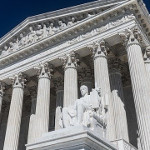
The Supreme Court will hear a slate of highly charged disputes when the justices return to the bench in the new year and resume one of the most politically volatile terms in recent memory, reports The Hill.

The court already has heard high-profile fights over LGBT rights in the workplace, the scope of the Second Amendment and the deportation status of nearly 700,000 young undocumented immigrants. But the remaining cases on the court’s docket are no less explosive, write The Hill‘s John Kruzel and Harper Neidig.

The top seven cases to be heard this session involve a separation of powers fight over President Trump’s financial records, Louisiana’s abortion law, religious school scholarships, religious exemptions from discrimination suits, the future of the Consumer Financial Protection Bureau, a fight over how copyright law treats software interfaces, and Bridgegate and public corruption.


Read the Hill article.


Ex-GC Sues Faraday & Future; Was Poached From Mayer Brown

The former general counsel of Faraday & Future Inc. sued the company for $106 million Jan. 3, according to a Bloomberg Law article.

Hong Liu, a China expert, claimed in Manhattan federal court that the electric car startup lured him away from a Mayer Brown LLP partnership by fraudulently overstating its prospects.

He alleges top executives made false claims about a pending $2 billion investment to persuade him to abandon his lucrative practice and move his family from New York to California. The investment didn’t materialize, and Liu alleges he was fired after less than a year without receiving the compensation he’d been promised: $6 million in cash and 20 million shares—valued at $100 million—in Faraday affiliate Smart King Ltd.

Read the Bloomberg article.


Wave Goodbye to Unenforceable Mineral Lien Waivers

Two Gray Reed lawyers give their take on a recent Texas appellate court’s ruling in Mesa v. Deep Energy, an opinion that will have profound impacts on mineral liens and contractual provisions purporting to waive mineral liens.

Writing on the firm’s website, Ethan Wood and Joe Virene describe the case in which Mesa sued Deep Operating for failing to pay fully for work Mesa performed on three wells. Deep Operating’s parent company claimed that Mesa contractually waived its right to assert liens against Deep Operating’s wells and waived its right to seek payment on the contract from any entity other than Deep Operating, which at that point was in bankruptcy.

“Relying on a 2012 case out of the Dallas Court of Appeals and a 2015 decision from the Texas Supreme Court, the Houston Court concluded that when a party to a contract agrees to seek payment or damages only from one source to the exclusion of all others, that party has effectively waived its rights to such payment or damages from other parties,” the authors write.

Read the article.


Biglaw Firm Sued by Crypto Fund Manager for Alleged Malpractice

Faegre Baker Daniels is being sued for legal malpractice by a company that says the firm provided “erroneous” legal services relating to the launch and operation of a fund set up to acquire and manage crypto assets, according to a Bloomberg Law report.

Digital Capital Management’s complaint alleges that the law firm provided “inaccurate analysis and advice” to Digital Capital’s predecessor, Crypto Asset Management, LP, regarding how to register under the Investment Advisers Acts of 1940.

Crypto Asset Management alleges the firm advised the plaintiffs that “Crypto Assets are not securities” and to thus structure the fund’s business “accordingly.” The advice was “erroneous,” the complaint says, resulting in a censure and penalty from the SEC.

Read the Bloomberg Law article.


Suit Claims Biglaw Firm Took Over Corporate Client’s Finances and Took Advantage of Its Impaired CEO

The ABA Journal reports that a lawsuit claims that Akin Gump Strauss Hauer & Feld and its lawyers took advantage of a corporate CEO who was suffering from substance abuse and mental health problems.

The Journal‘s Debra Cassens Weiss explains:

“The suit, filed in state court in New York, says Akin Gump took over finances and bookkeeping for Future Media Architects, a family-owned company that acquires and sells internet domain names. Akin Gump also directed and negotiated the sale of the domain names, often without input from its then-CEO and half owner, Thunayan Al-Ghanim, the suit says.”

“But eventually,” the suit alleges, “Akin Gump—aware that Thunayan was in no condition to monitor either FMA’s or Akin Gump’s activities—took advantage of the opportunity to loot FMA’s assets for personal profit.”

Read the  ABA Journal article.


Sullivan & Cromwell Sued for Malpractice by Ex-Skadden Attorney

A former Skadden attorney is suing Sullivan & Cromwell for legal malpractice, claiming that the firm represented a client in a matter for which one of its partners had once been an arbitrator, in violation of ethics rules, reports Bloomberg Law.

The plaintiff, Andrew Delaney, claims that Sullivan & Cromwell acted “unlawfully” and “unethically” in the international arbitration matter, according to Bloomberg’s Melissa Heelan Stanzione.

“The Harvard Law School graduate’s complaint alleges that Sullivan & Cromwell partner James H. Carter chaired an arbitration panel that found in favor of Delaney’s clients, and the firm subsequently “proceeded to represent the losing party” to oppose enforcement of the award,” Stanzione writes.

Read the Bloomberg Law article.


From Guns to Hemp to Immigration: Texas’ Top Legal Stories of 2019

Texas legal news in 2019 reflected the debates and court disputes being heard all across the country, according to this year’s list of Top 10 stories highlighted by Androvett Legal Media & Marketing.

Each year the Texas-based marketing and public relations agency follows news developments and develops a list of the biggest legal stories.

“Selecting the Top 10 is never easy,” said Androvett founder and CEO Mike Androvett. “There is no question that Texas is at the forefront of national debate over everything from the border wall to gun control measures. But just as important are the local issues directly affecting the lives of Texans.”

The Androvett team has compiled its annual top 10 legal news list since 2011.

Among the headlines featured:

  • Court battles have played out in the lawsuits against Austin-based InfoWars TV show host Alex Jones for promoting conspiracy theories claiming the horrific 2012 mass school shooting at Sandy Hook Elementary never happened. He has lost some recent rulings.
  • A new federal judge took the bench in Waco and immediately positioned the Western District as a challenger to the Eastern District’s stronghold on the patent litigation “rocket docket” title.
  • Houston homeowners earned a federal court win against the Army Corps of Engineers over its management of the Addicks and Barker Reservoirs which resulted in catastrophic flooding during Hurricane Harvey.
  • On death row for more than 20 years on a murky murder conviction, Rodney Reed was less than a week away from the death chamber when the state granted an indefinite stay of execution to consider new evidence.

The complete Top 10 Texas Legal Stories of 2019 can be found at https://www.androvett.com/news/the-top-texas-legal-stories-of-2019.


Eighth Circuit Rejects Claim That Arbitration Clause in Retainer Was Unconscionable

The Eight Circuit has rejected a plaintiff’s claim that an arbitration clause in a retainer agreement she signed with a law firm was unconscionable, according to Carlton Fields’ Reinsurance Focus.

The plaintiff claimed she had received a call from a purported agent of the firm informing her of a purported life-threatening medical condition, leading her to have surgery that she considered to be less than successful. She sued the law firm and other defendants, and the firm sought to compel arbitration pursuant to a retainer agreement.

The district court found the arbitration agreement was unconscionable and refused to compel arbitration. Despite acknowledging that the circumstances that gave rise to this lawsuit were “troubling,” the Eighth Circuit determined that the retainer agreement was not procedurally unconscionable.

Read the article.


NYC Litigation Boutique Sued for ‘Absurd’ Fees

Blomberg Law is reporting that a real estate developer is suing New York City litigation boutique O’Shea & Partners for breach of contract, alleging it charged “grossly excessive” and padded fees when it represented the developer beginning in 2013.

Plaintiffs claim the firm charged “almost $1.9 million over a three year period, without engaging in any discovery, or document collection, whatsoever.”

In the complaint in the New York court, plaintiffs Madison Equities LLC and the group’s principal, Robert Gladstone, are seeking at least $900,000 over the “fraudulent” billing, writes Bloomberg’s Melissa Heelan Stanzione.

Read the Bloomberg Law article.


Divided Virginia Federal Court Hears Trump Emoluments Case

Trump International Hotel
Image by Mike Peel

A federal appeals court in Virginia heard arguments Thursday about whether to revive a lawsuit accusing President Trump of violating the Constitution by profiting from his hotel near the White House, according to a report by  The New York Times.

The hearing marks the first time that a full appellate court has considered the emoluments or anticorruption clauses of the Constitution, and Trump is the first president to be sued for allegedly violating those clauses, writes the TimesSharon LaFraniere.

The hearing was a spirited session that indicated sharp divisions among the judges over the legal consequences of the president’s conduct, according to LaFraniere.

Read the  NY Times article.


Lawyer’s Heart Attack One Day Before Raise Doesn’t Cut Benefits

Bloomberg Law reports that a federal judge in Chicago ruled that Lincoln National Life Insurance Co. wrongly shortchanged a tax attorney’s disability benefits by $3,000 per month by determining he became disabled one day before he received a $65,000 raise.

Harlan Ten Pas, a former partner with McGladrey LLP, suffered a heart attack on Sunday over Labor Day weekend in 2014, one day before his raise became effective. The insurer based his disability benefits on his salary without the benefit.

Ten Pas sued, saying he was entitled to an additional $3,000 per month because the date of disability couldn’t be any earlier than the first non-holiday workday after his heart attack.

Read the Bloomberg  Law article.


Former GC Sues for $300K in Canceled Bonuses; Agency Countersues, Alleging Fraud

The Salt Lake Tribune reports that the Utah Transit Authority’s former general counsel is suing the agency for $300,000 in deferred bonuses and benefits that leaders had voided as “unconscionably high.”

The agency responded in state district court by counter-suing Bruce Jones, alleging “fraud and legal malpractice.”

Jones claims he negotiated for the bonuses in exchange for keeping his base salary lower. The agency claims Jones represented “both himself and UTA in salary negotiations” on contracts that gave him the generous benefits, which were never approved by the board.

Read the Tribune article.


Sanctions Motion By BigLaw Firm Alleges Plaintiffs Made Up Pay-Bias Claims ‘Out of Whole Cloth’

Jones Day has filed a motion seeking sanctions against plaintiffs who filed a $200 million lawsuit alleging that the law firm discriminates based on gender and motherhood, reports the ABA Journal.

The firm alleges in the sanctions motion that the plaintiffs made up the lawsuit’s pay-bias claims “out of whole cloth” and seeks their dismissal, writes the Journal‘s Debra Cassens Weiss. Jones Day also is seeking an order for the plaintiffs’ lawyers to pay fees and costs that the firm spent to litigate the motion.

Jones Day has claimed that the plaintiffs in the original suit wrongly assumed that female associates at the firm were paid less than their male counterparts.

Read the  ABA Journal article.


How Amazon Dodges Responsibility for Unsafe Products: The Case of the Hoverboard

Amazon boxThe Wall Street Journal takes a look at a specific product liability case and puts it into context in the larger question of how Amazon and other internet companies try to avoid a legal burden when the products they sell malfunction, causing injury and damage.

The article by Alexandra Berzon tells the story of malfunctioning hoverboards that caused millions of dollars in damages when they burst into flames.

“The cases are testing a longtime argument made by Amazon and other internet companies, one that underpins the modern tech industry,” she writes. “We are just operating a platform that connects buyers and sellers, the argument goes. It’s up to the sellers who use our site to make sure that they meet proper safety standards.”

Read the WSJ article.


Forum Selection Clause Gone Wrong, and Indemnification Woes

Lewitt Hackman discusses two recent cases concerning franchise agreements, one involving a forum selection clause and the other covering indemnification.

Inn the first case: “A California Court of Appeal held that courts should not enforce forum selection clauses in contracts that also contain a jury waiver. For franchisors that have California franchisees, this ruling could complicate the ability to litigate claims in their chosen forum.”

And in the second case, a federal appellate court held that a franchisee must indemnify a franchisor for its litigation defense costs, vacating a district court’s order of summary judgment for the franchisee.

Read the article.


Law Firms Face $500M Lawsuit in Fallout of Ponzi Fraudster’s Conviction

Nine law firms face civil claims they aided and abetted a multimillion-dollar securities scam run by convicted fraudster Robert Shapiro through the now-defunct real estate investment firm Woodbridge Group of Cos., according to a Courthouse News Service report.

The suit, seeking $500 million inn general damages, describes a web of collusion with Woodbridge, through which Shapiro engineered a classic $1.3 billion Ponzi scheme that targeted the elderly and their retirement accounts, reports Courthouse News’ Maria Dinzeo.

Woodbridge, now in bankruptcy, is suing through its trustee.

The firms named as defendants are Halloran & Sage LLP, Robinson & Cole LLP, Finn Dixon & Herling LLP and Rome McGuigan P.C. of Connecticut; Balcomb & Green P.C. and Davis Graham & Stubbs LLP of Colorado; Bailey Cavalieri LLC of Ohio; and Haight Brown & Bonesteel LLC and Sidley Austin LLP of Illinois.

Read the Courthouse News article.


Judge Berates Lawyers for Gig Economy Companies for Trying to ‘Worm Out’ of Arbitration

U.S. District Judge William Alsup of San Francisco has berated lawyers for big tech companies before, and now an attorney for DoorDash found himself the target, reports the San Francisco Chronicle.

The issue was the way the meal-delivery startup pushed its couriers into arbitration, writes the Chronicle‘s Mallory Moench.

Courthouse News Service describes an exchange Alsup had with DoorDash lawyer James Fogelman, of Gibson Dunn & Crutcher:

“Your law firm and all your firms have tried for 20 years to keep plaintiffs out of court, and you’ve gotten a lot of success in the courts,” U.S. District Judge William Alsup said. “Then someone says, ‘OK. We’ll take you to arbitration,’ and suddenly it’s not in your interest anymore. Now you’re wiggling away, trying to find a way to squirm out of your agreement.”

DoorDash had been ordered to pay more than $11 million in arbitration fees.

Read the SF Chronicle article.


Does an Arbitrator Have Authority to Compel Production of Third-Party Documents?

Construction disputes often involve voluminous amounts of discovery, including documents in the hand of third parties, points out Matthew DeVries in Burr & Forman’s Best Practices Construction Law blog.

If the case is subject to arbitration, it is likely there will be a dispute about whether the arbitrator has the authority to compel production of third-party documents or witnesses for deposition, he writes.

DeVries discusses a case in which the 11th Circuit  concluded that Section 7 of the Federal Arbitration Act precludes all pre-hearing discovery from non-parties.

Read the article.


Client Wins Punitive Damages Against Lawyer Who Called Him ‘A-Hole’ and ‘Jerk’ Online

The New York Post reports that a New York man who was acquitted of rape has won $280,000 against his former attorney for branding him an “a-hole” and a “dangerous jerk” online.

Citing published reporting, the Post writes that Donald Glassman was awarded the payout against Robert Feldman after a 10-day trial ruled that the lawyer committed legal malpractice and defamed him.

In an online posting, Feldman called his former client a “tragedy,” “total a-hole,” “dangerous jerk” and a “scary person” with “severe emotional and mental problems” including Asperger’s syndrome.

Read the  NY Post article.


Elon Musk to Face Trial Overtweets After Court Denies Motion to Dismiss Defamation Lawsuit

CNBC reports that Tesla CEO Elon Musk is headed to court to answer a defamation lawsuit filed by a British rescue diver he called a “pedo guy.”

U.S. District Judge Stephen Wilson in Los Angeles ordered the jury trial to begin Dec. 3.

The plaintiff is Vernon Unsworth, a diver who helped with the rescue of a boys soccer team in Thailand.

The dispute between Musk and Unsworth erupted after Unsworth criticized Musk’s efforts to send a submarine to help rescue the team from a cave in Thailand where they were trapped, according to CNBC’s Annie Palmer. In response, Musk called Unsworth a “pedo guy” on Twitter and a “child rapist” in an email to a reporter.

Read the CNBC article.