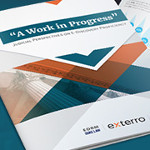
Download: E-Discovery Action Plan for 2018 – 6 Checklists

Exterro has published a new E-Discovery Action Plan e-book that provides checklists, guides and tips to help optimize the e-discovery process. The e-book can be downloaded from Exterro’s website at no charge.

“Sometimes the hardest part about updating your e-discovery process is just knowing where to start,” the company says on its website. “With this new e-book, get six easy to use checklists for every stage of the e-discovery process so you can create an E-Discovery Action Plan for 2018.”

The e-book provides checklists on topics such as:

  • Data Identification
  • Preservation/Legal Hold
  • Early Case Assessment
  • Collection and Processing
  • Review
  • Legal Project Management

Download the e-book.


A Third of Americans Are Leashed to Their Companies By Non-Disclosure Agreements

More than one-third of the U.S. workforce is bound to their employers by a non-disclosure agreement, or NDA, according to a Harvard Business Review report this week, which cites figures from a research paper published last year in the Vanderbilt Law Review.

Amy X. Wang, writing for Quartz at Work, says the contracts have been steadily growing in both number and breadth as companies grow warier about competition and proprietary material.

She adds that the problem has spread to cover personal harassment, to the point that many have questioned whether NDAs can end up enabling abusers.

Read the article.


Announcing Case in Point 2018 Webinar Series Schedule – Beginning Feb. 13

Andrews Kurth Kenyon LLP will kick off its 2018 Case in Point Webinar Series on Feb. 13 with “The Dog Ate My Evidence – Tips for Implementing Litigation Holds and Avoiding Sanctions.”

The first webinar will be on Tuesday, Feb. 13, at 10 a.m. Central time. Presenters will be  Kelly Sandill and Ashley Lewis.

Destruction of evidence can lead to the imposition of substantial sanctions against a company and its non-compliant employees, the firm says on its website. An effective litigation hold can be a first line of defense against claims of spoliation or obstruction. Unfortunately, implementing a litigation hold is not always a simple process and sometimes does not go as planned.

This CLE program provides an overview of developments in the law surrounding destruction of evidence, discusses the human and technological challenges of litigation holds, provides suggestions for avoiding common pitfalls, and discusses how companies can best handle situations in which evidence has gone missing.

Register for the Feb. 13 webinar

See upcoming  events in the series


Employer’s Notice of Mandatory Arbitration Program May Be Insufficient to Compel Arbitration

Employment contractA Sixth Circuit ruling in a recent case shows that an employer’s notice of its institution of a mandatory arbitration policy or program is, without more, insufficient to compel an employee to arbitrate a subsequent dispute, writes Gilbert Samberg in Mintz Levin’s ADR: Advice From the Trenches blog.

He explains that something more is required in order to be able to infer the employee’s knowing assent to the new term of employment. The new “Employment Dispute Resolution Process” (EDRP) was promulgated after the plaintiffs had commenced employment.

Samberg writes that the appellate court “determined that the employer’s failure to notify the employees expressly that ‘they would accept the terms of the EDRP by continuing their employment’ was a critical omission, and thereupon held that the employees had not manifested knowing assent merely by continuing to work at FCA.”

Read the article.


Sexual Harassment Settlements are No Longer Tax Deductible

Confidential sexual harassment settlements and accompanying attorney’s fees are no longer tax deductible under the new tax reform bill, according to a new post by Natalie Lynch of Lynch Law Firm in Austin.

In short, companies will no longer be able to use confidential settlements pertaining to sexual harassment as a tax-deductible settlement, she explains.

Non-confidential settlements can still be used for tax deductions. While the reform bill makes it clear that sexual harassment settlements that carry non-disclosure agreements can no longer be used as tax deductions, it stops short of making all confidential settlements non-deductible. Language that would include gender discrimination, retaliation, or Title IV is entirely absent in the bill.

Read the article.


Workplace Litigation Report: The Good and the Bad

Employers can find good news and some bad news in Seyfarth Shaw’s 14th Annual Workplace Class Action Litigation, which analyzes 1,408 rulings.

The firm has posted the 57-page report on its website and has created a microsite that provides a brief overview of the survey’s findings.

 of Human Resource Executive also has written a summary of the report.

Shadovitz offers the good news for employers from the report: “Legal precedents and new defense approaches resulted in better statistical outcomes for employers in opposing class-certification requests for the second straight year. For instance, in wage-and-hour litigation—one of the more active categories of employment law—employers won 63 percent of decertification rulings, a success rate of nearly 20 percent from the year before.”

On the other side of the coin, he writes, the monetary value of the top workplace class-action settlements jumped more than $1 billion to a record high of $2.72 billion.

Read the Seyfarth report.


Important eDiscovery Case Law Decisions of 2017 and Their Impact on 2018

E-discovery magnifying glassCloudNine has posted an on-demand webinar that covers key 2017 case law decisions covered by the company’s eDiscovery Daily blog and what the legal profession can learn from those rulings.

The presentation leader is Doug, VP of Products and Professional Services for CloudNine. And special consultant is Tom O’Connor, a nationally known consultant, speaker, and writer in the field of computerized litigation support systems.

Topics include:

  • Handling objections to production requests
  • Waiver of privilege and Rule 502(d)
  • Case law related to subpoenaed production of international data
  • Control of data stored by a third party
  • Dictation of search terms and production scope by courts
  • Form of production disputes and the issues involved
  • Performing keyword search before Technology Assisted Review
  • The state of sanctions with the new Rule 37(e)

Watch the on-demand webinar.


Fund Manager Alleges Firm Fired Her After She Accused Executive Of Coercing Sex

A former fund manager at TCW is suing the large Los Angeles asset management firm for $30 million, saying she was fired nine days after lodging a sexual harassment complaint against one of the company’s executives, according to The Los Angeles Times.

Sara Tirschwell, who worked in the firm’s New York office, alleged TCW Managing Director Jess Ravich coerced her into sex by threatening to withhold company resources from a fund she managed, writes James Rufus Koren. She said the company started withholding marketing support for her fund after she started Ravich’s advances.

Tirschwell is suing for breach of contract and violations of a New York City anti-discrimination law.

A TCW spokesman said Tirschwell was fired for cause.


Answers Demanded Following Deadly Oklahoma Rig Explosion

Monday’s blowout near Quinton, Oklahoma, that killed five workers is the deadliest oil and gas incident since the 2010 Deepwater Horizon disaster in the Gulf of Mexico. As this incident moves from the recovery of the victims to the cleanup and investigation stage, a prominent Texas trial lawyer says the industry must use this tragedy as a signal to self-reflect and take stock of their safety procedures, according to a post on the website of Androvett Legal Media & Marketing.

“When it comes to rig blowouts, somebody made a mistake,” says trial lawyer Frank Branson of The Law Offices of Frank L. Branson, who has handled numerous oilfield tragedies, including involvement in a 2015 onshore rig explosion where three men died in a well blowout near Midland, Texas.

“Every driller and operator knows that well control must be maintained at all times. That’s rule number one on these rigs. A failure to control the well is inexcusable and absolutely preventable. With so much at stake, companies like Patterson-UTI and Red Mountain Energy must make worker safety – not shareholder profits – the overriding priority.

“Patterson-UTI, one of the largest onshore rig operators in the U.S., has been called out for its safety shortcomings by name in Congressional reports and has been fined by OSHA following earlier oil and gas well fatalities. As the families of those killed search for answers, it’s clear that relatively toothless regulations are not enough to ensure the safety of hardworking oilfield workers. In cases like these, American jurors will be called upon to determine who was at fault and return a verdict that will make sure these companies put worker safety first.”


Royalty Owners Seek Class-Action Status Against Talisman Energy USA

Royalty owners are seeking class-action status in a lawsuit against Talisman Energy USA, Inc. over claims the company manipulated production volumes for wells operated in the Eagle Ford shale basin in South Texas, according to a post on the website of Androvett Legal Media and Marketing.

Attorneys for plaintiffs Rayanne Regmund Chesser, Gloria Janssen, and Michael and Carol Newberry filed a motion Jan. 22, 2018, seeking class certification in U.S. District Court for the Southern District of Texas and named lawyers Bryan O. Blevins Jr. and Mike Hamilton of Provost Umphrey Law Firm, L.L.P., to represent the class. The lawyers estimate approximately 4,000 royalty owners could be involved.

“It’s clear that Talisman knew what they were doing when the company voluntarily commingled production from different wells and then allocated net sales in violation of best oilfield practices and Texas law,” said Blevins. “We intend to prove that the amounts paid to the royalty owners were based on manipulated production volumes.”

The lawsuit charges that from Jan. 1, 2013, to June 1, 2016, Talisman failed to report, account for and make royalty payments based on its lease agreements. In addition, the company is accused of altering wellhead production volumes by as much as 20 percent and paying royalties based on estimated sales volumes instead of the actual amount of oil or gas sold or saved.

In 2010, Talisman entered the Texas oil and gas market in a joint venture with Statoil. In July 2013, the agreement was revised, with Statoil assuming half the well operations and Talisman operating the other half. Shortly after that, royalty owners noticed a difference in reported production volumes from Talisman compared to Statoil.

Talisman Energy USA is an indirect subsidiary of Calgary, Alberta–based Talisman Energy Inc., which was acquired by Repsol S.A. in 2015.

The case is Rayanne Regmund Chesser, Gloria Janssen, Michael Newberry and Carol Newberry v. Talisman Energy USA, Inc. No. 4:16-cv-02960 in the U.S. District Court for the Southern District of Texas, Houston Division.



AZA Adds Six Litigators to Trial Team

Ahmad, Zavitsanos, Anaipakos, Alavi & Mensing P.C.Houston-based  Ahmad, Zavitsanos, Anaipakos, Alavi & Mensing has added six litigators to its trial, the firm announced.

The new hires include:

  • Matt Caldwell, with experience advising clients on regulatory and compliance matters, especially involving tax and accounting questions
  • Monica Cooper,  a trial lawyer with civil and criminal experience
  • Shahmeer Halepota, a commercial litigator with mediation, international arbitration, and state and federal trial experience
  • Kyle A. Poelker, who handles all types of complex commercial litigation in state and federal court
  • Paul Turkevich, a commercial litigator who handles a variety of business disputes
  • Patrick Yarborough, a commercial litigator with experience representing clients in all aspects of litigation, including mediation, arbitration and trial

Read details about the new hires.


Download: Federal Judges Discuss E-Discovery Proficiency of Legal Teams

Exterro has published part 1 of the 2018 Judges Report, which provides an in-depth examination of how the bench views these e-discovery issues: attorney proficiency, judicial competency, how to resolve e-discovery mistakes effectively.

The report, which can be downloaded at no charge, includes:

  • 10-page report on how 30 federal judges feel about e-discovery competency in their courtrooms
  • Expert insights from judges on how to solve e-discovery mistakes
  • Why only 23% of the judges surveyed agreed with the statement, “The typical attorney possesses the legal and technical subject matter knowledge required to effectively counsel clients on e-discovery matters.”

Download the report.


Usual Suspects: MDL-Experienced Lawyers Flock to Opioid Litigation for Possible Big Payday

Pills - medicineThere will be a lot of familiar faces in U.S. District Judge Dan Polster’s courtroom in Cleveland on Jan. 31, when lawyers gather for a hearing on multidistrict litigation against the nation’s opioid manufacturers and distributors, writes Daniel Fisher, a contributor for Forbes.

“The prospect of the biggest payday since the $200 bill­­ion tobacco settlement in 1998 has drawn many of the same plaintiff lawyers who appear again and again in big tort cases over everything from VW diesels to Vioxx to the BP Deepwater Horizon disaster,” according to Fisher.

Some of those firms include Simmons Hanly Conroy, the Lanier Firm, Seeger Weiss, Lieff Cabraser, Motley Rice and Weitz & Luxenberg.

Read the Forbes article.


Trump Appointing Judges at Rapid Pace

A data analysis by the Los Angeles Times has found that President Trump is ranked sixth of 19 presidents for appointing the highest number of federal judges in their first year.

Reporter Kyle Kim explains that Trump’s Republican Party’s slim majority in the Senate is one reason he has been able to fast-track judges.

“Another reason is a little bit of political warfare. Republican senators blocked 36 judicial nominations in President Obama’s first five years, according to Politifact. The best-known nominee was Judge Merrick Garland, chosen to replace the late Supreme Court Justice Antonin Scalia,” writes Kim.

Read the LA Times article.


Biglaw Firm Hit With $300 Million Gender Discrimination Lawsuit

Above the Law reports that Ogletree, Deakins, Nash, Smoak & Stewart nonequity shareholder Dawn Knepper has hit her employer with a $300 million purported class-action suit alleging gender discrimination and unequal pay.

In her complaint, Knepper alleges: “Through formal policies and widespread practices, [Ogletree’s] male leadership interferes with, limits, or prevents female shareholders from receiving the appropriate credit for the business they bring to the firm and their hard work in running complex and demanding cases day-to-day.”

Kathryn Rubino writes that the complaint also alleges that on average, women shareholders make  to to $110,000 less than their male counterparts. And the complaint notes that while women represent about 58 percent of associates at Ogletree, a mere 32 percent of shareholders are women.

Read the Above the Law article.


Workplace Lawyers Race Against the Trump Clock

Litigators are settling more cases as labor agencies and federal courts fill up with business-friendly appointees, reports Bloomberg.

“While employers across the U.S. paid a record amount in settlements for workplace violations last year, don’t expect this to mark the beginning of a trend. Think of it more as the storm before the calm, as labor lawyers rush to lock in payouts ahead of a shifting legal landscape,” writes Rebecca Greenfield.

She quotes Paul DeCamp a lawyer at Epstein Becker & Green who represents employers:

“I think that what we see is a race to settle. I’ve seen it in my practice. Cases that plaintiffs’ counsel felt very strongly about and seemed more bullish and willing to go to trial—since the election they were more eager to settle those cases.”

Read the Bloomberg article.


Download: ‘Comprehensive E-Discovery Workflow Guide’

Exterro has published its “Comprehensive E-Discovery Workflow Guide,” which can be downloaded at no charge.

This resource compiles four checklists documenting best practices for each stage of the e-discovery process.

The guide includes:

  • 4 e-discovery checklists covering (1) Preservation and Legal Holds through (2) Preparation for Discovery, (3)Search and Collection, and (4) Review and Production
  • 32 workflow steps to ensure your e-discovery process is efficient and defensible
  • How to communicate across teams inside and out of your organization

Download the guide.


Choice of Venue Provision Upheld in Employment Contract

Employment contractForum selection clauses that are not adhesive will be interpreted independently of the court’s determination of the enforceability and validity of the contract as a whole, according to a post in Baker Sterchi Cowden & Rice’s Employment Law Blog.

Robert Chandler discussed the case of Reed v. The Reilly Company, LLC, in which the plaintiff, terminated by the Reilly Co., brought claims in Missouri. Reilly moved to dismiss, based on a contract provision stating that disputes must be brought in Kansas.

“Parties drafting forum selection clauses should exercise care to avoid contracts that are adhesive – i.e. agreements reached without a realistic opportunity for bargaining – and to choose forums which will be considered “neutral” and not overly advantageous to the party drafting the agreement,” Chandler explains.

Read the article.


Here are the Major Questions Before the Supreme Court This Year

U.S. Supreme CourtLos Angeles Times reporter David G. Savage takes a look at the most-interesting legal issues that the U.S. Supreme Court will be facing during the first half of the new year.

First on the list is a case that can have implications for religious liberty and gay rights: Masterpiece Cakeshop vs. Colorado.

Other cases involve cellphone tracking and privacy, jail before deportation, voting rolls and purges, sports betting, and public employees and union fees.

In NLRB vs. Murphy Oil USA, the court will consider: Can companies require workers to waive their rights to join any class or collective action against their employer and instead resolve disputes as individuals through binding arbitration?

 Read the LA Times article.


Southwest Airlines Reaches $15 Million Settlement in Price Collusion Lawsuit

Fortune is reporting that Southwest Airlines agreed to pay $15 million to settle nationwide antitrust litigation by passengers who accused the four largest U.S. carriers of conspiring to raise fares by reducing seating capacity.

The Dallas-based carrier denied wrongdoing but said it settled to avoid the cost and distraction of further litigation.

The remaining defendants, including American Airlines Group, Delta Air Lines and United Continental Holdings, have not settled.

The report says Southwest agreed to help plaintiffs with their suit against the other three.

Read the Fortune article.