Add One Line in Employment Contracts to Reduce Exposure to Misclassification Liability

An employee misclassification lawsuit can be difficult to dismiss early because plaintiffs are afforded great latitude in crafting factual disputes that can only be resolved at trial, points out a post in the Labor Days blog for Kelley Drye.

Special counsel Michael D. Yim offers a suggestion: one simple sentence in employment contracts, handbooks and policies for salaried employees that would likely reduce exposure by approximately two-thirds in FLSA cases.

He presents the wording of the sentence and then illustrates the  financial impact and disparity of the two calculation methods — first without the “magic words” in the agreement and then with the “magic words.”

Read the article.


Litigator Len Wade Joins Jackson Walker

Jackson Walker announced that Len A. Wade has joined the firm as a partner in the Fort Worth office. Wade has experience as a trial lawyer, mediator, arbitrator, and judge.

“The knowledge and experience Len brings to the Fort Worth office, and to the firm as a whole, will add a whole new dynamic to our litigation practice,” said William R. Jenkins, managing partner of the Fort Worth office.

“We are excited to bring in an attorney of Len’s quality who can enhance the team, which in turn will help us better serve our clients.”

In a release, the firm said Wade’s practice focuses on complex litigation, mediation, and arbitration. He received training from the Attorney-Mediators Institute in Dallas. He is a member of the Association of Attorney-Mediators and the Commercial Panel of Neutrals for the American Arbitration Association. Prior to serving as a judge for the 141st District Court for the State of Texas from 2003 to 2009, Wade represented both plaintiffs and defendants in state and federal court litigation for 15 years.

Wade has also served as an adjunct professor at the Pepperdine University School of Law. He received an AV Preeminent rating by Martindale-Hubbell Peer Review Ratings and was also listed in the Martindale-Hubbell Bar Register of Preeminent Lawyers before his judicial election.

Wade graduated cum laude from Baylor University Law School, where he served as executive editor of the Baylor Law Review.

He joins Pamela Madere and Scott A. Schepps as Jackson Walker’s third partner hire in 2018.


Assault Allegations Highlight Home Service Call Vulnerabilities, Plaintiff’s Attorney Says

A lawsuit has been filed against cable company Charter Communications and its third-party cable installation partner DCOMM after the alleged sexual assault of a 72-year-old Dallas woman during a cable installation visit, according to a post on the website of Androvett Legal Media & Marketing.

The woman, who is not named in the filing in order to protect her privacy, was sexually assaulted by the technician sent to set up television, internet and telephone service, according to her family’s attorney, Michael Lyons of the trial firm Deans & Lyons, LLP. The technician, Moises Cabrera, is facing criminal charges of aggravated sexual assault.

“Calling the cable person to come to your house — that’s not something you ordinarily associate with the threat of criminal danger,” Lyons told Dallas ABC affiliate WFAA.

There is a false sense of safety because these workers are viewed as representatives of a company that is trusted to properly screen, train and supervise its employees.

“But in reality, you don’t know who you are allowing into your home,” he said. “Consumers need to recognize that most of these workers are contractors who may not always be properly vetted, well-trained or supervised. That can result in dangerous consequences, especially for vulnerable customers who are home alone. Service companies need to be held accountable for the people they hire to go into residents’ homes.”


Harvey Weinstein’s Insurer Refuses to Pay for Legal Defense

Variety is reporting that Harvey Weinstein’s insurance company is refusing to defend him against 11 sexual harassment lawsuits, saying that his alleged misconduct is not covered under his personal liability policies.

Chubb Indemnity Insurance Co. sued on Wednesday, asking the New York Supreme Court for a declaration that it is not obliged to fund the disgraced producer’s legal defense, according to reporter Gene Maddaus.

The suit says that some of Weinstein’s policies cover damages he is obligated to pay “for personal injury or property damage.” The damages must arise from “an accident or offense” to be covered.

But Chubb’s position is that Weinstein’s alleged pattern of sexual assault and harassment does not qualify.

Read the Variety article.


Indemnification Clauses and Defining the Relationship

An attorney client-relationship can arise from something far less definite than an explicit agreement between the attorney and his or her client, warns Robert J. Glowacki Jr. in a post for Poyner Spruill LLP.

He explains:

“In the recently decided Friday Invs., LLC v. Bally Total Fitness of the Mid-Atl., Inc., the North Carolina Supreme Court found the existence of an attorney-client relationship under circumstances where neither party explicitly discussed legal representation. There, the central question was whether an attorney-client relationship exists between a defendant to a lawsuit and a non-party that contractually agreed to indemnify that defendant and, if so, whether correspondence between the two is protected by the attorney-client privilege.”

Read the article.


Landman Contract Defeated by the Statute of Frauds

Charles Sartain and Chance Decker, writing in Gray Reed & McGraw’s Energy & the Law blog, describe a contract case in which an oil and gas landman found out that the contract he signed with a purported agent for a client was unenforceable.

The independent landman signed a contract with the purported agent of the plaintiffs, in which the producers were to pay Moore “$600 per mineral acre for for leases signed. The plaintiff said he helped secure numerous leases, but defendants refused to pay.

The authors explain that the court found that the contract didn’t specify the properties it applied to, this violating the Statute of Frauds. Sartain and Decker then offer some ways the contract could have been written so it would have been enforceable.

Read the article.


States to Forego Most of $650M Legal Settlement With Takata

The Associated Press is reporting that Japanese air bag maker Takata Corp. has reached a $650 million deal to settle consumer protection claims from 44 states and Washington, D.C., but only a fraction of the money will be paid due to Takata’s financial problems and bankruptcy.

Plaintiff states agreed not collect the settlement so that victims of Takata’s faulty air bag inflators can get a bigger piece of the company’s remaining money. But South Carolina, which led the states, will get more than $139,000 to cover costs of the investigation.

Reporter Tom Krisher explains that Takata air bag inflators can explode with too much force and spew shrapnel into drivers and passengers. At least 22 people have died worldwide and more than 180 have been hurt.

Read the AP article.


Ponzi-Scheming Company’s GC (and Texas State Senator) Guilty on 11 Charges

A Texas jury found State Senator Carlos Uresti guilty on 11 felony charges — including fraud and money laundering — for his role as general counsel for a now-bankrupt oilfield services company that perpetrated a Ponzi scheme against its investors.

The Texas Tribune reports that Uresti could face a long prison sentence and fines amounting to millions of dollars.

“Uresti was charged last year in connection with FourWinds Logistics, a now-bankrupt oilfield services company that perpetrated a Ponzi scheme against its investors,” reports Emma Platoff. “Uresti served as general counsel for FourWinds and owned 1 percent of the company. He also earned commission for recruiting investors, according to court documents.”

Read the Tribune article.


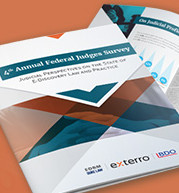
4th Annual Federal Judges Survey – Full Report Released

Exterro Inc., a provider of e-discovery and legal software, has released the 4th Annual Federal Judges Survey, produced in partnership with BDO Consulting and EDRM at Duke Law.

The survey report can be downloaded from Exterro’s website at no charge.

The report is a compilation and analysis of the responses of 30 judges to questions about attorney and judicial e-discovery proficiency, recommendations for improvements, and their thoughts on how legal teams are using new e-discovery rules.

It includes:

  • 33-pages of quantitative data analysis on where attorneys need to improve their e-discovery skills — and how to do so
  • Op-ed commentary from judges on the practical implications of the survey results
  • Access to the raw data, showcasing how the judges responded to  each of the 27 questions we asked them

Download the survey report.


Detours on the Way to Your Contractually Selected Forum

Glenn West, writing in Weil, Gotshal & Manges LLP’s Global Private Equity Watch, writes about a case in which a cut-and-pasted forum selection clause from an unrelated contract made its way into the wrong document.

The cut-and-pasted text declared that “any action pertaining to this agreement shall be the State of Illinois.” When the plaintiff sued the defendant in Florida, where the defendant’s headquarters were located, the defendant moved to dismiss on the basis that the contract required choice of Illinois as the forum.

The Florida appellate court said that mandatory forum selection clauses mean what they say, even when what they say was the result of a supposed cut and paste error. Accordingly, the case was dismissed for being filed in an improper forum.

West sees the ruling as good news for the careful transactional lawyer and bad news for those who fail to draft a bespoke clause.

Read the article.


Claim of Fraudulent Inducement of a Construction Contract Does Not Invalidate Arbitration Clause

Pepper Hamilton LLP’s Constructlaw blog discusses an Ohio case in which a plaintiff sued a building company and attempted to have the arbitration clause in a construction contract declared unenforceable.

The contract identified the builder in the case by a name that was a fictitious name for a similarly named company and was not registered with the Ohio secretary of state, writes Emily D. Anderson. The trial court denied plaintiffs’ motion to invalidate the arbitration clause.

The appellate court agreed with the trial court, observing that the builder did not initiate the action but was merely defending it.

Read the article.


For the Third Time, Supreme Court to Hear Mandatory Union Dues Arguments

Next week the Supreme Court will hear oral argument on whether to reverse a 41-year-old ruling that allows states to require government employees to pay union dues even though they don’t want to be union members.

“It’s a familiar question for eight of the nine justices, who have already heard oral argument on the issue twice,” writes Amy Howe in SCOTUSblog. “The court did not resolve the issue the first time; the second time, in the wake of the death of Justice Antonin Scalia, they deadlocked. This means that the outcome in [petitioner Mark] Janus’ case could hinge on the vote of the court’s newest justice, Neil Gorsuch.”

The case, appealed by Janus, an employee of the state of Illinois, comes after the U.S. Court of Appeals for the 7th Circuit rejected his argument that the agency fee violated his rights under the First Amendment.

Read the SCOTUSblog article.


Trump on Track to Nominate Record Number of 5th Circuit Judges

Dallas appellate attorney and specialist David Coale of Lynn, Pinker, Cox & Hurst LLP says President Trump is on track to nominate more full-time judges to the U.S. 5th Circuit Court of Appeals than any other president, according to a post on the website of Androvett Legal Media & Marketing.

Trump recently announced the nomination of Andrew Oldham as his third pick from Texas, after previously nominating to the 5th Circuit Don Willett, a Texas Supreme Court justice, and Jim Ho, a former Texas Solicitor General. Oldham is currently general counsel to Texas Gov. Greg Abbott and a former deputy state solicitor general.

Coale says the nominations could result in even more of a Republican influence on the bench for this traditionally conservative court.

Read the article.


Sexual Harassment Roundtable: Practical Guidance for Employers

Wolters Kluwer Legal & Regulatory U.S. announced that registration is open for a relevant and timely webinar to provide employers with practical guidance on sexual harassment policies.

The 60-minute webinar, titled “Sexual Harassment Roundtable: Practical Guidance for Employers,” will be Thursday, March 1, 2018, beginning at 1 p.m. EST.

The event will feature experts from law firms in employment and labor law.

Topics will include:

  • Why sexual harassment remains a persistent workplace problem
  • The types of sexual harassment allegations that can be trickiest for employers
  • Pros and cons of using nondisclosure clauses in settlement agreements
  • How mandatory arbitration impacts sexual harassment claims
  • Best practices for preventing sexual harassment and handling allegations when they do arise

Register for the webinar.


Remington Bankruptcy Could Put Rifle Settlement at Risk, Attorneys Say

CNBC is reporting that an expected bankruptcy filing by Remington could jeopardize a landmark class action settlement involving the company’s iconic Model 700 bolt-action rifle, according to an attorney involved in the case.

The article quotes Mark Lanier, a lead attorney for plaintiffs: “If they file for bankruptcy, it will stay all proceedings.”

Plaintiffs claim that Remington covered up a deadly design defect that allows the rifle — and a dozen similar models — to fire without the trigger being pulled. Remington denies those accusations.

“In 2014, while still maintaining the guns are safe, Remington agreed to replace the trigger mechanisms, free of charge, on millions of guns in order to settle the case. But two Model 700 owners, Richard Denney of Oklahoma and Lewis Frost of Louisiana, appealed the settlement. They argue the agreement deliberately downplays the risks from the guns, and does not do enough to notify the public,” reports Scott Cohn.

Read the CNBC article.


Exxon’s Response to Climate-Change Case: Sue the Lawyers

As climate-change lawsuits against the oil industry mount, Exxon Mobil Corp. is taking a bare-knuckle approach rarely seen in legal disputes: It’s going after the lawyers who are suing it, according to a Bloomberg report.

Exxon’s targets include the attorneys general of New York and Massachusetts, hitting them with suits, threats of suits or demands for sworn depositions. The company claims the lawyers, public officials and environmental activists are “conspiring” against it in a coordinated legal and public relations campaign, writes Bob Van Voris.

He quotes Howard Erichson, an expert in complex litigation and a professor at Fordham University School of Law in New York: “It’s an aggressive move. Does Exxon really need these depositions or is Exxon seeking the depositions to harass mayors and city attorneys into dropping their lawsuits?”

Read the Bloomberg report.


On Remand, District Court Breaks New Ground by Vacating Arbitrator’s Class Certification Award

In what appears to be a first-of-its-kind ruling, the District Court for the Southern District of New York recently concluded that a federal district court has the authority to vacate an arbitrator’s class certification award based on the due process rights of absent class members, according to a post on the website of K&L Gates.

The ruling involves the long-running Jock v. Sterling Jewelers, Inc., in which the district court and the Second Circuit Court of Appeals have rendered multiple decisions addressing the proper role of a court in reviewing an arbitrator’s authority to determine whether parties have agreed to class arbitration.

The K&L Gates authors explain that the Jock court determined that, absent an express class arbitration provision in each putative class member’s arbitration agreement, an arbitrator does not have the authority to bind absent class members to a class judgment—even if they signed the same form of arbitration agreement as the named plaintiffs.

Read the article.


Deans & Lyons Represents Family of Man Killed in Oklahoma Gas Well Explosion

The family of Parker Waldridge, one of five workers killed in the Jan. 22 gas well explosion near Quinton, Oklahoma, has hired the Texas trial law firm Deans & Lyons, LLP, to investigate and pursue a lawsuit involving the deadliest oil and gas drilling disaster since the 2010 Deepwater Horizon rig explosion in the Gulf of Mexico.

“Mr. Waldridge was an incredible man who will be terribly missed by his family,” said Deans & Lyons co-founder Michael Lyons. “While we mourn the tremendous loss experienced by all the families impacted by this tragedy, there are a number of questions raised about the circumstances of this explosion and what could have been done to prevent it.”

In a release, the firm said:

According to published reports, Waldridge, 60, of Crescent, Oklahoma, was among the workers trapped in an operations room when the first of two explosions occurred at the well site operated by Oklahoma City-based Red Mountain Energy. The drilling contractor was Houston-based Patterson-UTI Energy Inc., a company with an extensive history of fatal accidents and safety violations.

The resulting inferno was so intense that the site was inaccessible to emergency workers until the following day. An initial report by the U.S. Chemical Safety Board indicated that rig workers were preparing to change out a drill bit at the time of the explosion, but the investigation is not yet complete.

“The Waldridge family and the families of the other victims deserve to know the truth about what happened,” said Mr. Lyons. “Oil field work has inherent dangers, but this disaster appears to have been preventable if safety had been the paramount concern of this operation.”

Deans & Lyons represents clients in a broad range of complex personal injury and wrongful death claims, including cases involving the oil and gas industry.


Company Blames Gibson Dunn in Aetna HIV Settlement Notice Fiasco

A day after Aetna sued the claims administrator Kurtzman Carson Consultants for exposing confidential medical information about Aetna clients in a settlement notification, a KCC subsidiary brought a new suit blaming Aetna and its lawyers at Gibson Dunn & Crutcher for failing to protect the privacy of Aetna customers, according to Reuters.

The underlying case is based on the mailing of prescription notices sent to Aetna insureds. Those mailings by KCC were in envelopes that included transparent windows that displayed text including the words  “when filling prescriptions for HIV medications.”

KCC now claims that “Aetna and Gibson knew that windowed envelopes were being used in the mailings in question.” The law firm is not named as a defendant, but the firm’s actions on Aetna’s behalf are mentioned throughout the complaint, writes Alison Frankel.

Read the Reuters article.


Chevron Fights California Cities’ Climate-Change Lawsuits With ‘Creative Lawyering’

Lawyers for Chevron Corp., hoping to keep climate-change lawsuits by California cities out of state courts, have sued Oslo-based Statoil, calling it “one of many” oil producers that should help foot the bill if the industry is found liable, reports The Los Angeles Times.

Kartikay Mehrotra writes that adding foreign companies to the litigation is a tactical maneuver to keep the dispute out of state court, where the cities have more favorable prospects, and force it into federal court.

She quotes Julia Olson, executive director and chief legal counsel for the environmental law group Our Children’s Trust: “The industry is grasping at straws while looking for any way out of these cases and using creative lawyering to do so. By cherry-picking Statoil, a sovereign Norwegian entity, Chevron hopes to reinforce federal jurisdiction.”

Read the LA Times article.