Chadbourne Sex-Bias Class Action Adds Six Partners as Defendants

The woman partner who filed a gender discrimination class-action against Chadbourne & Parke leveled new accusations in an amended complaint on Thursday, including that the firm’s head of litigation placed a cartoon of a fat man in a bowler hat on her wall and took a postcard from her office, reports Bloomberg Law.

The complaint includes new allegations from former partner Jaroslawa Z. Johnson who is joining current partner Kerrie Campbell as a named plaintiff in the suit. Johnson ran the firm’s Kiev office for nearly 10years.

Reporter  writes that the complaint also adds six individuals as named defendants, including Abbe Lowell, the head of litigation based in D.C., and four members of the management committee — Andrew Giaccia, the firm’s managing partner; Lawrence Rosenberg, Howard Seife, and Paul Weber, who are all located in New York City. Marc Alpert, a former member of the management committee, is also named as a defendant.

Read the article.


Class-Action Attorneys Awarded $555.2 Million for Work in BP Suits

Image by U.S. Coast Guard

Image by U.S. Coast Guard

A federal judge has ordered that attorneys representing private individuals and companies who entered into economic and medical claims settlements with BP stemming from the Deepwater Horizon disaster are entitled to be paid $555.2 million to cover their legal fees and remaining court costs, reports The Times-Picayune of New Orleans.

U.S. District Judge Carl Barbier pointed out that award represents about 4.3 percent of the estimated $13 billion that BP is expected to pay under the ongoing settlements. That compares to the average 9.92 percent of awards paid as fees and court costs in 21 similar “super-mega-fund” settlements totaling more than $1 billion, he said in an order.

“In weighing the award against local billing rates, Barbier said it would be the equivalent to an average $450 per hour legal fee, after being weighted for the intensity of effort involved in the case,” writes reporter Mark Schleifstein. “That compares to average nationwide rates of $604 for partners and $370 for associates in 2014, and to the $600 per hour paid by the state of Louisiana to its attorney in the BP case, Barbier said.”

Read the article.


Casino Could Face Liability Claim in Crash That Killed Charter Bus Passengers

A California casino could be held responsible for the deaths of more than a dozen casino customers following the crash of a charter bus with a questionable safety record, says Dallas bus crash lawyer Frank Branson.

Even though the bus involved in the California casino crash was owned and operated by an independent charter company, casinos have been held liable for passengers’ safety based on incentives and control exercised over the charter company and scheduling of charter trips.

“Casinos depend on these charter buses to bring in business,” says Branson in a post on the website of Androvett Legal Media & Marketing. “They negotiate with charter bus companies to receive the cheapest price and pay little attention to safety. The end result is poorly maintained buses and overworked drivers to transport patrons.”

Branson’s input comes after the deadliest bus crash in California in decades early Sunday morning near Palm Springs. A USA Holiday tour bus returning from the Red Earth Casino slammed into a tractor-trailer, killing 13 people – including the bus driver – and injuring 31 others.

“The speed of the bus was so significant that when it hit the back of the big rig…the trailer itself entered about 15 feet into the bus,” according to the California Highway Patrol. There were no signs of the driver applying the brakes.

As the NTSB investigates the cause of the crash, early reports indicate the bus owner and operator had been sued twice for negligence involving previous crashes, including one that killed three people.

In May of this year, Branson won a $4.9 million judgment against the Choctaw Nation of Oklahoma for the family of an 83-year-old woman killed in a 2013 casino charter bus crash.

“If casinos are going to charter the buses to bring gamblers, they should make sure the buses and drivers are safe,” says Branson.


Judge Richard Posner On SCOTUS: ‘The Supreme Court Is Awful’

Judge Richard Posner

Image by Chensiyuan

Judge Richard Posner of the Seventh Circuit had some harsh words for justices of the U.S. Supreme Court, decreeing that only two of them write readable opinions and singling out Justice Samuel A. Alito for penning “the most tedious opinion I’ve ever read.”

Above the Law covered Posner’s interview at a Chicago bookstore on the occasion of the publication of a biography of the outspoken jurist.

“I’m very critical. I don’t think the judges are very good. I think the Supreme Court is awful. I think it’s reached a real nadir. Probably only a couple of the justices, Breyer and Ginsburg, are qualified. They’re okay, they’re not great,” he said in the interview.

Above the Law’s David Lat reported that Posner also was critical of the justices’ lack of trial experience: “[I]f you look at the Supreme Court, for example, of the nine justices — I’m bringing Scalia back from the dead to have the standard number of justices — of those nine, one had been in a trial courtroom. It’s ridiculous to have an appellate judge who doesn’t have trial experience.”

Read the article.


Is Claustrophobia a Disability? Yes, Says the EEOC

By Cortney Shegerian
Shegerian & Associates

The Americans with Disabilities Act protects disabled individuals from discrimination and harassment in the workplace, but what health conditions are considered disabling? According to the EEOC, claustrophobia is a disability that must be accommodated in the workplace.

Regis Corporation will pay $60,000 to former hair stylist Nora Jacquez to settle a disability discrimination suit filed by the EEOC. Jacquez told her employer she could not work in a station “if it was in a confined space located between others,” because of her claustrophobia. The employer initially gave in to her request and placed her in an open station, but later, she was moved in between two other stylists. Her requests to move back into an open station were denied, and as a result, she suffered anxiety attacks that led to her hospitalization.

Jacquez then requested up to two months off to treat her claustrophobia, but the company failed to assist her with the required paperwork. Regis Corporation eventually fired Jacquez from the SmartStyle salon in Midland, Texas.

On top of the $60,000 settlement, the company must also provide ADA training to district leaders, salon managers and hair stylists in the region. They are also required to provide their employees with information regarding disability discrimination in the workplace and how it can be reported.

An EEOC attorney commented on the case, “Claustrophobia is a serious matter. When we discovered management refused to give this employee some space, our investigation closed in on what amounted to intolerance by management.”

Some employers may be surprised to learn claustrophobia is considered a disability. According to the Americans with Disabilities Act, a person can prove he or she has a disability by meeting one of the following conditions:

• Having a physical or mental condition that substantially limits a major life activity (such as walking, talking, seeing, hearing, or learning).
• Having a history of a disability (such as cancer that is in remission).
• Believed to have a physical or mental impairment that is not transitory and minor.

Disabled employees are legally allowed to request that their employers make reasonable accommodations in the workplace for their disability, which is what Jacquez did by asking to be moved to an open station. As long as the accommodation does not severely hurt the business, employers are required to follow through and make the necessary changes.

But, employers often have a hard time determining what mental conditions are disabling, since there are rarely observable, physical signs of the disability. Even those employers who are more aware of mental disabilities may be under the impression that conditions such as depression, anxiety and bipolar disorder are the only ones considered to be disabling. But, as long as the condition can impair the ability to perform a “major life activity,” it is covered under the ADA. Because the definition of a major life activity is broad and can include everything from eating, hearing and standing to thinking, working and concentrating, many mental health conditions do qualify as disabilities.

The lesson here? Employers should never discount an employee’s health condition just because they don’t think it is serious. This case should also serve as another reminder that employers should never brush off an employee’s request for reasonable accommodations in the workplace. Just because you can’t see the signs and symptoms of a disability does not mean it doesn’t exist or deserve your attention.

Author Bio: Cortney Shegerian is an attorney with Los Angeles based Shegerian & Associates. Shegerian’s practice areas of expertise include discrimination, harassment, whistle blower retaliation and wrongful termination, among others. Her work includes all aspects of case management, with a particular emphasis on mediation, trial preparation and jury trial litigation.




Chicago Lawyer Has Filed More Than 900 Qui Tam Actions Against Internet Retailers

Attorney Stephen B. Diamond of Chicago has filed at least 911 qui tam actions in Cook County Circuit Court under the Illinois False Claims Act (FCA) and has racked up almost $30 million in settlements over 15 years, a new analysis by Bloomberg BNA reveals.

But the analysis shows that Chicago’s “king of qui tam” could be facing tougher sledding in the enterprise that has brought him $11.6 million.

“Bloomberg BNA’s analysis, drawn from hundreds of previously confidential settlements collected though a Freedom of Information Act request on the Illinois Attorney General’s Office, provides the first clear picture of Diamond’s false claims business model and the financial impact it has had on hundreds of defendants,” Bloomberg reports.

Read the article.


Apple Sues Amazon Supplier Over Fake iPhone Chargers

Counterfeit - fakeIn a federal lawsuit filed this week, Apple asserted that nearly all the iPhones, chargers and cables it surreptitiously purchased from online retailer Amazon were fakes, according to a Computerworld report.

Reporter  quoted the complaint: “As part of its ongoing brand protection efforts, [Apple] has purchased well over 100 iPhone devices, Apple power products, and Lightning cables sold as genuine by sellers on Amazon.com and delivered through Amazon’s ‘Fulfillment by Amazon’ program. Apple’s internal examination and testing for these products revealed almost 90% of these products are counterfeit.”

Apple sued Mobile Star, a New York-based former Amazon supplier. The plaintiff said it purchased iPhone-related products that were advertised by Amazon as genuine Apple gear, complete with Apple copyrighted images and sometimes in packaging copied from real Apple accessories.

Read the article.


New Patent Troll Makes Vast Claim to Web Video, Sues 14 Big Media Companies

Video - filmBartonfalls LLC, an entity formed in August in the patent hotspot of East Texas, has sued 14 big media companies, claiming the media giants like CBS, NBC Universal and Bloomberg violated patented technology designed to switch automatically from one video display another, reports Ars Technica.

Reporter  explains that the patent, filed in 1997, “doesn’t talk about Web video or the Internet at all. Rather, it talks about switching between different video inputs when changing television programs.”

“Corporate documents show that Bartonfalls was formed as a Texas LLC in August,” according to the article. “Its business office is a virtual office in Plano, a city that’s just inside the borders for the Eastern District of Texas, the venue that it filed its lawsuits in. The only listed manager of Bartonfalls is a paralegal at a small Texas law firm, Stoddard and Welsh.”

Read the article.


The Comprehensive Guide to E-Discovery Preservation

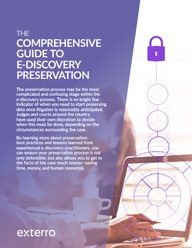
exterro-edisc-preservation-10-2016Exterro has published “The Comprehensive Guide to E-Discovery Preservation,” an e-book that discusses how to incorporate preservation principles into the legal process that will enable defensible and proportional policies.

“The preservation process may be the most complicated and confusing stage within the e-discovery process, namely because there is no bright line indicator of when you need to start preserving data once litigation is reasonably anticipated,” the company says on its website. “Instead, judges and courts around the country have used their own discretion to decide when this must be done, depending on the circumstances surrounding the case. That is why you should continually reference preservation best practices and lessons learned from experienced e-discovery practitioners to ensure your process is defensible.”

The guide discusses:

  • What is required within your preservation process
  • Need-to-know steps for deciding how and when to preserve data, including new data types
  • Preservation advice from in-house legal professionals

Download the guide.


Class Action Launched Against Samsung Over Note 7 Debacle

The ongoing fallout from Samsung’s Note 7 debacle now includes a possible class-action lawsuit against the company in the U.S., according to a report by digital Trends.

Three former Samsung Note 7 users in New Jersey filed the suit a week after the Korean company ended production of the handset after faulty batteries caused more than 100 units to overheat and catch fire, reports .

The suit focuses on Samsung’s handling of the recall, which the plaintiffs claim caused them to go without a phone for several weeks while still having to pay for the device and plan charges, Motherboard reported on Tuesday.

Read the article.


Hedge Fund Sues Theranos, Citing ‘Lies, Material Misstatements, and Omissions’

Elizabeth Holmes

Elizabeth Holmes

Photo by Max Morse for TechCrunch

Partner Fund Management, a San Francisco-based hedge fund that reportedly wrote out a $96 million check to Theranos in 2014, is now suing the blood-testing startup and its founder, Elizabeth Holmes, reports TechCrunch.

In its filing, the plaintiff says Theranos duped it into investing “through a series of lies, material misstatements, and omissions,” and accusing the firm of engaging in “securities fraud and other violations by fraudulently inducing” it to invest and to maintain its investment in the company reports .

Reports says that the plaintiff claims says Holmes and another former Theranos executive blatantly lied to the hedge fund by claiming it had developed “proprietary technologies that worked” and that it was nearing regulatory approvals.

Read the article.


Talisman Energy Facing Texas Federal Lawsuit Over Unpaid Oil, Gas Royalties

Attorneys representing oil and gas royalty owners with interests in the Texas Eagle Ford Shale have filed a federal lawsuit against Talisman Energy USA Inc. based on claims that the company manipulated oil and gas production volumes by as much as 20 to 30 percent and consistently shorted royalty payments, according to a news release posted by Androvett Legal Media and Marketing.

Attorneys from Texas-based Provost Umphrey Law Firm, L.L.P., are representing Eugene and Kimberly Cran of DeWitt County in their claims against Warrendale, Pennsylvania-based Talisman.

The article explains how a change in the operating agreement between Talisman and  Norway-based energy company Statoil in the Eagle Ford joint venture resulted in the Crans receiving monthly checks from both companies. But the production numbers accompanying the checks didn’t match — with Talisman reporting smaller total production.

Read the news release.


China Contracts: Why Choice of Foreign Law is So Often a Bad Idea

ChinaInvestors wanting to sue Chinese companies in U.S. courts for corporate governance violations — using contractual provisions requiring litigation in their home country to replace what they see as “unfair” Chinese laws — may be disappointed in their options, writes Dan Harris in the China Law Blog.

“What will actually happen is that the parties will be required to prove Chinese law in a U.S. court, a difficult, time consuming and expensive process. This is usually exactly the opposite of what the U.S. party assumed would happen in this situation,” he explains.

“A contract provision calling for disputes to be resolved in one country’s court has little to no influence on the law that court will apply to the case. Most importantly, it is difficult to imagine a thoughtful American judge applying U.S. corporate governance law to a transaction that took place wholly in Mainland China and that involves Chinese entities,” Harris adds.

Read the article.


DLA Piper Adds White-Collar Partner Matthew Graves in Washington, DC

Matthew Graves has joined DLA Piper’s litigation practice as a partner in the Washington, DC office.

Graves, who will also be part of DLA Piper’s White Collar practice, previously served as the acting chief of the Fraud and Public Corruption Section at the US Attorney’s Office for the District of Columbia.

In a release, the firm said he has extensive experience with white collar resolutions, foreign data privacy laws, and multi-agency investigations with US governing bodies, including the Securities and Exchange Commission, the Food and Drug Administration and the Department of the Treasury. He is also among the few lawyers who have prosecuted financial institutions for violating US sanctions laws.

The release continues:

“Matt is a highly respected trial lawyer whose background in white collar litigation and experience working at the US Attorney’s Office will complement our global platform, and help our clients navigate the complex regulatory and enforcement environment,” said Loren Brown, global and US co-chair of DLA Piper’s Litigation practice.

Graves will assist clients on complex civil litigation matters across industries including securities, healthcare, tax, election and export control laws. His practice includes counseling clients facing public integrity and anti-corruption challenges, including violations of the Foreign Corrupt Practices Act, contractual disputes and various forms of financial fraud.

“Washington, DC is the epicenter of federal government regulatory enforcement, and Matt’s government experience strengthens our presence in the market,” said Mary Gately, managing partner of DLA Piper’s Washington, DC office. “We expect Matt to quickly become a significant contributor to the firm’s sector-based practices in areas including financial services.”

Graves is the recipient of an FBI Service Award and six US Attorney’s Office Special Achievement Awards. He earned his J.D. from Yale Law School, and his B.A. from Washington and Lee University.


Apple Wins Appeal Reinstating $119.6 Million Samsung Verdict

Apple Inc. won an appeals court ruling that reinstates a patent-infringement verdict it won against Samsung Electronics Co., including for its slide-to-unlock feature for smartphones and tablets, reports Bloomberg.

The U.S. Court of Appeals for the Federal Circuit overruled a three-judge panel, saying the lower court was wrong to throw out the $119.6 million verdict in February. The 8-3 ruling sent the case back to the trial judge to consider whether the judgment should be increased based on any intentional infringement by Samsung, writes .

“The decision Friday comes less than a week before the U.S. Supreme Court considers another case Apple had filed against Samsung. That case, to be argued Tuesday in Washington, focuses on how much Samsung should pay for copying patented designs for Apple’s iPhone,” according to the Bloomberg report.

Read the article.


19 E-Discovery Tips for Fixing Troublesome Transitions

E-discovery magnifying glassExterro has published a complimentary e-book that presents best practices for streamlining the e-discovery process, especially relating to transitions between different stages.

“In today’s competitive legal market, many legal teams are looking to streamline their processes, and while focusing on streamlining the different stages of the e-discovery process is a great way to gain consistency and lower costs, there is much to be said about streamlining between those stages, before getting to the most expensive e-discovery stage: document review,” the company says on its website.

This e-book contains a series of tips and best practices to smooth out those bumps that fall in the gaps between the well-defined parts of the e-discovery process before the review stage, including transition tips between (1) information governance to identification, (2) identification to preservation and (3) preservation to collection/processing.

The book includes:

  • 7 tips on leveraging information governance to streamline identification
  • 5 questions to ask during identification for smart preservation
  • 6 ways your preservation strategy should influence your collection approach

Download the e-book.


Payday Loan Mogul Scott Tucker’s $1.3 Billion Judgment is a Record for the FTC

The Federal Trade Commission, in its first public remarks since a federal judge last week entered a $1.3 billion judgment against payday loan businessman Scott Tucker, called the penalty the largest of its kind, reports The Kansas City Star.

The judgment against Tucker and related entities eclipses the FTC’s previous record judgment from litigation: a $478 million judgment in 2012 ($501.4 million, when adjusted for inflation) against John Beck, the perpetrator of a deceptive real estate get-rich-quick scheme, according to reporter Steve Vockrodt.

U.S. District Court Judge Gloria Navarro last week entered a $1.3 billion judgment against Tucker and others to wrap up a case brought by the FTC in 2012.

“The FTC tracked and sued Tucker, his brother Blaine Tucker and several corporations under their control on claims that they extended loans that deceived consumers about the true cost of their credit,” Vockrodt explains. “For example, the FTC said that $300 loans extended by Tucker’s companies cost $390, at a 30 percent interest rate. In reality, through deceptive loan terms and automatic loan renewals, the FTC said many consumers ended up paying nearly $1,000.”

Read the article.


Law Firm Violated Layoff Notice Law for 700 Employees, Judge Rules

Layoff - dismissal - firedA federal judge has ruled that closure of Orlando-based Butler & Hosch law firm was illegal because executives knew it would close and didn’t warn employees in accordance with federal law, reports the Orlando Sentinel.

When the firm closed in 2015, about 700 employees in Dallas, Orlando, Miami, Tampa and other locations were told in a conference call that they would not be paid for their final three weeks at work, writes reporter Paul Brinkmann. Law requires 60-day notice of mass layoffs, but employees were told of the plan on the last day.

“If the company were still functioning, the law says it could be required to pay wages and benefits for 60 days to each employee, plus a fine totaling about $21 million — $500 per day per employee,” according to Brinkmann.  But now that claim becomes part of the firm’s bankruptcy process.

Read the article.


Expert Says Positive Train Control Eliminates Human Factors

Train safety expert Carl Berkowitz, Ph. D. discussed the value of a system called positive train control in a televised interview with Maurice Dubois of the CBS New York affiliate. The discussion came after the Oct. 29 train crash in Hoboken, NJ, that injured 100 passengers and killed a woman who was standing on the station platform.

Berkowitz explained that positive train control maintains the appropriate speed for a train, depending on where the train is at the time.

“You can’t leave everything in the hands of the individual because of human factors involved, and the reason for positive train control is to take human factor out of the equation and to make the system safe,” he said.

Installation of the system “was something that was mandated years ago, and the railroads just kept avoiding doing it. They didn’t want to spend the money. They didn’t think it was an important issue. So they let it go,” he added.

Watch the video.


Why You Need to Know If Your Construction Contracts are ‘Under Seal’

When a client wants to pursue a lawsuit or arbitration, one of the first things an attorney should do is determine whether the statute of limitations has run on the client’s claim, advise Darren Rowles and Scott Cahalan in a post for  Smith, Gambrell & Russell, LLP’s Construction Law blog.

“Many people are not aware, however, that parties to contracts, including construction contracts, may have the ability to increase the statute of limitations for a written contract by a factor of more than three hundred percent just by adding a few words to make their contracts ‘under seal.’ As a result, these people may increase their exposure to breach of contract/warranty claims without knowing they are doing so,” according to their post.

They explain that, in Georgia, for example, a written contract that is not for the sale of goods would normally have a six-year statute of limitations measured from the date of breach, But a contract signed “under seal,” has a statute of limitations of 20 years from the date of breach.

Read the article.