Lost Profits: Direct or Indirect Damages?

By 
King & Fisher Law Group, PLLC

In 2014, the New York Court of Appeals, in Biotronik A.G. v. Conor Medsystems Ireland, Ltd., held that the lost profits claimed by a party were “general damages”, and were recoverable. They were recoverable despite the limitation of liability provision in the contract, which stated that neither party would be liable for “any indirect, special, consequential, incidental or punitive damage with respect to any claim arising out of [the] agreement” for any reason, including a party’s performance or breach of the agreement.

Why is a case that was decided in 2014 worthy of writing about now? It’s been over three years since the Court’s decision, and we still commonly see limitation of liability language in commercial contracts that does not clearly address the issue of lost profits, and whether they are direct or indirect damages. That may be a strategic decision of the drafter, or it may be an oversight. While New York law does not govern all commercial contracts, other courts may rely on Biotronik in the future, or reach a similar holding independently. Regardless, it’s generally better to have a contract that clearly expresses the intent of the parties, rather than have a court determine it.

Direct Damages vs. Indirect Damages

Consider whether lost profits are reasonably foreseeable and quantifiable. Will breach of the contract almost surely cause a party to lose profits? Is there a reasonably certain way to prove the amount of lost profits? If so, lost profits may be considered direct damages. For example, if the parties have a non-compete agreement, the main purpose of that agreement is to ensure one party does not compete with the other party for business, thereby diverting customers, which results in lost profits. Lost profits can be reasonably quantified by sales to each diverted customer by the competing party. This is a situation where lost profits would likely be considered direct damages.

Defining Lost Profits

Consider whether the parties want lost profits to be recoverable. A provision can be included in the contract expressly stating that lost profits are direct damages, or that lost profits are indirect damages. Limitation of liability language can be included that states lost profits are not recoverable, regardless of how they are categorized. Alternatively, the limitation of liability language can expressly exclude lost profits from the limitation, making them recoverable.

Ultimately, whether lost profits should be recoverable, and how they are addressed in a contract will depend on the individual relationship or transaction in question. Given the potential for dispute, drafting clear language is key.




Join Our LinkedIn Group


Why Tiffany & Co.’s $19.4M Court Win Against Costco Is Correct – And Important

Tiffany signIn a legal battle that’s been underway since 2013, a federal judge ruled this week that Costco owes Tiffany & Co. a settlement of $19.4 million for selling diamond rings confusingly labeled as “Tiffany” in its stores, Forbes reports.

Forbes contributor Rachelle Bergstein explains that, while a jury found in Tiffany & Co’s favor in September of 2015, Costco continued to argue that its use of the name “Tiffany” referred to a generic style of ring, and not to the storied luxury house itself.

She writes that, while the suit sounds like a case of an elite, heritage brand pummeling a mass-market retailer for using its name to sell merchandise, it’s also a noteworthy example of how selling specialized products without a deep understanding of them can be disastrous (and potentially quite expensive) for the retailer.

Read the Forbes article.


Join Our LinkedIn Group


Big Pharma’s Tobacco Moment as Star Lawyers Push Opioid Suits

Big Pharma is having a Big Tobacco moment as litigation over opioids attract star lawyers and a growing list of states and local governments seeking their own multibillion-dollar payout to deal with costs of a burgeoning drug epidemic, reports Bloomberg Law.

Six states have sued opiod markers, alleging they have created a public health crisis.

“Plaintiffs’ lawyer Joe Rice, a plaintiff lawyer who helped negotiate a $246 billion settlement with the tobacco industry in 1998, suggests states are laying the groundwork to force a resolution that provides billions of dollars to cover the costs of an epidemic blamed for 62 deaths per day,” explain Jef Feeley and Jared S. Hopkins.

Read the Bloomberg article.


Third-Party Risk Management Feedback Needed

Risk managementIndependent marketing research firm Phase5 is conducting a comprehensive study on the current state of third-party risk management and is seeking input.

Confidential responses will be aggregated with other responses, summarized, and published in a comprehensive report.

A spokesman said anyone participating will receive a copy of the final report. That report will show how others manage their third-party risk and due diligence processes and discover techniques for effectively reducing legal risk.

Take the survey.


GM Accuses Bankruptcy Trust of Secret $1 Billion Stock Plot

General Motors GMGeneral Motors Co. accused the trust set up to handle its bankruptcy claims of secretly plotting with plaintiffs’ attorneys to make it pay $1 billion in stock as part of a $15 million class-action settlement. Bloomberg Law is reporting.

As Bloomberg’s Erik Larson explains, the accord will pit GM against the “Old GM” General Unsecured Creditors Trust for the first time since the 2009 bankruptcy sale created the split to save the company.

Larson writes that attorney Steve Berman said that the settlement “between the plaintiffs and the trust for old GM will resolve hundreds of personal-injury cases stemming from GM’s faulty ignition switches, as well as a class-action suit over millions of vehicles that allegedly lost value due to a series of recalls in 2014.”

Read the Bloomberg article.


Join Our LinkedIn Group


11th Circuit Holds Arbitrators Have Venue-Setting Authority in International Arbitrations

Alston & Bird asks and answers the question: In an international arbitration, when an arbitration provision is ambiguous about the seat of the arbitration, who resolves the question?

ArbitrationAuthors Andy Tuck and Lee Deneen discuss Bamberger Rosenheim Ltd. v. OA Development Inc., in which the Eleventh Circuit held that interpretation of a venue provision is the arbitrator’s prerogative.

They write:

The federal circuits are split on whether the FAA serves as a proper basis for vacatur of an international arbitration award. In this case, the panel saw “no reason to analyze [Bamberger’s] arguments under the New York Convention or [the FAA] separately,” since Bamberger’s argument was the same for both bases for vacatur. The court stated in a footnote that it “assume[d], without deciding, that [the FAA] applies to the award in the present case.”

Read the article.


Join Our LinkedIn Group


Confusion Between ‘FMLA’ and ‘Maternity Leave’ Sends Employer to Trial

HR Dive reports on a federal case in which an employee’s Family and Medical Leave Act suit will go to trial over how she was fired after confusion about how much leave she had available.

Reporter Kate Tornone explains: “The employer’s handbook had two separate sections: one discussed employees’ entitlements to 12 weeks of unpaid FMLA leave, while the other offered workers eight weeks of paid maternity leave, with the option to take four more weeks unpaid.”

The company fired the employee when she didn’t return to work after 12 weeks absence.

Read the HR Dive article.


Join Our LinkedIn Group


Defendant Company Faces Bad Faith Discovery Spoliation Tag

Plantronics faces a big hurdle in its upcoming trial on a competitor’s accusations that it used “monopolistic” power to control the market for telephone headsets: how to explain to a jury that its employees deleted potentially crucial emails, reports Bloomberg Law.

A federal judge concluded last July that Plantronics had engaged in bad faith discovery spoliation, and demonstrates the far reaching consequences of discovery. The presiding judge said at the time he would instruct the jury that “it may — not that it must” presume that the deleted emails — some of which were never recovered — were unfavorable to Plantronics, writes reporter Gabe Friedman.

The trial is scheduled for October.

Read the Bloomberg article.


Join Our LinkedIn Group


Download: In-Depth Analysis and Tips for Improving E-Discovery Strategy

Zapproved has published an exclusive report that reveals insights about current and year-over-year changes in legal hold and data preservation processes.

The “2017 Legal Hold & Data Peeservation Benchmark Report” discusses automation maturity levels, allowing users to see how their company measures up.

This complimentary report offers in-depth analysis of:

  • Legal hold automation trends over time
  • Meeting best practices with automation
  • Process satisfaction based on process type
  • Power Preservers’ secrets to success
  • Surprising dip in employee training

Download the guide.


Firm Wants Former Employee’s Millions From Recent Settlement; ‘Absurd,’ He Replies

Forbes tells the story of a plaintiffs lawyer who worked on a long-running class action for the past 13 years, and now his former firm wants nearly all of his $2.45 million in fees from a settlement, even though he resigned from the firm in 2004.

“On June 5, the Pittsburgh law firm Specter Specter Evans & Manogue filed a lawsuit against [R. Bruce] Carlson, who left the firm long ago to create Carlson Lynch in 2004,” explains John O’Brien, Forbes contributor and editor of Legal Newsline. “The Specter firm alleges Carlson owes it nearly all of his $2.45 million in fees gained in a recent $24 million settlement regarding fees imposed on those who took out second mortgages from Community Bank of Northern Virginia.”

The firm cites a separation agreement, but Carlson says the firm was only entitled to a percentage of his fees if the original 2003 settlement was approved. An appellate court rejected that settlement, and the case went on for another 11 years.

Read the Forbes article.


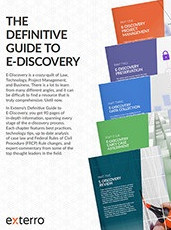
Download: The Definitive Guide to E-Discovery

Exterro has published “The Definitive Guide to E-Discovery” and made the 90-page document available for free downloading.

“E-Discovery is a crazy-quilt of Law, Technology, Project Management, and Business. There is a lot to learn from many different angles, and it can be difficult to find a resource that is truly comprehensive,” Exterro says on its website.

About the guide:

  • 90 pages of in-depth information, spanning every stage of the e-discovery process
  • Each chapter features best practices, technology tips, up to date analysis of case law, and FRCP Rule changes
  • Expert commentary from some of the top thought leaders in the industry

Download the guide.


Trump’s Real Personnel Victory: More Conservative Judges

While the public watches President Trump churn through White House staff members, his Administration is humming along nicely in filling federal judgeships, with the enthusiastic assistance of the Republican majority in the Senate, points out Jeffrey Toobin in The New Yorker.

Neil Gorsuch to the Supreme Court was Trump’s most important victory. Senate Republican leader Mitch McConnell kept that seat vacant for nearly the full final year of Barack Obama’s presidency.

“But McConnell didn’t just protect a Supreme Court seat for the next President; he basically shut down the entire confirmation process for all of Obama’s federal-judgeship nominees for more than a year,” Toobin writes. “It’s the vacancies that accumulated during this time—more than a hundred of them—that Trump’s team is now working efficiently to fill.”

Read the New Yorker article.


Join Our LinkedIn Group


Family of Brothers Electrocuted in Fort Worth Park File Suit Against Oncor

The family of two young brothers electrocuted by a downed Oncor power line in a Fort Worth park have filed a wrongful death lawsuit against the electric utility company.

Androvett Legal Media and Marketing reports on its website on the case:

On March 29, 2017, while exploring a heavily wooded section of Fort Worth’s Oakland Lake Park the day after a storm, Alex Lopez, 12, was electrocuted when he came into contact with an energized power line. Moments later, his brother, 11-year-old Isaiah, also was electrocuted when he raced to pull his brother to safety.

“Oakland Lake Park was a place Alex and Isaiah loved and felt safe to explore. It was never a place to fear,” said Dallas lawyer Jeffrey Rasansky, founder of Rasansky Law Firm, who represents Alex and Isaiah’s mother, Tammy Brooks. “But due to Oncor’s negligence and delay in cutting power to this live line, the park became the scene of horror, ending these young boys’ lives.”

According to the lawsuit, Oncor uses interactive smart technology that provides real-time notification of disruptions. Yet the company failed to address line problems in the park until after the tragedy. Even then, it took Oncor workers an hour to arrive on the scene to cut power so that emergency personnel could reach the Lopez brothers. Both boys died from extensive injuries resulting from high-voltage electric shock.

“As the owner and operator of Texas’ largest electric grid, Oncor has a responsibility to operate in a manner that protects all citizens,” said Houston lawyer Arturo Gonzalez of Arthur J. Gonzalez PC, who represents the boys’ father, grandmother and estate. “Not only did Oncor fail to secure the area and de-energize the downed line within a public park, the company also failed to warn the public.”

The lawsuit is Alejandro Luis Lopez, Tammy Brooks, and Ana Lopez as Personal Representative of the Estates of Jose Alexandro Luis Lopez and Isaiah Alexander Luis Lopez v. Oncor Electric Delivery Company, LLC, in Dallas County.


Join Our LinkedIn Group


McKool Smith Secures $9.4 Million Verdict for Quincy Jones Against Michael Jackson Estate

McKool Smith has secured a $9.4 million jury verdict on behalf of legendary music producer Quincy Jones against the late music icon Michael Jackson’s production company, MJJ Productions Inc., in a breach of contract and royalty dispute. Jones produced a number of the King of Pop’s most acclaimed albums, including “Off the Wall,” “Thriller,” and “Bad.”

According to a release from the firm, the lawsuit centered on allegations that MJJ Productions Inc., which is controlled by Michael Jackson’s estate, failed to pay Jones royalties for the soundtrack to “This Is It,” a documentary that was released just months after Michael Jackson’s death, and Jackson’s Cirque du Soleil productions, which both feature several musical hits produced by Jones.

Read the article.


Law Firm Releases Documents in Litigation, Angering Monsanto

Image by Mike Mozart

Documents released Tuesday in a lawsuit against Monsanto raised new questions about the company’s efforts to influence the news media and scientific research and revealed internal debate over the safety of its highest-profile product, the weed killer Roundup, reports The New York Times.

Monsanto said it was outraged by the documents’ release by Baum, Hedlund, Aristei & Goldman, writes Danny Hakim.

“There is a standing confidentiality order that they violated,” said Scott Partridge, vice president of global strategy for Monsanto. He said that while “you can’t unring a bell,” Monsanto would seek penalties on the firm.

A partner in the firm said Monsanto had failed to file a motion seeking continued protection of the documents, but the company said no such filing was necessary.

Read the NYT article.


Join Our LinkedIn Group


Once Again, Trump DOJ Busts Convention, Splits Government in High-Profile Employment Case

EEOCThe case of Donald Zarda, a skydiver who claimed his employer, Altitude, violated Title VII when it fired him after finding out he was gay, illustrates how the U.S. Department of Justice and the Equal Opportunity Commission can sometimes operate at cross purposes in litigation.

According to a Reuters report, the EEOC, an independent federal agency, is representing Zarda’s estate against the former employer. At the same time, the DOJ has filed its own amicus brief, explicitly disavowing the EEOC’s stance.

Alison Frankel writes that the brief “argued primarily that the EEOC and the 7th Circuit, which adopted the agency’s reasoning in its en banc opinion last April in Hively v. Ivy Tech Community College, disregarded the actual language of the statute and misread Supreme Court precedent on interpreting that language. According to the Justice Department, it’s up to Congress, not the courts, to legislate protection for gay and lesbian employees, and Congress has steadfastly refused to do so.”

Read the Reuters article.


Join Our LinkedIn Group


Wells Fargo Lawyer Accidentally Releases Trove of Data on Wealthy Clients

MistakeA Bressler, Amery & Ross lawyer representing Wells Fargo, responding to a third party subpoena in a case between two financial advisors, produced documents without redaction or confidentiality designations that revealed “billions of dollars of client account information, from residents of numerous states and possibly Europe.”

Above the Law describes how the mistake got worse: “To compound the issue, [the lawyer] alleges that plaintiffs showed the documents — which, remember, weren’t protected by a confidentiality agreement — to the New York Times, which then wrote about the consumer information that was produced. All in all, an incredibly messy affair.”

Kathryn Rubino writes that a broadly worded confidentiality agreement could have mitigated the damage.

Read the Above the Law article.


Wells Fargo Oops: Confidential Data Went to Opposing Side

It was a mistake and a bad one. In responding to a subpoena for information, a lawyer for Wells Fargo inadvertently sent the opposing attorney in a lawsuit a disc filled with confidential information, including Social Security numbers, for 50,000 of the bank’s wealthiest clients, according to a post on the website of Androvett Legal Media & Marketing. This embarrassing and damaging error came to light in a New York Times article.

Telling the media is not the appropriate way to handle such a transgression, says Houston trial lawyer John Zavitsanos of Ahmad, Zavitsanos, Anaipakos, Alavi & Mensing P.C. or AZA, who has tried more than 75 cases to verdict. Normally, the recipient of the material would return it to the sender, understanding that mistakes like this happen sometimes, he said.

“Instead, this may boomerang on the people who publicized the breach, and they may get in trouble for it. Most judges are human beings and understand mistakes – and they don’t like gotchas.

“Also, many states have snapback procedures whereby if you inadvertently turn over privileged information, you can retrieve it and say it was inadvertently produced. Until that privilege is determined, the receiving party can’t hold onto it. There are a slew of states that have provisions like that. And even if this involved a state without a snapback rule, the other side can file a motion to protect their confidential information.

“Of course, if Wells Fargo is unsuccessful in retrieving the information, its law firm may be subject to claims and penalties. Usually you come up with a set of protocols to prevent this from happening. However, every lawyer with an active litigation practice has produced something in error at some point. You call the other side and ask them to return it. We’ve all been there.”


Join Our LinkedIn Group


Freeborn Adds Matthew J. O’Hara as Litigation Partner

Matthew J. O’Hara has joined Freeborn & Peters LLP as a partner in the Litigation Practice Group.

“We are thrilled to welcome Matt to our vibrant Litigation Practice Group,” said Freeborn’s Co-Managing Partner Michael J. Kelly. “Matt brings deep experience as a trial lawyer in diverse commercial matters, particularly involving securities, shareholder and partnership litigation, and the full range of business disputes. Matt also brings substantial experience in professional liability matters for law firms, including legal malpractice, legal ethics, and disciplinary defense.”

A release from the firm continues:

O’Hara concentrates his litigation practice in complex commercial matters in federal and state courts. He has tried cases involving antitrust, the federal securities laws, breach of fiduciary duty, trade secrets, trademark infringement, breach of contract, license agreements, executive employment, the Uniform Commercial Code and criminal defense. He also litigates cases involving private shareholder and partnership disputes, legal malpractice, the Uniform Fraudulent Transfer Act and other commercial matters. He has represented clients in investigative proceedings before the Securities and Exchange Commission, Federal Trade Commission, and Illinois Attorney Registration and Disciplinary Commission. He also is experienced in briefing and arguing state and federal appeals.

O’Hara most recently was a partner at Hinshaw & Culbertson LLP, where he served as a member of the Executive Committee and as co-chair of the Lawyers Professional Liability practice group.

Active in providing pro bono legal services, O’Hara was one of the recipients of the Constitutional Rights Foundation Chicago’s Bill of Rights in Action Award in 2008. He earned his J.D. from Chicago-Kent College of Law and his Bachelor of Arts from Northwestern University.


Join Our LinkedIn Group


The Supreme Court Delivers a Blow to Plaintiff Paradise

St. Louis archSt. Louis has been a destination of choice for attorneys going after companies that do business nationwide. But those days may be over, and drugmakers such as Bristol-Myers Squibb Co. and Johnson & Johnson couldn’t be more relieved, according to Bloomberg Law.

After the U.S. Supreme Court in June struck a blow against so-called litigation tourism, the fallout in St. Louis was quick. “Within days, J&J, citing the Supreme Court ruling, won a mistrial in a case in which the families of three women blamed their deaths from ovarian cancer on use of the company’s talc products. Two of the families were from out of state,” report Bloomberg’s Margaret Cronin Fisk and Jef Feeley.

The reporters predict more challenges to come in St. Louis, where many non-resident plaintiffs have been flocking for years.

Read the Bloomberg article.


Join Our LinkedIn Group