Choice of Venue Provision Upheld in Employment Contract
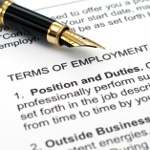
Employment contractForum selection clauses that are not adhesive will be interpreted independently of the court’s determination of the enforceability and validity of the contract as a whole, according to a post in Baker Sterchi Cowden & Rice’s Employment Law Blog.

Robert Chandler discussed the case of Reed v. The Reilly Company, LLC, in which the plaintiff, terminated by the Reilly Co., brought claims in Missouri. Reilly moved to dismiss, based on a contract provision stating that disputes must be brought in Kansas.

“Parties drafting forum selection clauses should exercise care to avoid contracts that are adhesive – i.e. agreements reached without a realistic opportunity for bargaining – and to choose forums which will be considered “neutral” and not overly advantageous to the party drafting the agreement,” Chandler explains.

Read the article.


Here are the Major Questions Before the Supreme Court This Year

U.S. Supreme CourtLos Angeles Times reporter David G. Savage takes a look at the most-interesting legal issues that the U.S. Supreme Court will be facing during the first half of the new year.

First on the list is a case that can have implications for religious liberty and gay rights: Masterpiece Cakeshop vs. Colorado.

Other cases involve cellphone tracking and privacy, jail before deportation, voting rolls and purges, sports betting, and public employees and union fees.

In NLRB vs. Murphy Oil USA, the court will consider: Can companies require workers to waive their rights to join any class or collective action against their employer and instead resolve disputes as individuals through binding arbitration?

 Read the LA Times article.


Trump’s Effort to Stop Publication of Scathing Book is a Break in Precedent

Legal experts and historians said the decision by President Trump to threaten “imminent” legal action against a publishing house, a journalist and a former aide represented a remarkable break with recent precedent and could have a chilling effect on free-speech rights, according to Slate.

The threats did not appear to work, at least as far as the scathing book by Michael Wolff. His publisher announced Thursday that publication had been moved forward four days to Friday because of what they described as “unprecedented demand.”

Reporters 

“Though several presidents — including Jimmy Carter and Theodore Roosevelt — have sued for libel after leaving office, it is uncommon and potentially damaging for a current occupant of the Oval Office to try to use the powers of the presidency to take on personal and political rivals, Brinkley said.”

Read the Slate article.


Southwest Airlines Reaches $15 Million Settlement in Price Collusion Lawsuit

Fortune is reporting that Southwest Airlines agreed to pay $15 million to settle nationwide antitrust litigation by passengers who accused the four largest U.S. carriers of conspiring to raise fares by reducing seating capacity.

The Dallas-based carrier denied wrongdoing but said it settled to avoid the cost and distraction of further litigation.

The remaining defendants, including American Airlines Group, Delta Air Lines and United Continental Holdings, have not settled.

The report says Southwest agreed to help plaintiffs with their suit against the other three.

Read the Fortune article.


Spotify Hit With $1.6B Copyright Suit Over Tom Petty, Neil Young Songs

Tom Petty
Image by musicentropy

A music publishing company has filed a lawsuit in California federal court that alleges that Spotify is using tens of thousands of popular songs without a license and compensation, reports Billboard.

Reporter Eriq Gardner writes that Wixen Music Publishing is seeking damages worth at least $1.6 billion plus injunctive relief.

The report says Wixen administers song compositions by Tom Petty, Zach De La Rocha and Tom Morello of Rage Against the Machine, The Black Keys’ Dan Auerbach, Steely Dan’s Donald Fagen, Weezer’s Rivers Cuomo, David Cassidy, Neil Young, Sonic Youth’s Kim Gordon, Stevie Nicks, and many others.

During 2017, Spotify was hit by lawsuits from some other songwriters.

Read the Billboard article.


Webinar: The 2017 Open Source Year in Review

Black Duck will present a complimentary webinar reviewing the past year’s legal developments in open source software.

The event will be on Wednesday, Jan. 17, 2018, at 11:30 a.m. Eastern time.

Two of the leading open source legal experts, Karen Copenhaver, partner at Choate Hall & Stewart and counsel for the Linux Foundation, and Mark Radcliffe, partner at DLA Piper and general counsel for the Open Source Initiative, will lead the discussion.

This annual review will highlight the most significant legal developments related to open source software in 2017, including:

  • Current litigation
  • An open source security update
  • Blockchain and its forks
  • Software Package Data Exchange (SPDX) and OpenChain
  • GDPR
  • And more

Register for the webinar.


GM Wins Ruling That Could Narrow Ignition Switch Litigation

Image by C_osett

Reuters is reporting that General Motors Co. on Thursday won a court ruling that could reduce the private litigation it faces over flawed vehicle ignition switches, which have been linked to 124 deaths and triggered a big recall.

“U.S. District Judge Jesse Furman in Manhattan said the plaintiffs in two bellwether cases, involving accidents where airbags had deployed, could not introduce expert testimony to show how defective ignition switches might have played a role in the crashes,” reports Jonathan Stempel.

The judge in the multi-district litigation ruled that the expert testimony offered by plaintiffs was unreliable, and their opinions “do not pass muster.”

Read the Reuters article.


Apple’s iPhone Slowdowns Have Customers Hurrying to Court

TextingBloomberg Law reports that IPhone users have begun racing to courthouses, infuriated by an Apple Inc. software update that slowed down the operation of their smartphones.

Plaintiffs complain about the deterioration of their phones’ performance.

A group of plaintiffs in a suit filed in Chicago federal court claims the software updates that slow down iPhone 5, iPhone 6 and some iPhone 7s were were intended to push customers to buy newer iPhones, some of which sell for more than $1,000, writes Joe Schneider.

Apple acknowledged that the update slows down iPhones with dying batteries.

The Bloomberg report says: “The fix was supposed to help people get more out of their aging batteries, and ‘reduce occurrences of unexpected shutdowns,’ according to the company.”

Read the Bloomberg article.


The Net Neutrality Lawsuits Are Coming. Here’s What They’re Likely to Say.

Because of the potentially far-reaching consequences of the FCC’s vote on net neutrality, consumer groups and some state attorneys general have vowed to sue the agency to overturn its decision, writes Brian Fung in an article for The Washington Post.

Some analysts told the reporter that the first suits could be mere weeks away.

“Opponents of the FCC are expected to make two broad categories of arguments, analysts say,” Fung writes. “One thrust is likely to target the FCC’s legal reasoning for undoing the net neutrality rules, and the other will concentrate on the decision-making process that led to the vote, which some critics claim had been ‘corrupted’.”

Read the Post article.


Whistleblowers’ Lawsuit Leads to Massive Medical Fraud Settlement

What started seven years ago as a whistleblower lawsuit filed by two Charlotte-area doctors ended Tuesday with two emergency room physicians groups paying federal and state governments more than $33 million to avoid going to court, according to a report by The Charlotte Observer.

“The payments cap off longstanding allegations of a vast medical-fraud conspiracy between a major hospital chain and the physicians groups that bilked federal and state healthcare programs in North Carolina and five other states out of millions of dollars,” writes Michael Gordon.

He explains that prosecutors allege that EmCare physicians took kickbacks and other inducements from Health Management Associates, a now defunct chain of acute-care hospitals, to recommend that their patients be admitted to HMA hospitals rather than receive outpatient care. Then the doctors would order expensive and unnecessary tests, resulting in Medicare and Medicaid reimbursements to the hospitals.

Read the Observer article.


Trump Judicial Nominee Struggles to Answer Basic Legal Questions at Hearing

A Trump judicial nominee struggled to answer basic legal questions posed to him by a Republican senator, including his lack of experience on trial work, the amount of depositions he’d worked on and more, reports CNN.

Matthew Spencer Petersen, who currently serves as a commissioner on the Federal Election Commission, was in the hot seat when GOP Sen. John Kennedy of Louisiana asked him a string of questions about his experience on trials. On the question of how many depositions Petersen had worked on, the nominee said the number was fewer than five. And in response to another question, he said he couldn’t remember the last time he had read the Federal Rules of Civil Procedure.

The report by Miranda Green says that Petersen, who  is up for a seat on the U.S. District Court for the District of Columbia, had to acquiesce on many occasions that his “background was not in litigation.” despite the role he was up for.

Read the CNN article.


Download: FRCP & E-Discovery: The Layman’s Guide

Exterro has published “FRCP & E-Discovery: The Layman’s Guide” to sort out the technical aspects of the FRCP as they relate to e-discovery, supported with relevant case law and expert opinions. The publication can be downloaded at no charge.

“Simply put, The Federal Rules of Civil Procedure (FRCP) prescribe how federal civil lawsuits are governed,” Exterro says on its website. “The FRCP is constantly evolving and many parts may change over the years. The FRCP is intentionally vague, with the idea that judges are not to be constrained by a rigid set of directives, and ultimately, judicial rulings will determine what the FRCP really mean and how they are to be applied.”

The guide includes:

  • 30-pages on how the FRCP governs the e-discovery process
  • Expert analysis from federal judges and legal scholars
  • Practical e-discovery tips for taking advantage of the new FRCP e-discovery rules

Download the guide.


Inside Trump’s Legal Team: Trying to Protect the President From Mueller’s ‘Killers

As lawyers for the world’s highest-profile client, John M. Dowd and Ty Cobb have come under scrutiny for their every move and utterance — and the criticism has been harsh, according to a report The Washington Post published on President Trump’s legal team’s representation in the Russia probe.

The report says that, when the president “frets that Mueller may be getting too close to him, they assure him he has done nothing wrong, urge him to resist attacking the special counsel and insist that the investigation is wrapping up — first, they said, by Thanksgiving, then by Christmas and now by early next year.”

The team is derided by some as being indiscreet, error-prone and outmatched, write .

They quote Alan Dershowitz, a criminal defense attorney and Harvard Law School professor: “These are not the kinds of things that one would expect from the most powerful man in America, who has a choice of anybody to be his defense counsel. Well — almost anybody.”

Read the Post‘s article.


Republicans Attack ABA Over ‘Not Qualified’ Judicial Nominee Ratings

Senate Republicans have declared war on the American Bar Association, according to a report from Politico.

For decades, the ABA has assessed judicial nominees and their fitness to serve on the bench. But now, reporters Seung Min Kim and John Bresnahan write, as the ABA has emerged as a major stumbling block in President Donald Trump’s effort to transform the courts, the GOP is accusing the nonpartisan group of holding a liberal slant and is seeking to sideline it.

“The ABA has deemed at least four of Trump’s judicial nominees ‘not qualified’ — a high number, although other administrations had the ABA evaluate candidates privately before they were nominated,” they write.

Republicans have responded by ratcheting up their attacks to try to discredit the century-old group.

Read the Politico article.


2017 Data Discovery: Celebrity Lessons on Litigation, Legal Ethics, and e-Discovery

Reed Smith LLP will present a webinar offering a look back on celebrity data discovery law in 2017 and how it affects you and your organization.

The one-hour complimentary event will be Thursday, Dec. 14, 2017, at 2 p.m. Eastern time.

Presenters will be U.S. Chief District Judge Joy Flowers Conti (W.D. Pa.), e-discovery authority and Reed Smith partner David Cohen, noted entertainment lawyer Michael Kump of Kinsella Weitzman Iser Kump & Aldisert, and join Relativity’s David Horrigan.

Objectives are:

  • What you should—and should not—do if you or your client suddenly become a news or social media celebrity
  • Understanding your legal obligations to preserve evidence for litigation
  • Knowing the potential pitfalls with data sources, including audio files and text messages
  • Learning ways to protect and avoid waiving the attorney-client privilege

Register for the webinar.


Is Non-Compete in Purchase/Sale of Family-Owned Business Enforceable?

Courts will generally enforce a non-compete agreement negotiated as part of a business sale as long as it is reasonable in geographic scope and duration, writes Michael P. Connolly in the Murtha Cullina Family Business Perspectives blog.

“What is reasonable will depend on factors such as the type of business being purchased, the pre-sale geographic reach of the business, and the consideration paid for the restriction on the seller’s future competition,” he explains. “Parties to a non-compete should therefore carefully consider these factors when drafting the agreement. The parties also should carefully define what type of ‘competitive’ conduct will be restricted.”

Connolly discusses the case of E.T. Products, LLC v. D.E. Miller Holdings, Inc., in which the United States Court of Appeals for the Seventh Circuit recently addressed the enforceability of non-compete agreements that had been negotiated in connection with a sale of a business.

Read the article.


How Forced Arbitration and Non-Disclosure Agreements Can Perpetuate Hostile Work Environments

Non-disclosure agreements are part of an arsenal of legal tools that employers have at their disposal to protect their reputation and their bottom line — but those tools often come at the expense of wronged employees, writes Michelle Chen in an article for The Nation.

She also discusses the use of forced arbitration that requires employees to channel their workplace disputes through an extralegal negotiation process, rather than through the courts.

She adds:

According to the National Women’s Law Center (NWLC), both forced arbitration and NDAs have in many workplaces become a standard tactic to preempt workers from taking legal action or disclosing sexual-harassment and -assault charges. These agreements force workers to sign away their rights in exchange for a job, by making them agree to settle future disputes outside the courts through an opaque negotiation process controlled by management and lawyers—effectively sentencing women to silence before they ever step into a courtroom.

Read the article.


Will Biglaw Firms Get Caught in the Weinstein RICO Lawsuit?

Reporting on the filing of a RICO suit against the “Weinstein Sexual Enterprise” has brought up names of some Biglaw firms, but they’re not named in the complaint.

The suit alleges that Harvey Weinstein, the Weinstein Co., the company’s board members, Miramax Film Corp., and others violated the Racketeer Influenced and Corrupt Organizations Act and helped “facilitate and conceal” a pattern of sexual assault and harassment.

“Boies Schiller & Flexner has already a lost client over the debacle, and they now appear to be implicated by this RICO lawsuit,” reports Kathryn Rubino for Above the Law, adding that other firms mentioned in reports include K&L Gates, U.K.-based BCL Burton Copeland, and Israel-based Gross, Kleinhendler, Hodak, Halevy, Greenberg & Co.

K&L Gates denied the implications: “The claims relating to K&L Gates are false. K&L Gates has never represented Mr. Weinstein or any other person or entity concerning investigations or inquiries relating to Mr. Weinstein,” the firm said in a statement.

Read the Above the Law article.


Legal Symposium to Explore Groundbreaking Terror-Financing Case

Mark S. WerbnerTrial lawyer Mark Werbner of Dallas litigation firm Sayles Werbner will address Texas lawyers about his decade-long quest to hold the Arab Bank responsible for providing financial support to U.S.-designated terror organizations.

Werbner will discuss Linde, et al. v. Arab Bank PLC in a presentation titled, “Fighting Terror-Financing in the Courtroom,” during the State Bar of Texas Litigation Update Institute’s 34th annual course in January 2018.

In 2014, a jury in New York sided with Werbner, finding Jordan-based Arab Bank responsible for providing financial services to Hamas for 24 terror attacks during the “Second Intifada” in Israel and the Palestinian territories. The verdict was the culmination of a lawsuit filed in 2004 to obtain justice for nearly 300 American victims and their families. The case marked the first liability verdict against a foreign bank for violating the Anti-Terrorism Act.

Currently under review by the U.S. Supreme Court is Jesner, et al., v. Arab Bank, a related case that would clarify if the Alien Tort Statute (ATS) applies to corporations under the 1789 U.S. law.

The Linde verdict earned Werbner the 2016 Trial Lawyer of the Year Award from Public Justice, which honors attorneys who made the greatest contribution to the public interest through their work in precedent-setting, socially significant cases. His work has also been consistently recognized in top legal publications, such as The Best Lawyers in America.


J&J, Bayer Ordered to Pay $28 Million in First Xarelto Loss

Johnson & Johnson and Bayer AG are responsible for a woman’s injuries tied to the blood-thinning drug Xarelto and must pay almost $28 million in damages, jurors concluded in the companies’ first loss at a trial over the medicine.

Bloomberg Technology reports that the plaintiff said she took Xarelto, sold by J&J’s Janssen Pharmaceuticals unit, for more than a year before being hospitalized in 2014 with gastrointestinal bleeding she blamed on the drug.

The jury in Philadelphia on Tuesday ordered J&J and Bayer, which jointly developed the product, to pay $1.8 million in actual damages and $26 million in punitive damages.

“The companies still face more than 21,000 patent suits over Xarelto, which has been linked to at least 370 deaths, according to U.S. Food and Drug Administration reports. Patients have said that Xarelto can cause uncontrollable bleeding and that Bayer and J&J failed to provide an antidote. Some also claim the companies failed to properly warn about the drug’s risks,” according to Bloomberg’s Jef Feeley and Margaret Cronin Fisk.

Read the Bloomberg article.