Lawyer Who Allegedly Lied About Health for Deadline Extensions Should be Suspended

“An Illinois lawyer, who reportedly lied and said he had cancer—when he did not—and instead was looking for discovery deadline extensions, is facing potential suspension from the practice of law. He also allegedly lied about having cancer on his University of Chicago Law School application,” reports Stephanie Francis Ward in ABA Journal’s News.

“In 2015, Vincenzo Field reportedly asked an assistant U.S. attorney in the Northern District of Illinois for additional discovery time because he would be out of the office for four months.”

Read the article.


Trustee Looks to Question Former Leclairryan Insiders in Bankruptcy Case

“The trustee overseeing the bankruptcy liquidation of Richmond law firm LeClairRyan is starting to dig a little deeper,” reports Michael Schwartz in Richmond Bizsense.

“Lynn Tavenner, who has led the hunt for assets for creditors since the once mighty firm collapsed last year, will question and gather information from a lengthy list of LeClairRyan’s former attorneys, management and others it did business with over the years.”

“Tavenner sought and received court approval last month to begin the so-called 2004 examination process, which would give her the ability to push for the turning over of documents and conducting of depositions, including via subpoena if necessary.”

Read the article.


Layoffs Hit Furloughed Staffers at Two Biglaw Firms, Lawyers and Staffers at Another

“Baker McKenzie is laying off 6% of its workforce in the United States, Canada and Mexico. Those laid off include lawyers, other timekeepers and business professionals,” reports Debra Cassens Weiss in ABA Journal’s News.

“Davis Wright is laying off 39 staff members who had been furloughed. The staff members were in office services, legal assistance and other administrative positions.”

“Venable is laying off some furloughed employees, as well as some other professional staff members. The firm did not disclose numbers.”

Read the article.


6 Proven Steps to Maximize Insights from Your Legal Spend Data

Improving rate management to optimize cost-effectiveness of your legal department operations.

By Kris Satkunas, director of strategic consulting of LexisNexis CounselLink

As businesses of all sizes scramble to cut costs and reformulate budgets during today’s economic uncertainty, corporate legal departments are under immense pressure to smartly manage outside legal spend. In turn, this pressure is prompting inside counsel to examine the rates they pay outside counsel and raising questions about what rates are justified. But to properly determine rates they should pay outside counsel, corporate legal departments must use their enterprise legal management (ELM) systems to mine data, analyze it, and make wise decisions.

How do you optimize ELM data to get the answers to your business questions? Below are six essential steps to take.

Step 1: Choose Your Metrics
Consider the questions you need to answer to choose the best metrics. In this case, the goal is to identify where the greatest opportunities are to negotiate lower rates. What metrics will help you best? I’d suggest three are highly relevant:

• Current year timekeeper billed rates – for obvious reasons. This is the current state.
• Change (increase) in timekeeper rates over the last two years – Firms that have increased rates more significantly are likely ones where there is greater leverage to negotiate. Evaluating the percentage change over a two-year period will help to normalize for firms that may have increased rates by a significantly higher amount in one year, but minimally or not at all in another.
• Two-year hours billed – It’s important to focus analytic efforts on areas likely to yield the greatest results. There may be a partner that bills $2,000/hour, but only is engaged on your matters for a couple of hours per year. Bringing a volume metric into this analysis helps keep the focus on what’s most relevant.

Step 2: Organize Your Data
Legal departments pay widely disparate rates for different types of legal work, e.g. work that is largely commoditized vs. work that is unique or requires specialized legal skills. Therefore, when comparing rates paid to multiple firms, it’s critical to look at comparable types of legal work. Most organizations classify legal work by matter type, which will help with this step of segmentation.

Additionally, it’s worth considering whether particular matters have greater strategic value or a larger potential impact on the organization. You may decide that you’re willing to pay premium rates for this type of work, so you want the ability to filter them in/out of your data set and look at them independently.

Step 3: Filter
The matter segmentation referenced in step 2 is one important way to filter data. Additionally, for a billable rate analysis, it’s going to be important to filter data based on timekeeper title (eg. distinguishing between rates paid to partners versus various levels of associates).

Step 4: Analyze & Visualize
In this stage, you’ll evaluate the data you’ve collected to look for the stories it tells. The analytic process typically starts at a higher, aggregate level and then drills down to lower levels of detail to identify patterns vs. outliers. It can be very helpful to have a business intelligence tool that supports data visualization to perform such analysis.

A bubble chart is a useful type of visualization to show the interrelationship of three metrics. In this example, the X-axis represents the two-year percentage increase in rates, the Y-axis represents the hourly rate billed, and the size of each circle represents the volume of hours billed. At an aggregate level, this analysis might start by comparing law firms. Each circle is plotting the weighted average hourly rate (weighted on hours billed) of partners billing from different firms.
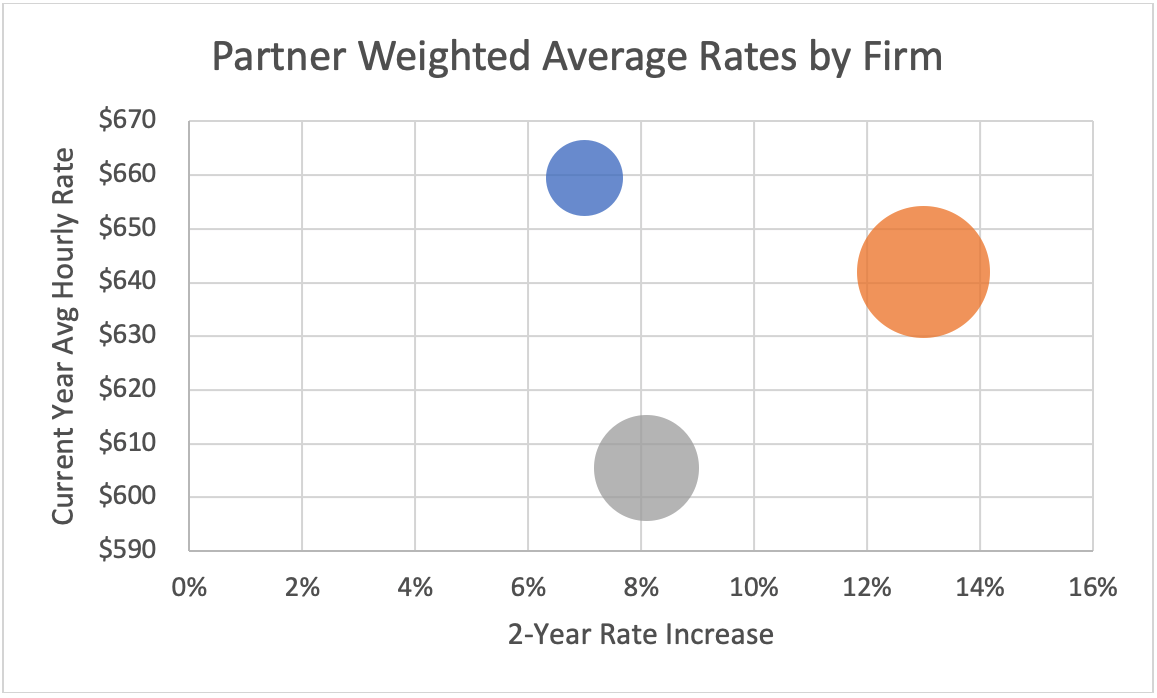
Partner Weighted Average Rates by Firm

Using a chart like this clearly paints the story that the law firm handling the highest volume (the largest bubble) has increased partner rates the most, and bills average rates that are materially higher than the firm handling the second highest level of volume (the mid-sized bubble). This firm may be a good candidate for rate negotiation.

A subsequent natural step would be to drill to the individual timekeeper level where each bubble would represent an individual partner, colored by law firm. Remember, start at the aggregate level for analytic purposes, and gradually peel back the onion to probe more deeply. Starting at a more granular level can lead to losing sight of the big picture.

Step 5: Benchmark
The analysis up until now has been based on a given corporation’s legal data. Bringing in external benchmarks at this stage will enrich the analysis and potentially help to validate the conclusions drawn from internal data. ELMs such as CounselLink incorporate benchmarking modules into their platforms for just this purpose.

When leveraging benchmark data, it is critical to be discerning in the filtering process so that external data is as comparable to your legal work as possible. The two most important filters to apply to benchmark data are matter type and law firm size. These are the most highly correlated attributes to hourly rates. For example, if in Step 2 when you organized your own data, one of your material buckets of legal work was immigration-related employment matters, you want to look at benchmarks of what other companies pay for immigration work, not the broader bucket of employment work. Further, if you are using mid-size, regional firms to handle immigration matters, make sure that’s what your benchmark data represents as well. There is a tendency to gravitate toward geographic filters when benchmarking rates billed by law firm, but size of firm has a greater correlation to rates than does geography.

Step 6: Leverage
Once you have categorized, filtered, and analyzed your data from your ELM, it’s time to leverage the output to answer the original question – “Where are the greatest opportunities to negotiate lower hourly rates?” Rather than taking a scattershot approach, you’re now armed with data to target firms with the greatest savings opportunities.

These six steps will set you well on your way to determining what your legal department should be paying, and which vendors will help you meet your budget goals. Remember, it all starts with the right questions. Your data will give you the answers, it’s just a matter of tapping into your ELM in the smartest way.


Overbilling Suit Alleges K&L Gates Used These Techniques to Increase Fees

“An overbilling lawsuit filed against K&L Gates on Monday alleges the law firm used multiple techniques to increase its fees fraudulently while representing a company in a suit over a failed lease agreement,” reports Debra Cassens Weiss in ABA Journal’s  News.

“The Aug. 24 suit, filed in the District of Utah’s Central Division, says K&L Gates billed $1.6 million in legal fees between May 2016 and October 2016, even though it was not hired to be the primary law firm in the representation.”

“The suit was filed by Chicora Life Center and its owner, Chicora Garden Holdings. Chicora Life Center’s manager is lawyer and developer Douglas Durbano, who announced a congressional run in January but failed to get on the primary ballot, the Deseret News reported in May.”

Read the article.


Tips for Virtual Negotiations

“Social distancing and stay-at-home measures enacted in the wake of COVID-19 have forced many businesses to significantly change the way they operate and communicate. Nowhere is this change more noticeable than in the world of negotiations, which have moved almost entirely to digital platforms,” discusses a post in Davis Wright Tremaine’s Corporate and Business Transactions Blog.

“Businesses that are quick to adjust and adapt have an advantage over those which lag behind.”

This post provides “some tips on how to effectively conduct virtual negotiations—where communications involve the ability to hear and see (at least a headshot of) the other parties.”

Read the article.


Billion-Dollar Am Law 50 Firm Walks Back Its COVID-19 Salary Reductions

“The latest firm to roll back salary reductions is K&L Gates, another member of the billion-dollar club that placed 39th in the Am Law 100, with $1,026,626,000 in 2019 gross revenue. Back in April, the firm reduced salaries across the board, with equity partners seeing a 20 percent reduction in scheduled advances, and firm leaders taking even larger reductions. Income partners, associates, and allied professionals and staff were subject to a 15 percent reduction in their salary provided their income didn’t fall below a $75,000 floor (with some regional variations),” reports Staci Zaretsky in Above the Law’s Biglaw.

“Now, because the firm has ‘performed better than expected’ in 2020, those reductions are being reduced.”

Read the article.


Attorney Fieger Sued for Discriminating Against Mother of Sick Child

“Attorney Geoffrey Fieger, one of Michigan’s most prominent lawyers, refused to let one of his employees work from home to care for her sick child during the coronavirus pandemic, according to a new lawsuit,” reports Tresa Baldas in Detroit Free Press.

“The woman says human resources approved her request to work remotely for two days, and, that she offered to take unpaid leave if necessary because her son was ill.”

“But Fieger — who for years has worked from his luxury Caribbean hotel that he has long referred to as home — wouldn’t budge. He fired her instead, she says, so she sued the legal giant in federal court.”

Read the article.


Former Reed Smith Lawyer Sues Law Firm for Alleged Discrimination After Receiving Concussion

“A lawsuit has accused Reed Smith of wrongly firing a lawyer after a ‘discriminatory chain of perceptions and events’ stemming from a concussion that the lawyer received while on vacation,” reports Debra Cassens Weiss in ABA Journal’s News.

“The lawsuit by former of counsel Aaron Chase, filed Wednesday in the Southern District of New York, alleges unlawful retaliation and disability discrimination by Reed Smith.”

“Chase says he received the concussion when he hit his head hard on the frame of a vehicle that he was entering while on vacation in September 2019. He returned to work the same month and informed his direct supervisor, partner Jennifer Achilles, about the injury soon afterward.”

Read the article.


BigLaw Firm Sued Over $3M Wire Transfer to Fraudster’s Account

“Holland & Knight is facing a lawsuit alleging that it failed to prevent the transfer of more than $3 million to a fraudster’s account in Hong Kong,” reports Debra Cassens Weiss in ABA Journal’s News.

“The lawsuit, filed in June in Utah state court, was removed to federal court this week, the American Lawyer reports.”

Holland & Knight is accused of failing to investigate after the fraudster intercepted emails regarding a stock sale, posed as the seller, and instructed the law firm to wire $3.1 million from the stock buyer to another account. The new fraudulent account was identified as Wemakos Furniture Co. Limited.”

Read the article.


Amazon, Google Tap Big Law to Bolster In-House Ranks

“Amazon.com Inc. and Alphabet Inc.’s Google LLC have hired a pair of public policy experts to expand their antitrust and energy capabilities,” reports Brian Baxter in Bloomberg Law’s Business and Practice.

“Sean Pugh and James ‘Jamey’ Goldin left Faegre Drinker Biddle & Reath and Nelson Mullins Riley & Scarborough, respectively, this month for in-house legal roles at the technology giants.”

“Pugh, a former Senate Judiciary Committee staffer who served as antitrust counsel to Sen. Mike Lee (R-Utah), confirmed in an email that he joined Amazon’s public policy shop July 6.”

“Pugh joined Amazon after five months at Faegre Drinker, a law firm that hired him as counsel in March for its litigation group in Washington. Faegre Drinker advised Boulder, Colo.-based warehouse robotics startup Canvas Technology LLC on its $100 million sale to Amazon in 2019.”

Read the article.


Law Grads Have Had Job Offers Rescinded at 49% of Surveyed Law Schools 

“Law grads have had employment offers rescinded at 49% of the law schools surveyed by the National Association for Law Placement,” reports Debra Cassens Weiss in ABA Journal’s Latest News.

“Hardest hit were graduates of schools in the Southeast region, where 57.5% of the schools reported rescinded offers; and schools with more than 750 students, where 61% reported rescinded offers. ”

“Rescinded offers were most common in private practice. Among schools that reported rescinded offers, 85% said private sector employers had done so.”

Read the article for more findings.

Read the article.


Am Law 50 Firm To Lay Off Lawyers And Staff, Close Office

“Bryan Cave Leighton Paisner co-chairs Steve Baumer and Lisa Mayhew sent a firmwide email letting everyone know that it will be laying off attorneys and staff as a result of the coronavirus crisis. On top of that, the firm will be shuttering its Beijing office,” reports Staci Zaretsky in Above the Law’s Biglaw.

“BCLP will offer severance to the affected lawyers and staff based on the higher salaries they received prior to the cuts that the firm instituted in April and reimburse the 15 percent salary cuts to those who are laid off before they leave the firm. The firm will also offer outplacement coaching and counseling to those who are let go.”

“Sources have already told us that associates in the firm’s Phoenix and Dallas offices have been affected by the layoffs. Let us know if your office has been impacted.”

Read the article.


Many Public Defenders in Indiana Getting Compensated Less Than Minimum Wage

“Many attorneys doing public defender work do so under contract with counties – meaning they get paid a flat amount, regardless of the number of hours they work. And that’s the primary method of public defense in about a third of Indiana,” reports Brandon Smith in Indiana Public Media.

“Many lawyers in Indiana doing public defender work earn less than minimum wage, after accounting for overhead costs.”

“Those attorneys have significant overhead costs that public defenders who are employees of the counties don’t have, staffing and office space the most significant.”

“And when taking into account those overhead costs, the Public Defender Commission’s survey says contract attorneys earn less than $6 per hour.”

Read the article.


Hughes Hubbard Lays Off Lawyers, Staffers After Receiving Paycheck Protection Loan

“Hughes Hubbard & Reed has laid off some associates and staff members after receiving a paycheck protection loan from the federal government,” reported by Debra Cassens Weiss in ABA Journal.

“The law firm confirmed layoffs of “certain attorneys and staff” in a statement to Above the Law. The statement did not provide specifics.”

“Hughes Hubbard provided this statement to the ABA Journal: “We decided in the early stage of the pandemic to keep our entire team intact for as long as we could, hopeful for a swift economic recovery. We were one of the more than 100 firms that decided in the early stage of the pandemic to apply for the [paycheck protection program] and were approved based on the [Small Business Administration] criteria. That money was used for its intended purpose, to save jobs during the worst of the crisis.”

Read the article.


Biglaw Firms Complete Big-Money Merger During Pandemic

“It’s been a very long time coming, but Philadelphia-based Pepper Hamilton and Atlanta-based Troutman Sanders have finally completed their merger to create Troutman Pepper Hamilton Sanders, a 1,100-lawyer firm with combined legacy revenue of $900 million in 2019, making it one of the 50 highest-grossing firms in the country,” reports Staci Zaretsky in Above the Law’s Biglaw.

“The merger was publicly announced in November 2019 and the firms were originally supposed to combine on April 1, 2020, but the pandemic put a damper on their plans. ‘While we are well-positioned to execute the combination on April 1, we believe the decision to postpone is in the best interest of our attorneys, staff, and clients,’ the firms noted in a March announcement, postponing the merger to July 1 due to the “unprecedented” challenges associated with the coronavirus crisis. In the meantime, both firms enacted austerity measures like pay cuts to control costs while COVID-19 wreaked economic havoc across the country.”

“Now that Troutman Pepper is finally here, with 26 offices spread across the country, CEO and chair Stephen Lewis, who formerly served as Troutman’s managing partner, is ready to get this party started.”

Read the article.


New Lawsuit Accuses DLA Piper Of ‘Strident Double-Dealing’

“A new lawsuit filed in Kansas state court by propane supply company Ferrellgas Partners, an ex-client of Biglaw firm DLA Piper, alleges the firm engaged in ‘strident double-dealing’ that was only revealed when the wrong invoice was mistakenly sent to Ferrellgas,” reports Kathryn Rubino in Above the Law’s Biglaw.

“In July of 2018, the company hired DLA Piper for debt restructuring advice. According to the suit, the work on that matter naturally tapered off by November of that year, but the representation was not formally terminated. However, in November of 2019 Ferrellgas received a $14,000 invoice, signed by Thomas Califano — the same restructuring partner they’d previously worked with — for research about Ferrellgas. During that same time, the company was fielding hostile takeover threats.”

“The lawsuit says that after inquiries from Ferrellgas, DLA returned their client file and that the firm says an internal investigation revealed the client information was not used in connection with work for any other client. But the lawsuit draws the conclusion that the invoice revealed DLA was working for adverse interests.”

Read the article.


Calls for Investigation into Arrests of Legal Observers at Las Vegas Strip Protest

“Gov. Steve Sisolak on Sunday called for an investigation into the arrests of several legal observers at a protest against police brutality this weekend on the Strip,” reports David Ferrara in Las Vegas Review Journal’s local news.

“At least seven attorneys and law students who documented interactions with police and demonstrators were taken to jail late Saturday.”

“News of the arrests drew condemnation from public officials and attorneys on social media.”

“Attorneys are trained to ‘take notes and not engage with either side.’”

Read the article.


Court Grants Judgment for TCPA Lawyer in Suit by Aggrieved Consumer

“The Law Offices of Jeffrey Lohman has faced some significant setbacks in litigation with Navient purporting that Lohman’s office set up TCPA lawsuits in violation of RICO. While no substantive ruling has been entered in that suit yet, the Court has at least preliminarily found that emails between Lohman and his clients are discoverable pursuant to the crime-fraud exception to the A/C privilege,” reports Eric J. Troutman in

“But Lohman’s office had a better day … in a suit in federal court in Missouri.”

“The Johnson case is quite different from the Navient matter in that it is not a RICO case and does not directly challenge Lohman’s (alleged) conduct of encouraging folks to stop payment to create possible TCPA lawsuits. Rather the suit involves the relationship between Lohman and something called Burlington Financial Group, which allegedly took $2,500.00 from the Plaintiff for debt services it (allegedly) never provided.”

“Lohman’s role in the overall transaction appears to be pretty limited.”

Read the article.


2 More Law Firms Announce Pay Cuts; Are They a Stopgap Measure Before Layoffs?

“Two more law firms announced pay cuts in the past week, marking a third slow week of bad news,” reports Debra Cassens Weiss in ABA Journal’s News.

“If larger law firms lose the same percentage of lawyers as in 2008 to 2010 during the financial downturn, there will be 20,000 jobs lost, Simons wrote. Most of the departures—17,000 of them—would be in the nation’s top 100 grossing law firms, he said. The other 3,000 departures would be in second hundred firms.”

“The entire legal services sector has already surpassed that number in job losses. According to the U.S. Bureau of Labor Statistics, the sector lost 64,000 jobs in April.”

“The two firms that announced cuts in the past week are Reed Smith and Stroock & Stroock & Lavan.”

Read the article.