Jones Day Women Point to Managing Partner’s ‘Totalitarian Grip’

Jones Day’s “hypercentralized,” subjective decision-making process places final control over pay, promotion, and other significant decisions “unchecked in the hands of one man,” six female former lawyers told the U.S. District Court for the District of Columbia.

That man is managing partner Stephen J. Brogan, claim Nilab Tolton and the five other lead plaintiffs. They filed a supplemental memorandum Oct. 24  opposing Jones Day’s motion for partial judgment on the pleadings in their proposed class action, filed in April, according to a Bloomberg Law article.

Brogan backs his “totalitarian grip” on Jones Day with a “no whining policy” under which women aren’t allowed to raise sex-based inequities, they say.

Read the Bloomberg Law article.



Laid Off Blackjewel Coal Miners to Get Millions in Back Pay After Train Blockade

Bankrupt coal company Blackjewel has agreed to pay roughly $5.1 million to cover back wages of more than 1,000 its Kentucky, Virginia and West Virginia miners, reports The New York Times.

For two months this summer, out-of-work miners blocked a train full of coal from shipping out of an eastern Kentucky mine, demanding weeks of unpaid wages after their employer went bankrupt and shut down operations in the middle of an afternoon shift, writes the TimesMihir Zaveri.

The company did not file a mandatory 60-day advance warning and did not post a bond, required by Kentucky law, to cover payroll. And workers did not receive pay for their last week on the job. Paychecks for two previous weeks bounced.

Read the  NY Times article.


Is It Time to Reconsider Your Non-Compete Policy? It Might Be If You Employ Low-Wage Workers

Over the course of the past several years, several states have banned or severely restricted the ability of businesses to bind low-wage workers to post-employment restrictive covenants, points out a Seyfarth Shaw client alert.

“While such legislation trickled out over the last several years, 2019 has seen five additional states enact prohibitions on utilizing non-compete agreements for certain low-wage employees, with at least seven other states and the District of Columbia considering similar non-compete legislation,” write the authors, Justin K. Beyer and Daniel P. Hart.

Because these new laws and other developments in restrictive covenant law over the past year may require changes to a company’s template restrictive covenant agreements, companies should consider reviewing and revising their template agreements more broadly by the end of the year, the authors advise.

Read the article.


SCOTUS Clarifies Vague Arbitration Clauses Affecting Class Disputes for Growing Businesses

Employment contractTo reduce the risk of a class action disrupting business operations and impacting revenue, businesses may want to consider including arbitration clauses in their employment and consumer agreements, advises Patrick K. Burns in a blog post for PilieroMazza PLLC.

Many businesses include arbitration clauses in employment and consumer agreements in an attempt to shield themselves from class action lawsuits, he explains. “The success of these types of clauses in accomplishing the same largely depends upon its wording, the respective jurisdiction, and the nature of the underlying agreement.”

In his post, he demonstrates how, if class arbitration is not explicitly addressed in an arbitration agreement, it cannot be compelled.

Read the article.


Want to Protect Your Trade Secrets? Update Your Employment Agreements

Trade secretIn order to preserve the right to seek punitive damages and attorney fees from an employee or former employee who has misappropriated trade secrets, the employer must have provided notice of the whistleblower-protection provisions of the Defend Trade Secrets Act.

“Notice of the whistle-blower protection provisions must be included ‘in any contract or agreement with an employee that governs the use of a trade secret or other confidential information,’” explains author Anthony George in the article on the website of Bryan Cave Leighton Paisner.

He advises employers to include the DTSA whistleblower-protection provision, or to amend existing contracts if necessary.

Read the article.


Important Changes Coming to Nondisclosure Agreements in New York

The prohibition in New York state on requiring nondisclosure sexual harassment claims in nondisclosure agreements has been strengthened, reports Hogan Lovells.

The law has been strengthened to include all claims of discrimination, harassment and/or retaliation in “any settlement, agreement or other resolution of any claim, the factual foundation for which involves discrimination … that would prevent the disclosure of the underlying facts and circumstances … unless the condition of confidentiality is the complainant’s preference.”

Authors Michael E. DeLarco and Zachary Siegel explain that if the employee requests confidentiality, then the agreement may contain this provision.

Read the article.


Biglaw Firm Hit by Law Student Protests Over Arbitration

Bloomberg Law reports that law students from elite universities protested outside DLA Piper offices in three cities Oct. 10, calling on the firm to drop arbitration agreements from employee contracts.

“Demonstrators from Harvard, Columbia, NYU and Georgetown law schools handed out leaflets in New York, Washington, and Boston,” writes Bloomberg’s Stephanie Russell-Kraft. “They’re part of a student-led initiative leveraging their status as top Big Law recruits to fight what they says is ‘harassment and discrimination in the legal profession.’”

DLA Piper partner Vanina Guerrero, who claims she was sexually assaulted and retaliated against by a fellow partner, said she is unable to bring those claims in court because of a mandatory arbitration agreement.

Read the Bloomberg Law article.



3 Types of Contracts and Agreements Your Company Should Be Using

Regina Campbell offers an overview of the three types of contracts and agreements that companies should consider using.

Writing on Lawyers. com, Campbell, of The Campbell Law Group, discusses employee agreements, advising that companies should use an at-will agreement that clearly states that a new hire’s employment can be terminated at any time for any reason.

She also discusses vendor agreements and independent contractor agreements.

Read the article.


Supreme Court Justice Gorsuch Calls LGBTQ Workplace Discrimination Case ‘Really Close’

Neil Gorsuch

Justice Neil Gorsuch

The Supreme Court justices sounded closely split Tuesday and a bit uncertain over whether to make it illegal under federal law for companies and public agencies to fire employees solely because they are gay, lesbian or transgender, with Justice Neil M. Gorsuch likely the deciding vote, according to the Los Angeles Times.

Trump-appointee Gorsuch described the case as “really close…. Assume for the moment I’m with you on the textual evidence,” he told an ACLU lawyer representing a transgender woman who was fired from her job at a funeral home in Detroit.

“The four liberal justices, joined at times by Gorsuch, said they agreed that firing gay or transgender employees was discrimination based on sex as the law defined it,” writes the TimesDavid G. Savage. “But others, including most of the conservatives, said that Congress in 1964 did not mean to outlaw discrimination based on sexual orientation or gender identity.”

Read the  LA Times article.


Goldman Sachs, Dell Settle Pay Bias Allegations for Millions

Goldman Sachs and Dell Technologies will pay a combination of almost $17 million to settle separate Labor Department allegations of pay bias based on gender and race, reports Bloomberg Law.

“Both Goldman Sachs and Dell-EMC agreed to nationwide ‘early resolution’ agreements, whereby their compliance will be routinely monitored in exchange for five years free of random OFCCP audits,” explains Bloomberg’s Paige Smith. “These are at least the fourth and fifth ‘early resolution’ agreements with the agency, joining those with Bank of America, Performance Food Group, Cintas Corp., and US Foods Inc. ”

Read the Bloomberg Law article.



2020 Guide: Resolving Legal’s (Internal) PR Problem

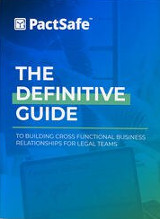
PactSafe has published a new guide that outlines different ways a legal department can foster effective cross-departmental relationships. It offers ideas that can be implemented this week, and tips that can plant the seed for more strategic, long-term change.

“Whether your goals are focused on increasing sales velocity, more efficient employee on-boarding, or mitigating risk of a new product, the legal department is often seen as an operational bottleneck and inhibitor of innovation,” PactSafe says on its website. “With 2020 on the horizon, legal needs to refresh its reputation—and understand its unique position to enable innovation—and it starts with better interdepartmental relationships.”

The guide covers:

  • How legal and sales can maintain a united front when closing a deal
  • Why legal and finance need to collaborate better on budget
  • Ways legal and HR can limit risk of employee charges
  • How legal and dev can find common ground in risk management and UX design

Download the free guide.


Standing Up for Justice: Challenging the Erosion of Civil Rights, Diversity and Inclusion

Duane Morris LLP and the Bar Association of San Francisco will present the 7th Annual Citywide Diversity and Inclusion Networking Event and Panel Discussion on “Standing Up for Justice: Challenging the Erosion of Civil Rights, Diversity and Inclusion.”

The event will be in the Duane Morris office at One Market Plaza, Suite 2200, in San Francisco on Thursday, Oct. 10, 2019, 5-8 p.m.

The panel will explain and share examples of how they became bias interrupters by making small tweaks to basic business systems (hiring, performance evaluations, assignments, promotions and compensation) that interrupt and correct explicit and implicit bias in the workplace. Instead of approaching diversity initiatives as large-scale culture changes, bias interrupters identify and change the constant flow of bias in basic business systems. Bias interrupters work because they change systems, instead of people.

Opening Remarks :

Doris Cheng, President, Bar Association of San Francisco
Christopher Punongbayan, Executive Director, California ChangeLawyers

Panelists:

Doris Cheng, President, Bar Association of San Francisco
Charles Jung, President, Asian American Bar Association of the Greater Bay Area
Catherine Ongiri, President, Charles Houston Bar Association
Jeff Kosbie, Co-Chair, Bay Area Lawyers for Individual Freedom
Christopher Punongbayan, Executive Director, California ChangeLawyers

Moderator:

Terrance J. Evans, Partner and Co-Chair of the Duane Morris LLP SF Diversity and
Inclusion Committee

Register for the event.


Never Too Late to Arbitrate? Tips on Getting Your Agreement On

Employment contractThree recent court decisions raise a few issues to keep in mind for employers to keep in mind when drafting arbitration agreements for employees, according to a post on Bradley Arant Boult Cummings’ Labor & Employment Insights blog.

The authors, Bridget Warren and Anne R. Yuengert, discuss the common characteristics that an agreement should include.

They also advise drafters to include class and collective action waivers and how to update existing agreements to include such a waiver while a lawsuit is pending.

Finally, they advise paying attention to state laws that affect what can be included in the arbitration agreement.

Read the article.


5 Biglaw Firms Make Working Mother’s List Of The ‘100 Best Companies To Work For’

The number of Biglaw firms on Working Mother’s list of the 100 Best Companies to Work For climbed from two in 2018 to five this year, reports Above the Law.

Making a return appearance on the list this year are Arnold & Porter and Katten Muchin Rosenman.

Joining them on the list this year are:

  • Finnegan Henderson Farabow Garrett & Dunner
  • Katten Muchin Rosenman
  • Pillsbury Winthrop Shaw Pittman

Read the Above the Law article.


Average Attorney Salary Might Surprise New Lawyers (And Judges’ Average Earnings Are Even Lower)

Money-payment-cashAn Above the Law contributor takes a look at a Bureau of Labor Statistics report and finds that the estimated mean annual wage for lawyers is a respectable $144,230.

Jonathan Wolf points out that while $144,000 a year doesn’t even scratch the bottom of the Milbank/Simpson/Cravath scale, it’s still “more than enough to live a comfortable life and have a reasonable shot at paying off your student loan debt.”

He breaks down the numbers by median annual wage (lower than mean annual) and shows the range from the 10th percentile to the 75th percentile.

He also looks at judges’ wages, which tend to be lower than other attorneys’.

Read the Above the Law article.


Global Employment Contracts: The Modern Tower of Babel

International - foreign - globeWhile US-based businesses are accustomed to working with at-will offer letters for prospective employees, these are mostly unheard of elsewhere, points out a post for McDermott Will & Emergy.

In most jurisdictions, detailed employment contracts are not only customary, but are required by law.

The post explains that companies must ensure the legal compliance of their contractual documentation for each country in which they do business. This includes engagement letters, employment offers, employment contracts, bonus schemes, stock option plans, etc.

Read the article.


Employers Beware: It’s Once Again Time to Review Your Arbitration Agreements

Employers may not be aware that the National Labor Relations Board has issued an opinion holding that arbitration agreements that could be “reasonably construed” to prohibit an employee from filing unfair labor practice charges with the board are invalid under the National Labor Relations Act, warns a post from Foley & Lardner.

“What is significant about this unanimous employee-friendly decision is that even if the language in your arbitration agreement does not expressly prohibit the filing of an NLRB charge (or accessing the Board or its processes), you may not be safe from a determination that your agreement is invalid,” explains the author, Cristina Portela Solomon.

She lists three steps employers should take if they use arbitration agreements.

Read the article.


Biglaw Firm Announces Nationwide Buyout Program

Above the Law is reporting that Morgan Lewis & Bockius will be offering voluntary buyout packages for all of its legal secretaries, across the country.

Senior editor Staci Zaretsky writes:

“Sources say that the firm’s separation package is extremely generous, and that those who take the deal will receive 2 weeks’ salary for each year of service, up to 52 weeks’ pay. Compared to the six-month cap we’ve seen at many Biglaw firms, longtime legal secretaries at Morgan Lewis could be walking away with a huge payday should they choose to leave.”

Read the Above the Law article.


‘Click to Accept’ Arbitration: A Cautionary Tale

A recent federal court decision reminds employers that an employee’s electronic acceptance of an arbitration agreement may not, by itself, be enough to prove that the employee has agreed to arbitrate, points out Stokes Wagner post.

In Shockley v. PrimeLending, the U.S. Court of Appeals for the Eighth Circuit recently affirmed the lower court’s decision to deny the employer’s motion to compel arbitration where the arbitration agreement was signed via the employer’s automated intranet system.

The author, Jordan A. Fishman, discusses the reasons that acceptance via intranet system was insufficient.

Read the article.


Enforcement of Non-Competes: Increasing Difficulty Depending on State

In Seyfarth’s fourth installment in its 2019 Trade Secrets Webinar Series, Seyfarth attorneys Kristine Argentine, Eric Barton, and Katelyn Miller focused on the enforcement of non-competes and how the difficulty of enforcement of these restrictive covenants vary by state, especially based on recent legislation in various states.

The post includes a link to the webinar for on-demand viewing.

It also includes a summary of takeaways from the discussion.

Read the article.