NY Attorney General Sends a Message: Re-Think Non-Compete Agreements

Barbara E. Hoey and Dustin E. Stark of Kelley Drye’s Labor and Employment group have a warning for New York employers – your non-compete agreements may be under attack.

In an article published on the firm’s Labor Day blog, the authors wrote that the office of the state’s attorney general recently reached settlements with two companies that require each to stop requiring incoming employees to sign non-compete agreements.

“The settlements clearly send a signal that the New York AG is critical of employers who require low-level employees to sign non-competes as a condition of employment. These agreements were never favored by New York courts, and this may be the time to re-think the broad use of such contracts,” according to the report.

“The take-away here is that if your company requires that all (or a large number of) employees sign non-compete agreements, you should re-examine this process. For one, a non-compete signed by a ‘low-level’ employee may not be enforceable anyway. Second, you do not want to wind up to be the next subject of an AG investigation,” they write.

Read the article.


Big Bank’s General Counsel Fired Over ‘Personal Matter’

Cincinnati-based Fifth Third Bancorp has reportedly fired its general counsel, Heather Russell Koenig, over what the bank called “a personal matter,” reports the Cincinnati Business Courier. She was the bank’s chief legal officer and corporate secretary.

In a statement, the bank said: “A personal matter has been brought to our attention that Fifth Third believes represents a conflict of interest. To resolve this, we have determined that the best course of action was a separation. Heather is a very qualified lawyer, and this matter had nothing to do with any of the legal work done by Heather during her tenure at Fifth Third.”

She previously worked at Bank of New York Mellon, Bank of America and Skadden, Arps in its Washington and London offices, reports Erin Caproni.

Read the article.


JPMorgan Said Near Settlement With U.S. Over Hiring in Asia

Bloomberg Law is reporting that JPMorgan Chase & Co. is expected to settle later this year with the U.S. Justice Department and Securities and Exchange Commission to end a three-year probe into whether it inappropriately hired the children of Chinese decision-makers to win business, according to people familiar with the matter.

The deal could cost JPMorgan about $200 million in the settlements over its hiring practices, according to one of the sources.

“At issue in the inquiry is whether the bank hired relatives of influential Chinese officials or executives of state-run enterprises to help obtain business or even as a reward, and whether that ran afoul of the Foreign Corrupt Practices Act of 1977, which makes it illegal to provide pay or benefits to a foreign government official,” explain Bloomberg’s  and . “The law also specifies what records must be kept to ensure compliance.”

Read the article.


Preventing Discrimination Claims: Who is Protected and How to Maintain Compliance

ComplianceLittler Mendelson will present a webinar about maintaining compliance under Title VII of the Civil Rights Act as it concerns protection of employees, both legal and illegal immigrants.

The hour-long webinar will be Wednesday, August 31, at 1 p.m. Eastern time.

In a recent undocumented worker case, the Fourth Circuit Court of Appeals ruled that the EEOC has the authority to investigate claims made by both legal and illegal immigrants, the firm said on its website. This decision has heightened employers’ attention as to who in their workforce is protected under Title VII of the Civil Rights Act and added to an already complex system of compliance standards set by the EEOC and OSC.

Topics will include:

  • What changes do employers and in-house counsel need to be aware of?
  • Who in your workforce is protected?
  • What are the common pitfalls that lead to discrimination claims?
  • What procedures can you implement to reduce legal risk?

Register for the webinar.


Can Non-Compete Agreements Be Classified As Personal Services Contracts?

Employment contractThe 8th Circuit Court of Appeals recently addressed an issue that frequently arises in the non-compete context: what happens when a company buys the assets of another and then tries to enforce non-compete agreements?

Michael Elkon of Fisher & Phillips LLP explains in the article: Two employees worked as mobile x-ray technicians for Ozark Mobile Imaging. Both signed non-compete agreements saying they could not work in the mobile diagnostic business in a set geographic area for a two-year period after the end of their employment. Mobilex later bought Ozark in an asset purchase, and both employees declined offers to work for Mobilex, citing inferior terms of employment, and instead took positions with a competitor. Mobilex filed suit against the ex-employees for breach of contract, but the district court granted summary judgment to Greenbaum and Tabanag, finding that because they had not consented to the assignment of their contracts at the time of the asset purchase.

The appellate court reversed, providing a reminder that “it is important to pay attention during the sale process to ensure that there will be no issues with the purchaser enforcing the seller’s restrictive covenant rights with employees,” Elkon writes.

Read the article.


How GC Pay Stacks Up in the Corporate Ladder

Banking - investing - money - advisorsBloomberg Law has drilled down through Securities and Exchange Commission documents to see how the compensation of 30 of the highest paid general counsel compares to the pay for other top-ranking executives in their corporations.

The analysis found that 10 of the GCs were the fourth highest paid at their company, meaning less well-compensated than at least three other executives. “Then, in order, eight of the GCs were the third highest paid exec at their company, seven were in the number five spot, two were the second highest paid and so on,” wrote .

Thomas Mason was the only GC from the list ranked as the highest paid executive at his company. Mason’s whose title changed in December 2015 from a vice president to executive vice president and general counsel of Energy Transfer Equity, a Dallas-based natural gas storage and transportation company, the report says.

Read the article.


The GC Who Took Home $25 Million and 29 Other Highly Paid GCs

Bruce Sewell

Bruce Sewell is Apple’s general counsel and senior VP of Legal and Global Security.

Bruce Sewell, senior vice president of legal and global security and general counsel at Apple Inc., leads Bloomberg Law’s list of the most highly compensated general counsel in American companies.

While his 2015 salary was $1 million, other benefits brought his total compensation to $25,017,626, according to the report.

The list names 30 of the best-paid GCs, with total compensation ranging from $4.8 million for Eli Lilly’s Michael Harrington, to Sewell’s $25 million.

The top five slots on the list include GCs from Apple, General Electric, Amgen, Hertz and PayPal.

Blake Edwards and Gabe Friedman, with special assistance from Brandon Kochkodin, compiled the list for Bloomberg.

Read the article.


New Federal Trade Secret Statute Requires Important Updates to Contracts

Employment contractWith the recent passage of the Defense of Trade Secrets Act (DTSA), businesses are welcoming the many benefits the statute brings, including federal jurisdiction, robust equitable relief, and the ability to recover compensatory damages, punitive damages, and attorneys’ fees, according to a report by Fisher & Phillips LLP.

The article points out that many employers may overlook a requirement that requires revisions to existing confidentiality agreements and restrictive covenants.

“Namely, employers are required to provide employees with notice that they are entitled to immunity if they disclose a trade secret for the purpose of reporting suspected illegal conduct,” writes Michael R. Greco. “If employers fail to give notice in the manner required by the DTSA, they will not be able to recover punitive damages or attorneys’ fees. Consequently, employers must pay careful attention to the DTSA notification requirements, which are not as straightforward as many believe.”

Read the article.


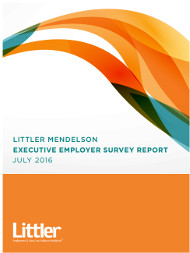
Littler Survey Shows Employers Grappling With Regulatory, Social Changes

Littler Mendelson's 2016 Executive Employer SurveyLittler Mendelson, the world’s largest employment and labor law practice representing management, has released the results of its 2016 Executive Employer Survey. The fifth annual survey, completed by 844 in-house counsel, human resources professionals and C-suite executives from some of America’s largest companies, examines the key legal, economic and social issues impacting employers as the 2016 presidential election approaches.

New Overtime Rules, Aggressive DOL Enforcement Plague Employers

The Department of Labor (DOL) has advanced several regulatory initiatives that have brought the agency’s enforcement of federal employment laws more to the forefront for employers. The vast majority of respondents to this year’s survey (82 percent) expect DOL enforcement to have an impact on their workplace over the next 12 months, with 31 percent anticipating a significant impact (up from 18 percent in the 2015 survey).

This concern is no doubt driven in large part by the recently finalized Fair Labor Standard Act “white collar” overtime regulations that drastically increase the number of Americans who can qualify for overtime pay. Although respondents completed the survey in the weeks prior to the release of the final rule, 65 percent had already conducted audits to identify affected employees.

“Employers are clearly feeling the impact of the DOL’s increasingly aggressive regulatory agenda, most notably the new overtime regulations,” said Littler attorneys Tammy McCutchen and Lee Schreter in a joint statement. “While it is encouraging that the majority of respondents started to prepare before the rule was finalized, more than a quarter (28 percent) said they had taken no action given delays in the rulemaking process. Given that the reclassification process can take up to six months and the rule is unlikely to be blocked from going into effect on December 1, 2016, employers should move quickly to ensure compliance.”

Further, in ranking the priority they expect a presidential candidate from each party to place on various issues, the majority of respondents (75 percent) said income inequality (e.g., overtime rules, state equal pay, minimum wage laws, etc.) would be a significant priority of the Democratic candidate. This is in comparison to only 4 percent who felt income inequality would be a significant priority of the Republican candidate.

Joint Employer, ACA among Top Regulatory and Legislative Issues Facing Workplace

Increased DOL enforcement is just one example of employers grappling with a continuously shifting regulatory and enforcement landscape, as federal agencies continue to be the governmental bodies inflicting the most pressure on employers.

With the National Labor Relations Board’s recent expansion of the definition of a “joint employer,” 70 percent of respondents expect a rise in claims over the next year based on actions of subcontractors, staffing agencies and franchisees. Approximately half of respondents predicted higher costs (53 percent) and increased caution in entering into arrangements that might constitute joint employment (49 percent).

“It is significant and telling that only 2 percent of respondents said the expanded definition of a joint employer will have no impact on their workplace,” said Michael Lotito, co-chair of Littler’s Workplace Policy Institute. “This finding shows the breadth of the NLRB’s decision, overturning a standard of joint employment that had been in place for decades, which required a relationship that was actual, direct and substantial.”

As was the case in the 2015 survey, 85 percent of employers said the Affordable Care Act (ACA) would have an impact on their workplace in the next 12 months. While two-thirds said they do not expect a repeal of the ACA if a Republican is elected president this fall, respondents saw a greater likelihood of changes to individual provisions. Fifty-three percent said a Republican administration could lead to a repeal of or changes to the Cadillac excise tax and 48 percent saw a likelihood for changes to the play-or-pay mandate.

Rising Public Attention to Social Issues Influences the Workplace

Employers have always had to keep an eye on demographic and social trends, but as information spreads more rapidly and as office culture shifts to accommodate a new generation, today’s companies are increasingly experiencing the incursion of social issues into the workplace.

In the largest year-over-year change in Littler’s survey results, 74 percent of respondents expect more discrimination claims over the next year related to the rights of LGBT workers (up from 31 percent in 2015) and 61 percent expect more claims based on equal pay (up from 34 percent in 2015). This change is driven by LGBT discrimination and equal pay ranking among the top enforcement priorities for the Equal Employment Opportunity Commission (EEOC), but it also mirrors key focus areas for the Obama administration, government efforts at the state and federal levels, and increased public awareness.

“The EEOC has sent a clear signal that it will continue to prioritize rooting out discrimination based on sexual orientation and equal pay, so employers’ instincts that claims in this area will likely rise are right on the mark,” said Barry Hartstein, co-chair of Littler’s EEO & Diversity practice. “As LGBT rights and the gender pay gap continue to be in the headlines and topics of discussion among the general public, employers can expect to face increased pressure to address these issues in the workplace.”

In addition, the changing nature of work and the rise of the so-called gig economy have given companies more hiring options than ever, including independent contractors, contingent workers and an online workforce. While this shift has created greater flexibility for workers and increased efficiency for employers, it has also given rise to more independent contractor misclassification lawsuits and regulatory investigations. Despite the legal challenges, more than half of respondents at large-cap organizations either said they were not reluctant to hire more freelancers or contractors (24 percent) or they were neutral on the matter (35 percent).

Employers Take Steps to Prevent Workplace Violence

In response to tragic mass shootings across the nation, companies are taking a range of actions to keep their employees safe, including updating or implementing a zero-tolerance workplace policy (52 percent), conducting pre-employment screenings (40 percent) and holding training programs (38 percent). Only 11 percent of respondents said they had not taken any action because violence is not a concern for their company.

“Putting policies in place to increase awareness of workplace violence and ensure that employees understand how to report threats in the workplace are steps that all employers would be advised to take,” said Terri Solomon, a Littler shareholder with extensive experience counseling employers on workplace violence prevention. “Unfortunately, even though workplace violence – and particularly active shooter instances – are statistically rare, no employer is truly immune, so taking preventative action can help save lives.”

View the 2016 Executive Employer Survey Report here: http://www.littler.com/files/2016_littler_executive_employer_survey.pdf

About Littler

Littler is the largest global employment and labor law practice, with more than 1,000 attorneys in over 70 offices worldwide. Littler represents management in all aspects of employment and labor law and serves as a single-source solution provider to the global employer community. Consistently recognized in the industry as a leading and innovative law practice, Littler has been litigating, mediating and negotiating some of the most influential employment law cases and labor contracts on record for over 70 years. Littler Global is the collective trade name for an international legal practice, the practicing entities of which are separate and distinct professional firms. For more information visit: www.littler.com.



New Federal Trade Secrets Law Contains A Hidden Trap

Trade secretWith the recent passage of the Defense of Trade Secrets Act (DTSA), businesses are welcoming the many benefits the statute brings, including federal jurisdiction, robust equitable relief, and the ability to recover compensatory damages, punitive damages, and attorneys’ fees, writes Michael Greco in Fisher Phillips’ Non-Compete and Trade Secrets blog. However, in the midst of celebrating this new federal cause of action, many employers are overlooking a requirement embedded deep within the statute.

“Namely, employers are required to provide employees with notice that they are entitled to immunity if they disclose a trade secret for the purpose of reporting suspected illegal conduct,” he writes. “If employers fail to give notice in the manner required by the DTSA, they will not be able to recover punitive damages or attorneys’ fees. Consequently, employers must pay careful attention to the DTSA notification requirements, which are not as straightforward as many believe.”

He explains that “the immunity notification requirements of the DTSA are less than straightforward. If employers intend to avail themselves of the new federal cause of action, they should carefully analyze their agreements and policies to ensure compliance.”

Read the article.


Associate Salary Tally: The Good, the Bad & the Ugly

About 107 law firms have issued raises to their associates after the initial big salary hike announced by Cravath, Swaine & Moore almost a month ago, reports Above the Law editor Joe Patrice in a transcribed interview with  on Bloomberg Law.

“Not all of these firms have matched Cravath entirely,” Patrice explains. “Some only matched in some markets, others have matched for younger classes but offered more modest raises to senior attorneys. A couple have issued holding statements that they will increase salaries but won’t release details until later.”

He says general counsel’s concern over higher billing rates is overblown. Even if firms passed 100 percent of the cost of the raises on to clients, the hike would amount to about a $10 per hour increase in billing rates for associates, he says.

Read the interview.


The New DOL Fiduciary Rule: Overview and Next Steps

Practical Law will present a free webinar about new DOL regulations that make major changes to the definition of “fiduciary investment advice” under ERISA.

The event will be Wednesday, July 13, at 1 p.m. Eastern time.

Practical Law’s webinar will explain the new standards and how they will affect investment advisers who give retirement advice and sell retirement products such as IRAs. The webinar will also focus on what plan sponsors need to do to comply.

Presenters:

George Sepsakos, Groom Law Group, (Washington, DC)

Heidi Winzeler, Director, Practical Law Employee Benefits & Executive Compensation

Register for the event.


Employee Pay and the Bankruptcy Stay – Potential Pitfalls for Employers

BankruptcyBusinesses need to have written protocols in place to deal with bankruptcy filings by their employees and independent contractors, or they risk serious sanctions and, potentially, punitive damages for violations of the bankruptcy laws, according to a report in Hunton & Williams’ Employment & Labor Law Perspectives blog.

The article discusses two scenarios: one in which the employer has unwittingly violated the Bankruptcy Code, and another in which the employer has knowingly violated the automatic bankruptcy stay by taking an action to collect a pre-bankruptcy debt from post-bankruptcy earnings.

“A process should be developed whereby notices relating to bankruptcy cases are channeled to a designated member of the legal or accounting team trained to immediately take action to ensure payments are correctly routed and stay violations are avoided,” the article says.

Read the article.


Foley Adds Labor & Employment Group in Boston

Foley & Lardner LLP announced that James Nicholas and Donald Schroeder have joined the firm’s Labor & Employment Practice as partners in the Boston office.

In a release, the firm said Nicholas represents and counsels employers on a wide range of federal and state employment issues, including wage and hour, employment classification, wrongful termination, discrimination and harassment, leaves of absence and the enforcement of noncompetition and nondisclosure agreements. He has represented clients in numerous actions before federal and state courts in cases involving claims for wage and hour violations, defamation and shareholder disputes, among others. A significant portion of his litigation experience involves defending employers against wage and hour class actions brought under the Fair Labor Standards Act and state wage and hour laws.

The release continues:

Schroeder has extensive national trial experience in state and federal courts representing Fortune 500 clients on a wide range of employment matters, including restrictive covenant litigation, wage and hour class actions and single plaintiff discrimination cases. His trial experience includes state and federal court jury trials, bench trials and employment arbitrations throughout the United States. Schroeder’s client base spans a number of industries including staffing, healthcare, sports, higher education and technology.

Schroeder also regularly handles traditional labor matters related to union avoidance training, unfair labor practice proceedings, union elections, mass picketing, labor arbitrations and collective bargaining negotiations. In his traditional labor work, Schroeder routinely appears before the National Labor Relations Board.

“We look forward to having Jim and Don on our team. Their strong track record litigating complex cases and vast experience will help ensure our clients remain compliant and protected across a myriad of employment issues,” said Kevin Hyde, chair of Foley’s Labor & Employment Practice.

In addition, both Nicholas and Schroeder have experience drafting C-Suite level employment agreements and advising clients on the terms and use of offer letters, employee handbooks and personnel policies.

“Our clients will benefit from Jim and Don’s decades of combined experience related to employment issues and proceedings. We are excited to add them to our robust litigation bench in Boston,” said Susan Pravda, managing partner of Foley’s Boston office.

In addition, they will be joined by their former colleagues, Jill Collins (Washington, D.C. office) and Erin Horton (Boston office), who are mid-level associates.


California Employment Law Update

Hatmaker Law Group will present a free one-hour webinar covering new laws passed during 2016 impacting California employers and legislation pending on the horizon.

The event will be Wednesday, July 20, beginning at noon Pacific time.

The webinar also will cover notable employment law judgments and what the rulings mean for California businesses, the firm said in a release.

Register for the event.


The Cravath Pay Raise: Challenges and Opportunities for Law Firms

In a new Bloomberg article, Stephen Poor, chair emeritus of Seyfarth Shaw, offers some perspective on what lies ahead for law firms in light of the recent escalation of pay for associates. He concludes that firms “still using a more traditional structure will experience this compensation increase as the first domino in a cascade throughout all fee earners, putting immense pressure on future performance and the health and stability of the firm.”

Traditionally, he writes, firms passed the burden of salary hikes to their clients via higher rates, reducing expenses elsewhere in the organization, raising (often silently) expectations on associates or being quicker to cut expenses (and people) in the face of declining demand.

This time is different,” he writes. “Not because Big Law has moved into some form of corporate socialism, but because circumstances have changed. As power has shifted to buyers of legal services and the options for legal service delivery have expanded, the idea that firms will be able to shift some or all of the cost of associate compensation to rate increases seems almost inconceivable. Over a period of years? Perhaps. From the start? Not likely.”

Read the article.


FedEx Agrees to $240 Million Settlement With Drivers in 20 States

Fedex truckFedEx Ground Package System Inc. has agreed to pay drivers in 20 states $240 million to settle lawsuits claiming the second-largest U.S. parcel delivery company misclassified them as independent contractors, it said on Thursday, according to a Reuters report.

Reporter said Beth Ross, lead lawyer for the plaintiffs, said in an email that the settlement, if approved, would be divided among 12,000 drivers, some of whom would receive tens of thousands of dollars.

FedEx previously contracted directly with independent operators in an effort to save on taxes, fringe benefits, health care costs, pensions and other workers’ costs.

“The deal, subject to approval by a federal judge in Indiana where the cases were consolidated, would end nationwide litigation claiming that because drivers were required to use company-branded trucks, uniforms and scanners, FedEx was their employer under federal and state laws,” Reuters reports.

Read the article.


Computer Use Policies – Are Your Company’s Illegal According to the NLRB?

Data privacy - cybersecurityThe National Labor Relations Board (NLRB) has continued its assault on businesses and their ability to legitimately protect their computer systems and information against unauthorized non-business use by employees, writes , in Cybersecurity Business Law.

Tuma is a cybersecurity and data protection partner at Scheef & Stone, LLP.

“On May 3, 2016, an NLRB Administrative Law Judge struck down as overbroad a Computer Use Policy in Ceasars Entertainment Corporation d/b/a Rio All-Suites Hotel and Casino (NLRB Docket Sheet). The policy, titled Use of Company Systems, Equipment, and Resources, was part of the company handbook and stated that computer resources may not be used to do several things that were listed out and is standard in many similar policies,” he writes in his article.

Read the article.


Why Not Having an Employment Contract With Bank Officers Will Hurt You

In today’s business environment, bank officers are heavily recruited by competitors, and these competitors offer opportunities for promotion and higher salaries and benefits, write for Hunton & Williams.

If a bank doesn’t have a contract with its officers, it must consider the legal ramifications of an officer departing to work for a competitor when an agreement is not in place.

“Having an employment agreement with an officer and other key employees is advisable, as it is the easiest way to protect the bank’s interest when an officer departs,” the authors explain. “With proper planning and preparation, any financial institution can proactively prevent the disruptive event and potential loss of business that can be caused by the announcement of an officer’s resignation.”

Read the article.


Wal-Mart Wage Hike to $15 an Hour Would Cost It $4.95 Billion, Study Says

Walmart store frontWal-Mart Stores Inc. would have to spend an additional $4.95 billion if it were to raise the minimum wage for its hourly employees in the United States to $15 per hour from the current $10 per hour, according to an estimate by the UC Berkeley Center for Labor Research, Reuters is reporting.

Study found that 1.1 million of the big retailer’s 1.5 million employees are paid hourly wages. An estimated 979,000 employees would get an increase if Wal-Mart went to $15 per hour.

Labor groups have been demanding a $15 minimum wage for the company’s workers, and the “Fight for Fifteen” movement has been a topic of discussion during the U.S. presidential campaign, reports .

Read the article.