Katz, Marshall & Banks Partner Co-Authors Whistleblower Law Practitioners Guide

Lisa J. BanksLisa J. Banks, co-founding partner of Katz, Marshall & Banks, LLP, is co-author of the recently released book “Whistleblower Law: A Practitioner’s Guide.”

Available in eBook and print formats from its publisher, ALM’s Law Journal Press, the book is a practical, comprehensive guide to rapidly evolving whistleblower law and the numerous and often complex issues facing practitioners today from both sides of the whistleblower bar, the firm said in a release. Banks, along with Gibson, Dunn & Crutcher LLP Partner Jason Schwartz, have written a balanced view of the law useful to both whistleblower advocates and defense counsel alike.

The book’s topics include:

• Major legislation, including the False Claims Act of 1863, the Sarbanes Oxley Act of 2002, and The Dodd-Frank Act;

• Whistleblower protection for employees across a broad spectrum of industries, including the nuclear and environmental, consumer and investor, and transportation fields;

• Survey of state whistleblower laws in the 50 states and the District of Columbia;

• Whistleblower incentive programs, including those from the U.S. Securities and Exchange Commission (SEC), U.S. Commodity Futures Trading Commission (CFTC), and Internal Revenue Service;

• Unique challenges faced by whistleblowing attorneys and compliance officers; and

• Employer considerations, including preventative measures, investigations, disclosures, privilege and settlements.

In her review of the book, Danielle Brian, Executive Director of the Project on Government Oversight, said: “As a federal government watchdog, I often work with corporate and government insiders with first-hand knowledge of matters vital to the public interest. Whistleblowers are the first and best line of defense against waste, corruption, and other misconduct by the government and its contractors. This book is simply without equal as a comprehensive, non-biased guide to the current landscape of federal and state whistleblower law.”

Roel Campos, former Commissioner of the U.S. Securities and Exchange Commission and current Chair of the Securities Enforcement Practice at Hughes Hubbard & Reed added: “Lisa Banks and Jason Schwartz have given lawyers an excellent resource for navigating the growing maze of whistleblower laws that impact on nearly every practice area today. For attorneys involved in the heavily regulated financial markets, where whistleblowers are playing in increasing role, the authors not only equip practitioners with an in-depth knowledge of statutes and case law, but they also provide insightful practice tips for that can help both sides of the bar counsel their clients on the handling of whistleblower issues as they arise and unfold. This fresh look at whistleblower law and practice is a go-to resource for in-house counsel, compliance officers and whistleblowers alike.”



Bernard Gaffney Joins Wilson Elser’s Hartford Office

Bernard Gaffney has joined Wilson Elser’s Hartford, Connecticut, office as of counsel.

Formerly a partner with Rome McGuigan, P.C.in Hartford, Gaffney practices as a corporate transactional attorney and litigator, focused on matters involving commercial contracts and agreements, general and product liability and professional disputes.

In a release, the firm said Gaffney has experience in all aspects of litigation, from sensitive corporate investigations to taking first chair jury trials to verdict.

The  release continues: In handling transactional matters, Gaffney has assisted his corporate clients from the inception of deals, providing strategies and legal advice, through the drafting and negotiating various major business agreements to conclusion. He is admitted to practice in Connecticut and Massachusetts.

“When we opened the Hartford office in 2011, we focused on establishing a foothold in the Government Affairs and Lobbying arenas,” explained Brian Del Gatto, regional managing partner of Wilson Elser’s New England Region. “We are now making a concerted effort to grow our litigation and transactional practices with Bernard on board and the 40 attorneys split between our Stamford, CT, and Boston, MA, offices.”

Gaffney obtained his B.A. degree from Saint Anselm College (1989) and his J.D. degree from Suffolk University Law School (1993), where he was editor in chief of the Adelphia Law Journal and president of Delta These Phi Law Fraternity.

Earlier this year, Jim Perras, of counsel, joined the firm’s Hartford office. His practice focuses on government affairs and insurance regulatory and compliance matters.


Are Artificial-Intelligence Software Audits Around the Corner?

By Christopher Barnett
Scott & Scott LLP

Recent weeks have seen a number of news reports and announcements indicating that the Next Big Thing for audits – financial audits, at least, for the time being – is the use of artificial intelligence technologies to facilitate the analysis of large volumes of data in the context of audit-related activities. KPMG’s recent announcement was particularly noteworthy from my perspective, because it indicated that the audit firm would be deploying IBM’s Watson “cognitive computing technology” to KPMG’s professional services offerings. According to the announcement:

One current initiative is focused on employing supervised cognitive capabilities to analyze much larger volumes of structured and unstructured data related to a company’s financial information, as auditors ‘teach’ the technology how to fine-tune assessments over time. This enables audit teams to have faster access to increasingly precise measurements that help them analyze anomalies and assess whether additional steps are necessary.

IBM is, of course, one of KPMG’s biggest software-auditing clients. Big Blue regularly entrusts enterprise-level audit projects to the firm for project-management, data-collection and data-analysis responsibilities.

All of these recent reports mention that the AI technologies currently are being contemplated for use in connection with financial audits. However, it is not at all difficult to imagine the same or similar tools being put into use in connection with software audits, which for larger organizations also can require auditors to process vast quantities of deployment and usage information. In that context, KPMG’s and IBM’s announcement is potentially troubling.

Auditors like KPMG and Deloitte typically characterize their roles in software audits as being independent collectors and analyzers of data. From this writer’s past experience, such assurances do not always seem to align with the standard operating procedures for many audits, where doubts of all degrees almost always are resolved in favor of the software publishers paying the auditors’ bills. However, that concern would be compounded if, in the future, auditors were to merely feed deployment data into an AI tool developed by the publisher of the products being audited and to then transmit the output to IBM. Under those circumstances, the auditors arguably would be nothing more than project planners and button-pushers.

Furthermore, we increasingly are seeing auditors insist on broad rights to “access” their customers’ computers during audits, and we also have started to see indications that some publishers may be moving toward requiring the use of specific tools to measure usage during audits. Companies need to realize that any such access or tool-deployment rights in publishers’ favor almost certainly would run counter to licensees’ best interests. Such terms must be avoided at all costs.

It will be very interesting to see in coming years how new developments in technology change the scope of software audits and processes they entail.


Former Reading Int’l GC Joins Akerman Los Angeles Office

Veteran real estate lawyer William “Bill” Ellis has joined Akerman LLP‘s Los Angeles office as a partner in the Real Estate Practice Group.

William EllisEllis is former general counsel of global real estate conglomerate Reading International Inc. Prior to Reading, Ellis was a real estate partner at Sidley Austin, and he began his career at Morgan, Lewis and Bockius in Los Angeles.
“Bill is an industry veteran, who is known for his experience in complex real estate transactions for institutional investors and lenders,” said Richard Bezold, Real Estate Practice Group Chair. “He brings tremendous market knowledge in the hospitality and retail sectors, and adds important depth to our fast-growing practice in Los Angeles and across the region.”

In a release, the firm said Ellis has more than 30years of transactional real estate experience handling workouts and restructurings, leasing, acquisitions, dispositions, financings, joint ventures and developments across the United States. He works with private equity funds, global financial institutions, investment banks, real estate investment trusts, investment funds and private developers based both in New York and on the West Coast. He also has significant experience in corporate and securities transactions, including corporate mergers and acquisitions and initial public offerings.

Ellis previously served as general counsel and NASDAQ-listed Reading International Inc., the successor to Reading Railroad and now developer, owner and operator of retail and commercial real estate in Australia, New Zealand and the United States, including entertainment-themed retail centers, multiplex cinemas and live theater assets in Chicago and New York.


U.S. Judge Orders Deposition of Bernard Madoff

Bernard MadoffA federal judge has ordered Bernard Madoff to submit to a deposition by lawyers for some former customers who lost money when the imprisoned swindler’s firm collapsed in December 2008, Reuters reports.

But the bankruptcy judge in Manhattan set strict limits on what Madoff can be asked, restricting questions to the meaning of more than 91,000 transactions recorded as “profit withdrawal” on the books of the former Bernard L. Madoff Investment Securities LLC.

Madoff, 77, would be deposed at the North Carolina prison where he is serving a 150-year sentence for running a huge Ponzi scheme,” according to the report.

Read the article.


Abbott Wins in $1 Billion Trial Over Marketing of Stents

Abbott Laboratories didn’t cause medical providers to submit false payment claims to Medicare for unapproved stents, a Texas jury ruled, thwarting a whistle-blower’s lawsuit seeking as much as $1 billion, reports Bloomberg.

A former salesman for Abbott’s predecessor Guidant claimed the company pushed bile duct stents that were intended for short-term purposes for more complex vascular use. His 2006 lawsuit on behalf of the U.S. government accused the company of encouraging doctors and hospitals to code bills to Medicare falsely.

“Abbott, which acquired Guidant’s stent business in 2006, denied during the trial in Dallas federal court that it induced anyone to submit false claims to Medicare. Its lawyers told jurors the use of biliary stents for peripheral vascular or arterial disease was accepted medical practice and Medicare knowingly approved payments,” Bloomberg reports.

Read the article.


Justice Department Sues to Block Merger of Halliburton and Baker Hughes

Mergers - acquisitionsThe Justice Department has sued to stop Halliburton Co. from acquiring oilfield services rival Baker Hughes, the Associated Press and CNBC are reporting.

The deal would combine two of the world’s three leading providers of those services to oil and gas companies and would create a bigger rival to the industry leader, Schlumberger.

“But Justice Department officials say in their lawsuit that the Halliburton-Baker Hughes deal threatens to raise prices and eliminate competition,” the report says.

Read the article.


CFTC Issues $10M Whistleblower Award

WhistleblowingThe U.S. Commodity Futures Trading Commission (CFTC) Whistleblower Office announced on April 4 that it would issue an award of more than $10 million to a whistleblower whose information led to a successful CFTC enforcement action, reports Katz, Marshall & Banks on its website.

“The award was the largest the agency has ever issued. The recipient of the award and the company penalized were not disclosed — steps purposefully taken by the CFTC to protect the confidentiality of whistleblowers who are concerned about the effect that blowing the whistle may have on their career,” the firm wrote.

“Awards like this one show whistleblowers that blowing the whistle is worth the risk, and will go a long way toward solidifying the CFTC Whistleblower Program,” said Lisa J. Banks a partner in the firm.

Read the article.


Akerman Continues Expansion in New York and Dallas

Akerman LLP has announced continuing growth in the New York and Dallas markets with the addition of new partners in both offices.

In New York, labor and employment partners Bran NoonanSarir Silver and associate Vincent Avery have joined the firm. The new team joins Akerman’s Labor & Employment Practice Group from Gordon & Rees LLP.

“With the ever-evolving labor and employment law landscape, we continue to add exceptional lawyers where our clients need us the most,” said Eric Gordon, chair of the Labor & Employment Practice Group. “The growth of our national team in New York enhances our ability to counsel clients on a range of workplace matters, particularly in the business-critical realm of employment litigation and compliance.”

In a release the firm reported:

Noonan focuses his practice on employment litigation. He has experience representing businesses in both state and federal courts in a wide range of employment actions, including Fair Labor Standards Act (FLSA), Americans with Disabilities Act (ADA), Title VII, Family and Medical Leave Act (FMLA), Age Discrimination in Employment Act (ADEA), National Labor Relations Act (NLRA), and New York human rights and labor laws. He also regularly represents clients in various complex commercial matters, such as those involving issues of unfair competition, restrictive covenants, breach of contract, breach of fiduciary duty and fraud.

Noonan previously served as an adjunct professor at New York Law School and as associate editor of the New York State Bar Journal. In his efforts to give back to the community, Noonan has assisted several organizations and individuals in various pro bono matters, including AmeriCorps in connection with the development of public school educational programs.

Silver focuses her practice on employment litigation. She is experienced in all areas of employment law such as the ADA, ADEA, Title VII, Title III, New York State Human Rights (NYSHR), New York City Human Rights (NYCHR), New Jersey Law Against Discrimination (NJLAD) and Conscientious Employee Protection Act (CEPA). Silver defends employers against claims of discrimination, harassment, wrongful termination, retaliation and other employment claims in state courts, federal courts and administrative agencies. She also counsels management concerning employment law issues in employee terminations, employment discrimination, sexual harassment, equal employment opportunity, employee handbooks, family and medical leave, and compliance with federal and state employment laws.

Avery focuses his practice on defending employers in state and federal litigation involving all types of employment-related lawsuits, ranging from individual and class-based wage and hour litigation under the FLSA, New York Labor Law (NYLL), New York Hospitality Wage Order, and New Jersey Wage and Hour Law (NJWHL), to single and multi-plaintiff discrimination and retaliation claims asserted under various employment statutes. He also routinely counsels employers on various wage and hour issues including overtime pay, minimum wage issues and prevailing wage concerns, among others.

New York has grown into Akerman’s second largest office, tripling headcount to nearly 90 lawyers and other professionals in just 2 1/2 years, the firm says. In addition to Noonan and Silver, the office has welcomed three other partners since 2016 began, including corporate transactional lawyers Lorenzo Borgogni and Jack Habert, and real estate transactional lawyer Dianne Penchina.

The firm has further expanded its Dallas office with securities and commercial litigation partner Bryce Benson in the Litigation Practice Group. He joins Akerman’s national bench of trial lawyers and enhances the firm’s core strengths in the financial services sector.

“Bryce is an experienced litigator, whose strong financial sector focus extends Akerman’s capabilities in complex disputes at the federal and state level,” said Lawrence Rochefort, Litigation Practice Group Chair. “His practice enhances our ability to serve clients with securities and commercial litigation needs and adds important depth to our team in Dallas and nationally.”

Benson’s practice focuses on securities litigation, including the representation of broker-dealers in Financial Industry Regulatory Authority (FINRA) arbitrations, regulatory investigations and enforcement proceedings. He also has experience litigating complex commercial cases and business disputes, including cases involving claims for breach of contract, fraud, breach of fiduciary duty, negligent misrepresentation, and other business torts in state court, federal court and in arbitration proceedings. Benson represents Fortune 500 corporations, mid-size companies and individuals in a variety of industries, including financial services, energy, health care, technology and manufacturing.

Benson joins Akerman’s Dallas office after the team recently welcomed bankruptcy and restructuring partners John Mitchell and David Parham from Baker & McKenzie.


Gardere Promotes Four New Partners in Dallas, Houston

Gardere Wynne Sewell LLP announces that attorneys Chris Deskin, Rick Jordan, Mike Seely and Glenn T. Singleton have been elected to partnership, effective April 1.

“These distinguished attorneys demonstrate integrity, expertise across a breadth of specialties, professional initiative and a dedication to providing our clients with exceptional service,” says Gardere Chair Holland N. O’Neil. “We applaud their accomplishments and are honored to welcome them to the firm’s partnership.”

Deskin is a tax attorney in the Firm’s Dallas office. He focuses his practice on trusts and estates, with an emphasis on estate planning and federal tax-related matters, business succession planning, marital property planning and asset protection planning. Deskin is a 2005 graduate of The University of Texas School of Law.

Jordan works in Gardere’s corporate practice group and splits his time between the firm’s Dallas and Austin offices. He focuses his practice on venture capital financings, mergers and acquisitions, securities regulation and corporate governance. Jordan is a 2008 graduate of Southern Methodist University Dedman School of Law.

Seely is a trial attorney in Gardere’s Houston office. He represents both plaintiffs and defendants in a wide variety of matters including complex commercial litigation, oilfield litigation, professional malpractice, real estate disputes, collection of unpaid invoices and promissory notes, and other business torts. Seely is a 2007 graduate of South Texas College of Law.

Singleton works in Gardere’s corporate practice group in Dallas. He focuses his practice on representing buyers, sellers, investors, fundless sponsors, joint ventures and other business entities in sophisticated debt and equity financings and other complex business transactions. Singleton is a 2007 graduate of University of Georgia School of Law.


Technology Contracts and Boilerplate Language: Be Aware of the Pitfalls

The most dangerous terms of a contract — the terms in the “boilerplate” — are often ignored and overlooked, writes Brad N. Mondschein in an article published on Pullman & Comley LLC‘s website.

“Because similar boilerplate language is included in all contracts, many parties ignore the language as unimportant ‘legalese’ that has no real effect on the contractual relationship and is only understood by lawyers,” he writes. “While there is boilerplate language that is standard and is looked at only in passing (such as the ability to sign the contract in counterparts or the fact that changes to the contract must be in writing signed by the parties), technology contract boilerplate language has become increasingly complex and important to the relationships of the parties.”

Read the article.


Are they Worth Price of Paper They’re Printed On? – Ubersization of Arbitration Clauses

Arbitration agreements are evaluated on a case-by-case basis, writes Vanessa L. Goddard, of counsel with Steptoe & Johnson.

While many are still disfavored, they are more likely to be upheld if they are not unconscionable, she writes in an article posted on the firm’s website.

“The procedural component of the unconscionability analysis usually deals with the formation of the agreement itself. This includes the characteristics of the parties (e.g., age, literacy, sophistication), the manner and circumstances under which the contract was executed, and whether terms of the agreement are hidden or complex, among other things.  The substantive component looks at the unfairness of the agreement,” according to the article.

She provides some tips that make arbitration agreements more likely to be upheld by courts in the employment context.

Read the article.


Why Smart Contracts Need Shrewder People

So-called “smart contracts” are science fiction realized, write Professor Michael Mainelli, executive chairman of Z/Yen Group and principal advisor to Long Finance, and Bob McDowall, an Associate of Z/Yen. Executable pieces of code stored on a mutual distributed ledger for future execution bind people and payments to actions and outcomes, they explain in their article published by CoinDesk.

In their article, the authors discuss challenges facing blockchain-based smart contracts and make recommendations for how they can be best used in the short term as they mature.

“Most critically, the implementation of the contract requires no direct human involvement after the smart contract has been made a part of the distributed ledger, which makes these contracts “smart,” or autonomous. The code automates the “what if this happens” element of traditional contracts,” according to the article.

Read the article.


Arbitration Under Fire: Brace for Less Contract Freedom and More Class Actions

ArbitrationEncouraged by consumer groups and trial lawyers, federal regulators are pushing for limits on arbitration provisions in consumer contracts, writes George Calhoun in IfrahLaw’s FTC Beat.

“At its core, the debate is about whether companies may compel consumers to arbitrate rather than litigate disputes and – perhaps more significantly – bar consumers from class action remedies as part of the arbitration requirement,” he writes.

“We will not be surprised to see some companies restrict their consumer offerings or increase prices to account for these new rules.” the article continues. “If you work in American business, we urge you to take notice of these changes and review how to protect your company from undue litigation in future contracts.”

Read the article.


The 10 FBI Questions That Could End Clinton’s White House Dreams

The FBI’s upcoming interview of Hillary Clinton will be a turning point in the race for Democratic nominee, especially since Clinton won’t be able to speak to FBI director James Comey and his agents in the same manner her campaign has communicated with the public, writes H.A. Goodman in the Huffington Post.

The questions could include: “Why didn’t you know that intelligence could be retroactively classified?” and “Did President Obama or his staff express any reservations about your private server?”

Others could include: “How was your private server guarded against hacking attempts?” and “What was the political utility in owning a private server and never using a State.gov email address?”

Read the article.


Donald Trump Settled a Real Estate Lawsuit, and a Criminal Case Was Closed

Trump SoHo

Photo by Jay Greinsky

Donald Trump’s campaign for the Republican presidential nomination rests on the notion, relentlessly promoted by the candidate himself, that his record of business deals has prepared him better than his rivals for running the country. But an examination of legal maneuvers around a 46-story luxury Trump condominium-hotel in Lower Manhattan provides a window into his handling of one such deal and finds that decisions on important matters like whom to become partners with and how to market the project led him into a thicket of litigation and controversy, writes Mike McIntire for The New York Times.

The buyers of some units asserted that they had been defrauded by inflated claims made by Trump, his children and others of brisk sales in the struggling project. Contrary to his claims that he rarely settles litigation, he and his co-defendants settled the case in November 2011, agreeing to refund 90 percent of $3.16 million in deposits, while admitting no wrongdoing.

A separate lawsuit claimed that Trump SoHo was developed with the undisclosed involvement of convicted felons and financing from questionable sources in Russia and Kazakhstan, the report states.

Read the article.


Exxxotica: Dallas Officials Knew What They Were Getting When They Approved Porn Expo

Just days after the city of Dallas filed an R-rated defense of the City Council’s vote to ban Exxxotica from the city-owned convention center, the porn expo has fired back that Dallas officials knew exactly what they were getting when they took the porn expo’s $28,080 last year, writes Robert Wilonsky for The Dallas Morning News.

The porn expo’s response is in response to a March 25 Dallas filing, which claimed Exxxotica’s organizers misrepresented the amount of nudity and sexually oriented activity that would take place during Exxxotica’s first event at the Kay Bailey Hutchison Convention Center last August. “As far as Dallas’ attorneys are concerned, broken promises to keep women (mostly) clothed trump Exxxotica’s allegations that the City Council trampled its First Amendment rights when it voted to ban the event two months ago,” reports Wilonsky.

U.S. District Judge Sidney Fitzwater will hear Exxxotica’s motion for a preliminary injunction on April 18.

Read the article.


The Plaintiff’s Attorney’s Search for Driver Fatigue to Inflate Value of Case

By Mark Perkins
Perkins & Associates, LLC

In any instance involving the tragic loss of life or serious injury in commercial truck collisions, extensive discovery is required and one of the critical areas focuses on proof of hours of service violations. It then focuses on how the proof of chronic violation of hour of service safety regulations can provide the basis for proof not only of negligence, but punitive damages against the company and driver.

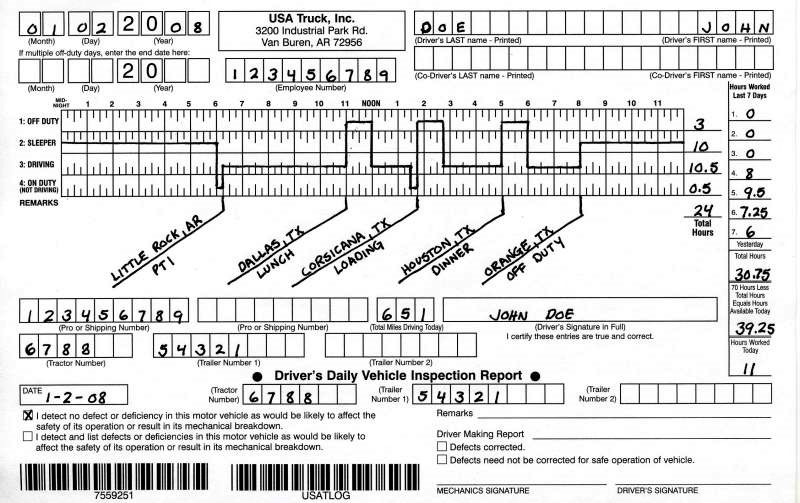
drivers-log

Where the driver’s log and grid show 3.5 hours driving time, but shows a route of 300 miles being covered, one can conclude:

  • The driver has lied about the time he spent driving, or
  • The driver was flagrantly speeding throughout his route (a truck obeying speed limits on highways will average 50 miles in an hour).

If a driver shows a 24-hour period of duty and begins with “driving” as the first entry, the driver has probably cheated on listing his duty time. It usually takes from 30-60 minutes for a driver to report to duty to the yard, get all of his paperwork, inspect his load, and perform the required inspections on his rig.

Where a driver logs 11 hours of driving time for the preceding 24-hour period and fails to get or log 10 solid hours of “off duty” time before resuming duty and driving, all of his driving for the following day is illegal and in violation of the safety regulations set forth in 49 C.F.R. 395.3.

Time and location of sequential fuel receipts can be important in showing the impossibility of compliance with the hours of service regulations in 49 C.F.R. 395.3.

Plaintiff’s attorneys investigating hours of service are suspicious that hours of service have been violated and records of driver’s duty status have been falsified until proven otherwise. In evaluating and defending claims for trucking companies, the defense attorney needs to THINK like his opponent.

Review and careful analysis  of the following documents helps cross reference criteria to check for validity or invalidity of driver’s duty hours:

  1. Driver’s log as required by 49 C.F.R. 395.8 for the day of the collision.
  2. Driver’s logs for defendant driver for the 6 months preceding the collision in question.
  3. Graph Grid required by 395.8 (g) for that day and for the 6 months preceding the collision.
  4. Records of automatic on-board recording devices required by 49 C.F.R. 395.15 for the day of the collision and the 6 months preceding.
  5. All payroll, or payment logs, or records for that driver for the time period, including the collision and 6 months prior thereto.
  6. All W-2’s for the driver in question for the withholding period, which includes the collision in question, and all reporting periods for 6 months prior thereto.
  7. All fuel receipts incurred from the time the truck left the carrier’s premises until the time of the collision.
  8. All Bills of Ladings and manifests pertaining to property transported and/or delivered from the time the truck left the carrier’s premises until the time of the collision.

The reason plaintiff’s attorneys ask for six months of logs is because of the belief that driver and company’s violation of hours of service regulations fall into a pattern. Examination of the logs and data for the prior 6 month period may  reveal those patterns. Where such patterns exist, an argument will be made of flagrant disregard of safety regulations, which “needlessly endanger” the general public (for those familiar with the “reptile theory” the phrase “needlessly endanger” is common).

The following post was written by a plaintiff’s attorney and is common refrain among plaintiff’s counsel:

49 C.F.R. Part 395 protects the public from the hazard of fatigued drivers operating huge trucks in their midst.  The hours of service regulations have been written from the blood of innocent citizens massacred by huge trucks at the hands of drivers impaired from fatigue.  Where a driver and carrier intentionally violate the safety regulations designed to guard against fatigue, they have shown a conscious disregard for the safety of the public using our highways.  Where such a fatigued driver has caused injury or death, the driver and carrier have acted with conscious and reckless disregard for the life and safety of the public on the highways.  This conduct justifies a punitive damage award against them, in addition to compensatory damages.

A bill approved by Congress on  Dec. 3, 2015 calls for a Federal Motor Carrier Safety Administration study on truck drivers’ long commutes and the safety hazards they present.

The $305-billion Fixing America’s Surface Transportation Act requires that  the U.S. Department of Transportation agency to track workforce commutes of two hours or more and provide an analysis of them in 18 months.

The section of legislation inserted into the potential new law is a direct result of the crash that almost killed former Saturday Night Live cast member Tracy Morgan. It states:

“Section 5515 requires the Administrator of the FMCSA to conduct a study on the safety effects of a motor carrier operator commuting more than 150 minutes. On June 17, 2014, a tractor-trailer struck a van near Cranbury, New Jersey, killing one person and injuring several others. According to the National Transportation Safety Board, the truck driver had been awake more than 24 hours at the time of the crash. In addition, the Georgia-based driver had driven 12 hours overnight to his job in Delaware before starting his shift. The study shall address the prevalence of long commutes in the industry and the impact on safety.”

If you’re a trucking defense attorney and you don’t evaluate the case like a plaintiff’s attorney would, you are not providing diligent representation.

If   you’re a trucking company or insurance company and you get offended by your legal representative diligently looking for problems and thinking like his opponent, you need to get over it. Your defense attorney is trying to help your company survive and thrive in this litigious society.  Be grateful that your legal counsel is a looking for problems. It’s better to know in advance than to be surprised.


Director Compensation Report: 2015-16 Executive Highlights

National Association of Corporate DirectorsThe National Association of Corporate Directors (NACD) has recently released its annual report on director compensation – a valuable guide NACD members use to benchmark their board’s compensation practices.

Determining what constitutes fair director pay is no easy task, the association says in a release. It’s important to periodically review your board’s compensation practices and to understand how they compare to those of your industry peers.

Compiled in partnership with Pearl Meyer, the report provides a comprehensive overview of non-employee-director pay practices across a wide range of industries and company sizes. The report also includes six leading practices for director compensation from the Report of the NACD Blue Ribbon Commission on Director Compensation.

Download the report’s summary.


Nine AZA Lawyers Named to Rising Stars List

Eight associates and a partner at  Houston-based Ahmad, Zavitsanos, Anaipakos, Alavi & Mensing have been named to the annual Texas Rising Stars list, which recognizes the top young attorneys in the state.

The lawyers include partner Elizabeth Pannill Fletcher and associates Jamie Alan Aycock, Sammy Ford IV, Benjamin Foster, Tiffany Joud, Alisa Lipski, Michael McBride, Adam Milasincic and Monica Uddin.

Only 2.5 percent of eligible attorneys are chosen for Texas Rising Stars, which recognizes lawyers who are 40 or younger, or who have been in practice no more than 10 years. Selection is based on peer nominations and editorial review.

Read more about the AZA Rising Stars.