Lawyer Gets Prison Time After Stashing $234K From Sorority

A South Carolina attorney who pleaded guilty to defrauding her sorority at the University of Alabama of hundreds of thousands of dollars was sentenced Tuesday to six months in prison and fined $50,000, reports AL.com.

The sentence also calls for Jennifer Elizabeth Meehan, 40, to serve 18 months of home confinement and 40 months supervised probation, along with community service and participation in a mental health program.

Meehan told the judge that she placed $234,000 of the money in a shoebox inside a closet to use for a scholarship program and other sorority expenses, according to the report by Kent Faulk.

Gamma Phi Beta Sorority at the University of Alabama intended the money to be used to furnish its sorority house.

Read the article.


Is Claustrophobia a Disability? Yes, Says the EEOC

By Cortney Shegerian
Shegerian & Associates

The Americans with Disabilities Act protects disabled individuals from discrimination and harassment in the workplace, but what health conditions are considered disabling? According to the EEOC, claustrophobia is a disability that must be accommodated in the workplace.

Regis Corporation will pay $60,000 to former hair stylist Nora Jacquez to settle a disability discrimination suit filed by the EEOC. Jacquez told her employer she could not work in a station “if it was in a confined space located between others,” because of her claustrophobia. The employer initially gave in to her request and placed her in an open station, but later, she was moved in between two other stylists. Her requests to move back into an open station were denied, and as a result, she suffered anxiety attacks that led to her hospitalization.

Jacquez then requested up to two months off to treat her claustrophobia, but the company failed to assist her with the required paperwork. Regis Corporation eventually fired Jacquez from the SmartStyle salon in Midland, Texas.

On top of the $60,000 settlement, the company must also provide ADA training to district leaders, salon managers and hair stylists in the region. They are also required to provide their employees with information regarding disability discrimination in the workplace and how it can be reported.

An EEOC attorney commented on the case, “Claustrophobia is a serious matter. When we discovered management refused to give this employee some space, our investigation closed in on what amounted to intolerance by management.”

Some employers may be surprised to learn claustrophobia is considered a disability. According to the Americans with Disabilities Act, a person can prove he or she has a disability by meeting one of the following conditions:

• Having a physical or mental condition that substantially limits a major life activity (such as walking, talking, seeing, hearing, or learning).
• Having a history of a disability (such as cancer that is in remission).
• Believed to have a physical or mental impairment that is not transitory and minor.

Disabled employees are legally allowed to request that their employers make reasonable accommodations in the workplace for their disability, which is what Jacquez did by asking to be moved to an open station. As long as the accommodation does not severely hurt the business, employers are required to follow through and make the necessary changes.

But, employers often have a hard time determining what mental conditions are disabling, since there are rarely observable, physical signs of the disability. Even those employers who are more aware of mental disabilities may be under the impression that conditions such as depression, anxiety and bipolar disorder are the only ones considered to be disabling. But, as long as the condition can impair the ability to perform a “major life activity,” it is covered under the ADA. Because the definition of a major life activity is broad and can include everything from eating, hearing and standing to thinking, working and concentrating, many mental health conditions do qualify as disabilities.

The lesson here? Employers should never discount an employee’s health condition just because they don’t think it is serious. This case should also serve as another reminder that employers should never brush off an employee’s request for reasonable accommodations in the workplace. Just because you can’t see the signs and symptoms of a disability does not mean it doesn’t exist or deserve your attention.

Author Bio: Cortney Shegerian is an attorney with Los Angeles based Shegerian & Associates. Shegerian’s practice areas of expertise include discrimination, harassment, whistle blower retaliation and wrongful termination, among others. Her work includes all aspects of case management, with a particular emphasis on mediation, trial preparation and jury trial litigation.


Complimentary Ethics & Compliance Virtual Conference

EthicsNavex Global will present the sixth annual Ethics & Compliance Virtual Conference on Nov. 15 — a free, one-day, online event.

The conference will be Tuesday, Nov. 15, from 8:30 a.m. until 2:30 p.m. Pacific time.

A goal of the event is to discuss how to deliver quantifiable value to an  organization, while meeting constantly changing legal and regulatory requirements.

The agenda consists of 11 educational sessions focused on harnessing the business value of an ethical culture, including three sessions specifically on the driving forces behind regulatory change and compliance challenges.

Howard Putnam, former CEO of Southwest Airlines, will headline the event, discussing how the culture of  Southwest Airlines benefit employees, reputation and profits—and the critical role compliance professionals played.

Register for the event.


This Single Mom Went From Partner to GC to CEO

Bloomberg Law describes how Chelsea Grayson went from being a high-powered M&A partner at Jones Day to general counsel of clothing brand American Apparel and then stepped in as CEO.

“As GC, Grayson saw the company through its chapter 11 bankruptcy  and helped engineer the debt for stock swap that transformed American Apparel from a public company to private one owned by hedge funds,” writes .

Her career at American Apparel began as general counsel in 2014. The next year she became chief administrative officer and defended the company against founder and ousted CEO Dov Charney’s litigation to regain control of the company. She took over the CEO role in September.

The article includes a question-and-answer transcript about her goals, preparation, learning the business, and handling the high-pressure job as a single mother.

Read the article.


Reviewing Banks’ Third-Party Vendor Service Contracts (Part 6)

The sixth installment in Bryan Cave LLP’s series about banks’ third-party vendor service contracts covers two subjects: first, ownership of trademarks, copyrights, patents and other trade secrets, source code escrow agreements; and second, confidentialty.

 wrote the article for the firm’s Bank Bryan Cave blog.

“The contract should include intellectual property provisions that clearly define each party’s intellectual property rights for their pre-existing materials and materials developed as part of the contract,” he explains.

And: “The bank will want the vendor to maintain the confidentiality of all information provided by the bank. This includes preventing the vendor or its subcontractors from using the information in a manner that is not anticipated by the contract.”

Read the article.


Contracting in the Cloud: Who Pays for a Data Breach?

Cloud - securityThe risk of a data breach cuts across industries and affects businesses large and small, causing some companies to migrate mission-critical data, including sensitive customer information, to third-party cloud providers, according to an article written by Sidley Austin lawyers Scott Nonaka and Kevin Rubino for Bloomberg Law.

“As data breaches have increased, so have the number of companies migrating mission-critical data to the cloud, including sensitive customer information,” they write. “These companies often turn to third-party cloud service providers to provide data hosting, software or infrastructure services. This trend is driven, in part, by the growing perception that cloud services are more secure than traditional information technology environments.”

They point out that data stored in the cloud faces many of the same threats as locally-stored data and, due to the growing amount of information in the cloud, it can be an attractive target for hackers.

Read the article.


Employers: Don’t Make Promises You Can’t Keep

Employment contractLaura Bartlow of Zelle LLP writes in a post on JDSupra that the very first item on her list of rules for employers is this: Don’t make promises to your employees that you can’t or won’t keep.

“Employers’ promises include those set out in employment contracts, of course, but there are others promises made by employers that can create legal liability and that are worth regular attention,” she explains. “And it works both ways – employees, related businesses, and vendors may also be obligated by the agreements that they have made with you.”

She discusses some of the most important points to consider, including: obligations in written employment contracts’ obligations in written policies and handbooks; obligations of employees, related organizations, and vendors; and obligations created by government contracts.

Read the article.


alt.legal: The (Nobel-Winning) Theory Of Contracts

Nobel Prize

Image by Dianakc

Ed Sohn writes at Above the Law about the the 2016 Nobel Prize for Economics being awarded to Oliver Hart and Bengt Holmström for their research in contract theory, saying the two return to basic principles of contract and are well-reflected in our policy-making and contract negotiation today.

“At minimum, efficient contracts are complicated business, and the financial burden of well-negotiated contracts is high,” Sohn writes. “Whether we’re talking about hidden covenants sneakily obscured in bond indentures or whether we’re looking at bad commercial leases that cripple a small business’s ability to grow, a fair and efficient economy requires fair and efficient contracts. To get there, we need more visibility and fairer incentives.”

The article discusses managed services solutions and technology solutions.

Read the article.


Chicago Lawyer Has Filed More Than 900 Qui Tam Actions Against Internet Retailers

Attorney Stephen B. Diamond of Chicago has filed at least 911 qui tam actions in Cook County Circuit Court under the Illinois False Claims Act (FCA) and has racked up almost $30 million in settlements over 15 years, a new analysis by Bloomberg BNA reveals.

But the analysis shows that Chicago’s “king of qui tam” could be facing tougher sledding in the enterprise that has brought him $11.6 million.

“Bloomberg BNA’s analysis, drawn from hundreds of previously confidential settlements collected though a Freedom of Information Act request on the Illinois Attorney General’s Office, provides the first clear picture of Diamond’s false claims business model and the financial impact it has had on hundreds of defendants,” Bloomberg reports.

Read the article.


Apple Sues Amazon Supplier Over Fake iPhone Chargers

Counterfeit - fakeIn a federal lawsuit filed this week, Apple asserted that nearly all the iPhones, chargers and cables it surreptitiously purchased from online retailer Amazon were fakes, according to a Computerworld report.

Reporter  quoted the complaint: “As part of its ongoing brand protection efforts, [Apple] has purchased well over 100 iPhone devices, Apple power products, and Lightning cables sold as genuine by sellers on Amazon.com and delivered through Amazon’s ‘Fulfillment by Amazon’ program. Apple’s internal examination and testing for these products revealed almost 90% of these products are counterfeit.”

Apple sued Mobile Star, a New York-based former Amazon supplier. The plaintiff said it purchased iPhone-related products that were advertised by Amazon as genuine Apple gear, complete with Apple copyrighted images and sometimes in packaging copied from real Apple accessories.

Read the article.


New Patent Troll Makes Vast Claim to Web Video, Sues 14 Big Media Companies

Video - filmBartonfalls LLC, an entity formed in August in the patent hotspot of East Texas, has sued 14 big media companies, claiming the media giants like CBS, NBC Universal and Bloomberg violated patented technology designed to switch automatically from one video display another, reports Ars Technica.

Reporter  explains that the patent, filed in 1997, “doesn’t talk about Web video or the Internet at all. Rather, it talks about switching between different video inputs when changing television programs.”

“Corporate documents show that Bartonfalls was formed as a Texas LLC in August,” according to the article. “Its business office is a virtual office in Plano, a city that’s just inside the borders for the Eastern District of Texas, the venue that it filed its lawsuits in. The only listed manager of Bartonfalls is a paralegal at a small Texas law firm, Stoddard and Welsh.”

Read the article.


Thomson Reuters Survey Reveals Developing Trend in Legal Departments

More than 40 percent of legal departments indicated the top benefit of increasing efficiency is being able to focus on more strategic work, and many are turning to legal department operations professionals to enable them to be more strategic in how they advise the business, according to the Thomson Reuters 2016 Legal Department In-Sourcing and Efficiency Report: The Keys to a More Effective Legal Department. The report, conducted for a second consecutive year, surveyed 429 attorneys and operational professionals working in corporate legal departments and examines how in-house teams are managing internal and external resources to achieve greater efficiency and productivity.

“As expected, we continued to hear that corporate legal departments are doing more with less,” said Mark Haddad, vice president of the Corporate segment for Thomson Reuters. “In-house teams are still dealing with the larger market changes that occurred following the 2008 global economic meltdown, and the survey uncovered how some in-house leaders are adjusting to these shifts: hiring legal department operations professionals to act as their change agents.”

The report reveals a rise in employing legal department operations (LDO) professionals in response to a backlash against the time-consuming administrative work facing legal departments. Many departments reported being besieged by the operational activities that come with being part of a corporation. Among the ways general counsel are addressing this is by employing LDOs to foster change.

“LDOs are managing outside counsel and employing legal managed services providers, as well as identifying and deploying new technologies across the legal department,” explained Haddad. “It’s an encouraging development in the legal profession. General counsel indicated a strong need to work more strategically, and bringing in LDO professionals to concentrate on business operations allows corporate counsel to focus on legal work and be more proactive and strategic in how they advise the business.”

The report found another upside to employing LDO professionals: By allowing corporate counsel to dedicate more time to the practice of law, less work has to go to outside counsel. The report analyzes how legal departments are keeping work in house, particularly with certain tasks related to contracts, intellectual property, mergers and acquisitions, and litigation. The report also explores which matters and tasks in-house counsel still turn to outside counsel for, and the reasons driving the work to law firms, including legal complexity and jurisdictional reasons.

“By changing how legal departments partner with outside counsel, hiring LDOs and implementing new technologies, legal departments are finding more ways to adapt to cost pressures and see a greater return on total legal spend,” added Haddad.

The report findings underscore general counsels’ awareness of the need for greater innovation to improve efficiency and productivity. It also assesses how in-house teams are introducing efficiencies within their legal departments — across people, processes and technology — and are further redefining the in-house/outside counsel relationship.

Download the report.


Your Organization’s Corporate Culture Needs TLC

By Patty P. Tehrani
Lawyer and Founder of Policy Patty Toolkit

ComplianceThousands of employees are fired at a bank, and a seasoned car engineer pleads guilty to criminal charges. Both cases involve examples of massive fraud with lingering doubt about how and whether the underlying companies can bounce back. And while these well-publicized scandals dominate headlines for a period the repercussions internally have long-term if not a permanent effect. Employees are left to doubt both the viability of their jobs and the future of their organizations. Morale wanes impacting service, productivity, and operations as uncertainty, frustration and anger increase.

Systemic malfeasance often reveals legal and regulatory issues but results in little to no focus on how the organization’s corporate culture contributed to the events. How can that be? Corporate culture is the character, the foundation of an organization. It is supposed to represent the common beliefs employees and management share about conduct and its consequences.

Another reason corporate culture is critical is the growing importance of the Millennial generation in today’s workforce. Unlike older generations less inclined to question management and corporate direction, this group is not shy about challenging established notions about employer identity and direction. They tend to emote more and use social media to quickly vocalize concerns and issues between an organization’s aspirations and its actions.

Corporate Culture can only be sustained through a history of trust, fair dealing, and ethical behavior. Left unattended or to deteriorate, your organization is susceptible and may suffer irreparable damage. With this in mind, you may want to assess your corporate culture. Below are key factors for a new organization’s culture to leverage or the first step to revitalizing or reshaping culture in an organization looking to change:

• Core Purpose – Vision
• Core Standards – Values
• Core Practices – Rules
• Core People – Leaders and Employees
• Core Understanding – Education and Training
• Alignment with Strategy and Processes

Core Purpose – Vision
The first component of corporate culture is a vision or mission statement that defines the organization’s purpose. The statement should:
• be short and simple;
• guide the actions of an organization;
• set out an overall goal; and
• provide a framework for which the organization’s strategies are formulated.

How do you draft your vision statement? The clearer your vision statement the more effective it is. To help draft the statement, Forbes contributor Patrick Hull considers the following four essential questions a mission statement must answer.

• “What do we do?”
• “How do we do it?”
• “Whom do we do it for?”
• “What value are we bringing?”

Another way to think about the vision statement is that it should tell current and future key stakeholders (employees, partners, shareholders, investors, and the public at large) where the organization is today and where it wants to be tomorrow.

Core Standards – Values
An organization’s culture cannot reside solely with a vision statement and requires standards on how to reach its purpose. That’s why you need to complement your vision statement with the next key component – values. These principles guide your organization’s core behaviors to reach its vision. Values let key stakeholders know how the organization will strive to reach its purpose – in particular – how it will serve its clients, act toward colleagues, and uphold minimum conduct standards. If done properly, they form an ethical foundation for the organization. If truly authentic, they guide the behavior of employees and ultimately assist them in determining what is right and wrong.

Core Practices – Rules
Values have little to no impact if there are no rules – the next component – to dictate an organization’s practices. Values must be integrated into an organization’s practices – principles, policies, and procedures. These rules guide accepted business strategies and objectives. They link up the organization’s Values and Vision with day-to-day operations. Rules identify the key activities and provide a general approach to decision-makers on how to handle issues as they arise. This is accomplished by providing the reader with requirements, possible limits and a choice of alternatives that can be used to ‘guide’ their decision-making process as they attempt to overcome problems.

Core People – Leaders and Employees
An organization’s culture is only sustainable if its people – leaders and employees – embrace it. Charles Ellis, author of What it Takes: Seven Secrets of Success from the World’s Greatest Professional Firms, noted that the best firms are “fanatical about recruiting new employees who are not just the most talented but also the best suited to a particular corporate culture.” That’s why it is critical to hire and maintain people that not only embrace their organization’s culture but also promote and reinforce it through the following means:

• Higher purpose – An organization’s social responsibility and corporate citizenship programs serve a goal greater than maximizing shareholder returns. By highlighting the value that employees can add to society, leaders can inspire them toward behaviors that may increase value. Actions beyond just self-interest and pride in the workplace through social and community help employee loyalty to the organization.

• Examples from the top – Leaders need to set the “tone at the top” and get in front of promoting and fostering the organization’s cultural attributes. One critical aspect is their promotion of accountability. Employees must know and see there is accountability for proven wrongdoing regardless of position or tenure. Failure to apply responsibility for malfeasance can be extremely damaging to corporate culture. This is especially true when leaders are not answerable for their actions, and others with far less power are. This leaves employees and probably others to wonder whether management is truly committed to the organization and its culture. Separately, leaders need to appeal to employees more through their stories and actions than directives. This allows leaders to be more relatable allowing them to reveal something of themselves and show some vulnerability.

• Participation – If an organization truly values its employees it needs to engage them and provide opportunities for them to participate. This can be done by linking the deeds of individuals at any level to key goals and strategies. The drive becomes more of movement allowing employees to drive the culture and not just to follow it. Employees that have a stake in the organization’s success will be more likely to push its initiatives through. With committed and engaged employees, companies can be more productive and possibly more profitable.

Core Understanding – Education and Training
To promote corporate culture, employees need to know what it is. That is why communication is the next core component to developing or fostering an organization’s culture. Some of the questions to ask in how effectively culture is being communicated:

• How is your corporate culture communicated across the organization?
• What message on ethics and compliance is being perceived by employees at the lowest level of the organization?
• How and how often do your measure your corporate culture?
• Are periodic surveys used to measure the organization on culture?
• Have there been any recent developments that require reinforcement or assessment of your culture – for example, acquisition, regulatory finding, major litigation or reputational harm?
• How involved is your management and as appropriate the board in communicating the organization’s culture?

Communication can be formal or informal, but in either case more powerful when done on an ongoing basis and in a manner that is relevant to its audience and easy to follow.

Alignment with Strategy
Culture can help determine the values and habits that shape how an organization’s strategy becomes a reality. If a new strategy conflicts with established practices, employees will likely struggle to change. Aligned strategies and culture help employees manage day-to-day challenges. They are more productive and loyal, and more likely to recommend the organization to friends. Additionally, a strong, sustainable culture helps create a powerful brand that can have positive effects on the bottom line.

Conclusion
There are other factors that influence culture but the components discussed above can provide a well-founded basis for shaping an organization’s culture.

To help you assess and where necessary revitalize or reshape the culture of your organization, consider the following assessment:
• Step 1: Assess your current cultural tendencies:
o Survey employees, clients, and business partners about values:
 that are important to them;
 they see being expressed in the current culture; and
 required to take the organization to the next level.

o Check to see how your culture is supportive of your strategy and visa versa.

o Use the results of the survey to:
 better understand your stakeholders – their motivations, experience within your organization, and where they think the organization should be heading; and
 identify potential roadblocks and cultural forces that will propel your organization forward.

• Step 2: Launch a discussion and do so on an ongoing basis:
o Share the results of your surveys – both good and bad news, for better transparency.
o Launch discussions with different focus groups to help bring about the desired cultural change.
o Find ways to encourage, solicit and cultivate ideas and behaviors from employees on an ongoing basis to help maintain the culture.

• Step 3: Identify the elements of your culture you want to focus on and review your processes to make sure they are aligned with it. Examples of processes include:
o Leadership behaviors
o Annual budget cycle
o Sales/service approach
o Performance management systems
o HR practices and hiring guidelines

• Step 4: Define a maintenance plan to periodically measure and update your culture as needed to make sure it is maintained and viable. Consider these steps:
o Assess your culture on a regular basis (at least every couple of years but preferably annually) to make sure your culture is moving in the right direction.
o Develop reporting measures that are simple and include minimum and stretch targets, and not be too easy or difficult to reach.
o Assess and update your processes.
o Communicate using different channels of communication to ensure an ongoing dialogue that encourages input from all levels of the organization and possibly some outside of it.
In the end, no organization is without its challenges but creating a viable organizational culture that is sustained properly will most definitely help it and possibly reap great returns.



Business Development for Litigators: Best Practices and Innovative Techniques

Practical Law will present a free 75-minute webinar involving a Q&A discussion on tips and techniques for litigators wanting to build their book of business. The event will be Thursday, Oct. 27, at 1 p.m. EDT.

The webinar will include discussions on:

  • Winning business from new clients and maximizing existing client relationships.
  • Best practices for client pitches.
  • Creative approaches to business development, including technological and practice management solutions.
  • Key takeaways when developing a personal business plan.

A short Q&A will follow.

PANELISTS:

  • James Lee, Managing Partner, LTL Attorneys LLP
  • Frederic Mauhs, General Counsel, BBVA S.A., New York Branch
  • Katherine Perrelli, Chair of the Litigation Department, Seyfarth Shaw LLP

The moderator will be Meagan Crowley-Hsu, Deputy Editor, Practical Law The Journal: Litigation, Practical Law

Register for the webinar.


Top Tips for Post-Audit Software Remediation

By 
Scott & Scott

Responding to a software audit can be an arduous, expensive, and time-consuming process for a company. The remediation process to close compliance gaps may vary slightly depending on whether the audit is initiated the software publisher itself or outsourced to an agency such as BSA| The Software Alliance (“BSA”) or the Software & Industry Information Association (“SIIA”).

Because many companies are weary from the time and expense incurred during the course of the audit, some do not take the remediation process seriously. The following are tips for remediation to ensure the post-settlement obligations are met and the release of liability is secured.

1) Determine the best license for each use case. Smaller companies prefer to purchase original equipment manufactuer (“OEM”) licenses for operating systems and other software on a case-by-case basis. However, larger corporations may choose to take advantage of bulk purchases by entering into site or enterprise agreements directly with the software publisher, which may offers discounts and other benefits. Regardless of which purchase option a company uses, it is important to ensure that each license covers the specific use case for the installed software.

2) Ensure subscription software is renewed. Some software publishers are moving to a subscription licensing model instead of a perpetual license. A perpetual license grants a user the right to use the software forever, as long as it is in accordance with the license agreement. However, a subscription typically must be maintained in order to continue to use the software. If a company misses a renewal, it may create a compliance gap if the user continues to install and use the software. There are very few instances (such as some Microsoft developer licenses) that allow the software to continue to be used after the subscription expires, but generally all subscriptions must be active in order to be compliant with the license agreement.

3) Avoid cutting corners and purchasing discounted software. A sizeable portion of software sold on online auction sites is not legitimate. Software auditors typically assume that all software sold for less than 90% of its MSRP value is counterfeit or being illegally sold or transferred. It is important to purchase from reputable, authorized resellers in order to avoid paying additional penalties in future audits. Some software publishers offer a list of authorized vendors on their web sites.

These are just a few issues to consider when completing post-audit software remediation. It is crucial to properly remediate any compliance gaps to secure the release of liability and protect against future audits. If in doubt, contact an attorney experienced in software licensing and copyright infringement matters.


DLA Piper Honored by Alternative and Direct Investment Securities Association

DLA Piper has been recognized with the President’s Award by the Alternative and Direct Investment Securities Association (ADISA) for the firm’s  service to the alternative investment securities industry.

ADISA is a national trade association of decision makers who influence over 30,000 professionals involved in alternative investments, primarily non-traded alternatives. These typically include non-traded Real Estate Investment Trusts (REITs), Business Development Companies (BDCs), Master Limited Partnerships (MLPs) and private and public funds (LPs/LLCs), 1031 exchange programs (DSTs/TICs), energy and oil and gas interests, equipment leasing programs, and other alternative and direct investment offerings.

DLA Piper received the award on September 27, 2016 at ADISA’s Annual Conference and Trade Show in Las Vegas. John Grady, a partner in DLA Piper’s Philadelphia office, is the President-Elect of ADISA, and currently chairs its Legislative and Regulatory Committee. He will take over from the current President, Mike Bendix, on January 1, 2017. Darryl Steinhause, a partner in DLA Piper’s San Diego office, currently serves as general counsel to ADISA and its Board of Directors. Darryl Steinhause has been active in the association since its formation and in the past has been a member of the Board of Directors and numerous committees and has been active in ADISA’s interaction with the SEC and FINRA.


The Comprehensive Guide to E-Discovery Preservation

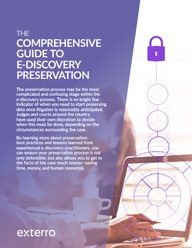
exterro-edisc-preservation-10-2016Exterro has published “The Comprehensive Guide to E-Discovery Preservation,” an e-book that discusses how to incorporate preservation principles into the legal process that will enable defensible and proportional policies.

“The preservation process may be the most complicated and confusing stage within the e-discovery process, namely because there is no bright line indicator of when you need to start preserving data once litigation is reasonably anticipated,” the company says on its website. “Instead, judges and courts around the country have used their own discretion to decide when this must be done, depending on the circumstances surrounding the case. That is why you should continually reference preservation best practices and lessons learned from experienced e-discovery practitioners to ensure your process is defensible.”

The guide discusses:

  • What is required within your preservation process
  • Need-to-know steps for deciding how and when to preserve data, including new data types
  • Preservation advice from in-house legal professionals

Download the guide.


U.S.-Asia Cross Border White Collar Crime Series: Dec. 6 in NYC

InnoXcell IAS 2016The Innoxcell Annual Symposium – The US -Asia Cross Border White Collar Crime Series will be on Dec. 6, 2016, in New York at the Warwick New York Hotel.

Complimentary passes are available for General Counsel, Corporate Compliance, Head of Audit, Head of M&A, IP and Head of Risk. Contact Jeffrey Teh at Jeffrey.teh@innoxcell.net for more information on passes.

The Innoxcell Annual Symposium (IAS) is the world’s largest and most comprehensive white-collar crime and regulatory compliance conference, focusing on cross-border business legal relations between the US and Asia.

In 2016, the Innoxcell Annual Symposium (IAS) has been held in Hong Kong, Shanghai, Singapore, Australia, the United Kingdom and now, the United States. This is the only event of its kind, featuring multiple streams covering the great diversity of cross-border issues, including:

  • US – Asia eDiscovery judiciary panel
  • US-China anti-corruption best practices
  • Financial Crime Compliance
  • Employee Misconducts
  • China outbound investment and merger review best practices
  • Cross-border fraud investigation and litigation
  • One belt, one road – risk and legal considerations

Register for the symposium.


The Supreme Court Questions Trump and Clinton Haven’t Answered Yet

Bloomberg’s  points out that this presidential election marks the first time since 1968 with a Supreme Court seat needing to be filled. And three current justices are at least 78 years old, so the next president could fill enough vacancies to shape rulings for a generation.

He suggests some questions for Wednesday night’s debate moderator Chris Wallace to ask Hillary Clinton and Donald Trump.

A question for Clinton: Secretary Clinton, the Supreme Court ruled in 2008 that the Constitution protects individuals’ right to have a gun. Should the court overturn that holding?

And for Trump: Mr. Trump, should the Supreme Court overturn the 2015 ruling that legalized same-sex marriage? If so, should the marriages of tens of thousands of gay couples since then be invalidated?

Other questions could cover who would be nominated for the Supreme Court, the Citizens United ruling, and the use of eminent domain.

Read the article.


Class Action Launched Against Samsung Over Note 7 Debacle

The ongoing fallout from Samsung’s Note 7 debacle now includes a possible class-action lawsuit against the company in the U.S., according to a report by digital Trends.

Three former Samsung Note 7 users in New Jersey filed the suit a week after the Korean company ended production of the handset after faulty batteries caused more than 100 units to overheat and catch fire, reports .

The suit focuses on Samsung’s handling of the recall, which the plaintiffs claim caused them to go without a phone for several weeks while still having to pay for the device and plan charges, Motherboard reported on Tuesday.

Read the article.