The Five Biggest Issues Facing the New Ninth Justice

 and  of BloombergBusinessweek list some of the top issues that will be waiting for a new U.S. Supreme Court justice who is likely to nominated by Donald Trump after he moves into the White House in 2017.

The new justice will fill the seat formerly held by the late Justice Antonin Scalia, who led 5-4 corporate majorities in a series of major rulings.

The authors discuss the top five issues, which include climate change, arbitration, class actions, property rights and insider trading.

Read the BloombergBusinessweek article.


Arnold & Porter to Merge With Rival Kaye Scholer for 1,000-Lawyer Firm

Two prominent law firms, Arnold & Porter and Kaye Scholer, winding up months of talks, announced on Thursday that they would combine to become a firm with more than 1,000 lawyers effective Jan. 1, The New York Times is reporting.

Reporter writes that the new firm will be called Arnold & Porter Kaye Scholer.

“The combination was not a surprise. Each firm brings complementary expertise — Arnold & Porter is a litigation and regulatory issues powerhouse in Washington, and Kaye Scholer, based in New York, which is almost half the size of Arnold & Porter, is best known for its financial services and life sciences work. At each firm, however, the revenue and profit per partner has been buffeted in the changing legal landscape,” Olson reports.

Read the article on The New York Times.


Goodell DeVries Wins Tier One Rankings in U.S. News Best Law Firms

Goodell DeVries received rankings in 10 practice areas in the 2017 “Best Law Firms” list by U.S. News & World Report and Best Lawyers®, including being ranked Tier 1 Nationally for Mass Tort Litigation/Class Actions and Tier 1 Regionally for Commercial Litigation, Legal Malpractice Law (Defendants), Mass Tort/Class Action (Defendants), Medical Malpractice Law (Defendants), Personal Injury Litigation (Defendants), and Product Liability Litigation (Defendants).

The U.S. News – Best Lawyers “Best Law Firms” rankings are based on a rigorous evaluation process that includes the collection of client and lawyer evaluations, peer review from leading attorneys in their field, and review of additional information provided by law firms as part of the formal submission process. Clients and peers were asked to evaluate firms based on the following criteria: responsiveness, understanding of a business and its needs, cost-effectiveness, integrity and civility, as well as whether they would refer a matter to the firm and/or consider the firm a worthy competitor.

Firms included in the 2017 “Best Law Firms” list are recognized for professional excellence with persistently impressive ratings from clients and peers. Achieving a ranking signals a unique combination of quality and breadth of legal expertise, and reflects the high level of respect that a firm has earned among other leading lawyers and clients in the same community and practice areas.

“Goodell DeVries is very proud to once again be recognized as a top tier law firm both nationally and regionally,” says Linda S. Woolf, Managing Partner at the firm. “For the past 28 years, we have made it our mission to, not only provide our clients with efficient and effective results, but also to have a deep understanding of our clients’ business. This has enabled us to serve the dual role of advocate and trusted advisor. Having our clients and peers recognize our commitment and dedication in 10 practice areas is truly an honor.”

Goodell DeVries received rankings in the following areas:

National Awards
Tier 1, Mass Tort Litigation / Class Actions – Defendants

Metropolitan Awards
Tier 1, Baltimore, Commercial Litigation
Tier 1, Baltimore, Legal Malpractice Law – Defendants
Tier 1, Baltimore, Mass Tort Litigation / Class Actions – Defendants
Tier 1, Baltimore, Medical Malpractice Law – Defendants
Tier 1, Baltimore, Personal Injury Litigation – Defendants
Tier 1, Baltimore, Product Liability Litigation – Defendants
Tier 2, Philadelphia, Mass Tort Litigation / Class Actions – Defendants
Tier 2, Philadelphia, Product Liability Litigation – Defendants
Tier 3, Baltimore Litigation – Construction


Herbert Smith Freehills’ New York Office Hires First LatAm Project Finance Partner

Herbert Smith Freehills’ New York Office has added Edward J. Dougherty is relocating to New York from São Paolo, Brazil, to join the firm as a partner focusing on project finance, trade finance and syndicated lending in the infrastructure, mining, power, oil & gas and financial sectors across Latin America.

In a release, the firm said Dougherty was previously in the project finance group of Allen & Overy LLP. He worked from its São Paulo office for the last three years with that firm. He gained prior experience in the legal departments of the Brazilian mining company Vale S.A. and the US private sector development agency OPIC, and was at the Brazilian law firm Veirano Advogados. He speaks fluent Spanish as well as Portuguese. He has advised clients in Brazil, Mexico, Colombia, Peru, Uruguay, Panama, Dominican Republic, Chile and the United States.

The release continues:

Herbert Smith Freehills’ Latin America Group comprises a highly regarded team in New York, Madrid, London, the Australasian offices, and other offices across the firm’s network.

In New York, Mr. Dougherty’s finance practice is a strategic complement to the projects practice of Juan-Jose Zentner, who joined the office earlier this year. Mr. Zentner was previously based in Herbert Smith Freehills’ office in Melbourne, Australia. Led by international arbitration partner Christian Leathley, the LatAm hub in New York includes other US, English and Australian – qualified lawyers, native and fluent in Spanish and Portuguese, with specialist projects and infrastructure and international arbitration experience, many of whom began their careers in Latin America. The practice offers expertise in mining, power, oil & gas and general infrastructure and represents a large number of global firm clients.

With expanding opportunities to serve existing global clients, existing LatAm based clients, prospective clients investing in and from the region, the New York hub plans to grow through further lateral hires.

Mr. Dougherty commented: “Eager to expand my practice in the competitive marketplace for Latin American legal services, Herbert Smith Freehills’ offering was instantly compelling. The firm is deeply experienced in key industries such as oil and gas and mining, with institutional links to the Japanese trading houses, large Korean conglomerates and Canadian and Australian pension funds that are major players in the project finance space. And the New York office is fully integrated with the global offering, key for knowledge sharing and cross-selling in a diverse marketplace of multiple jurisdictions. I could not be me more excited to join Herbert Smith Freehills in New York.”

Mr. Leathley, co-head of the firm’s Latin American group, said: “We are building the New York hub of our Latin American practice to better serve clients with interests in the region and seize upon clear opportunity in energy, infrastructure and mining and other industries in which the firm is strong. With a New York-based project finance capability, our very credible and high-quality offering meets the most critical legal needs of clients doing business in Latin America with a multi-lingual team that has deep roots in the region. The development of this capability is key to the firm and we will continue to add strength to our local team. Ed Dougherty is an impressive attorney. He has a breadth of experience and practice building record together with drive, energy and a real love of challenge. We are pleased to welcome him to Herbert Smith Freehills.”

Mr. Dougherty is admitted to the Bar in the State of New York.

The New York office also includes a team of US and UK-qualified disputes lawyers that represents clients in US courts in commercial litigation, investigations, cross-border matters and class actions. Lawyers working in the New York office are also qualified to practice in Paris, Singapore, Brazil, Ecuador, New Zealand and Australia.


Partner Luis Zambrano, Senior Counsel Sarah Bradbury Join Estes Thorne & Carr

Dallas litigation boutique Estes Thorne & Carr PLLC has added trial lawyer Luis Zambrano as partner and former in-house counsel Sarah Bradbury as senior counsel.

“We are proud to have two attorneys with such different professional backgrounds join our firm,” said managing partner Jessica Thorne. “Luis is a trial lawyer with extensive experience at every stage of the litigation process. Sarah has an innate instinct for the issues central to business success, having worked in-house for two different organizations. Our clients will benefit greatly from their unique perspectives.”

The release from the firm continues:

Zambrano is a litigator, arbitrator and mediator, representing and advising clients on matters involving complex commercial litigation, health care, private equity, securities, financial transactions and consumer class actions. He joins the firm from Miller, Egan, Molter & Nelson.

He began his career as a Texas Supreme Court briefing attorney for the late Justice James Baker. He earned his law degree, cum laude, from the Southern Methodist University Dedman School of Law. He earned his undergraduate degree and an MBA from Texas Christian University.

“I am excited to be joining a firm where every attorney is an excellent litigator with strong trial expertise,” said Zambrano. “This is unquestionably one of the most impressive legal teams I’ve seen and I’m truly excited to be a part of it.”

Bradbury joins the firm after serving as senior legal counsel at Energy Transfer, where she focused on labor and employment matters. She also served as senior legal counsel for MoneyGram International. Board Certified in Labor & Employment Law by the Texas Board of Legal Specialization, she previously was a senior attorney at Gardere Wynne Sewell LLP. Bradbury earned both her undergraduate and law degrees from Vanderbilt University.

“There is an atmosphere at Estes Thorne & Carr unlike any other,” said Bradbury. “There is a true sense of collaboration, so that every client receives the benefit of everyone’s expertise. That approach also helps make each of us a better attorney.”


Contract Terms: The Boilerplate Language IS Important

It seems easy to just cut and paste and/or use prior agreements and roll them over into a new situation when drafting a contract … but it may cost you more in the long run if and when something goes wrong, cautions Anette Beebe of Beebe Law, PLLC.

In her article, she discusses some of the boilerplate clauses that are typically at issue in a contract, including: choice of law and/or choice of forum clauses, arbitration clauses, jury trial waivers, severability clauses, cooperation clauses, integration/merger clauses, warranties, damages clauses, and indemnification clauses.

Read the Beebe Law article.


5 Points: Arbitration Clauses in Real Estate Contracts

While consumers may not have many choices when signing agreements that contain arbitration clauses, commercial parties often negotiate every last term of their agreements, according to a post on Shutts & Bowen LLP‘s website.

“This includes whether to require the parties to arbitrate their disputes or take them to court. There are advantages to each, so here are five things to consider when deciding whether to include an arbitration clause in a real estate contract, such as a purchase and sale agreement or lease,” write Al LaSorte, Matthew R. Chait and Matthew S. Sackel.

Those considerations include time, money, convenience, discovery and rules. The authors discuss the finer points of each one.

Read the Shutts & Bowen article.


White House Continues Attack on Non-Compete Agreements

“State Call to Action on Non-Compete Agreements” is the White House’s latest in a series of Executive Branch missives decrying the purported misuse of non-competition agreements by employers across the country, according to an article posted on the website of Jackson Lewis P.C.

Authors Clifford R. Atlas, David M. Walsh and Erik J. Winton write that the latest call to action repeats some of the Administration’s earlier conclusions on the subject: “including the view that use of non-compete agreements artificially restrict competition, restrict worker mobility, create barriers to changing jobs and weaken employees’ bargaining power. The stated goal of the White House issuances on non-competes is to address wage stagnation and boost the economy.”

“Many attorneys who represent companies in restrictive covenant litigation find the Administration’s conclusions and stated concerns about the evils of non-compete restrictions puzzling,” they write.

Read the article from Jackson Lewis.


Could Presidential Election Results Usher in Federal-Level Tort Reform?

Dallas lawyer Trey Branham of Dean Omar Branham says Donald Trump’s election could mean Texas-style tort reform at the federal level. As an example, he expects a revival of the FAIR Act – Fairness in Asbestos Injury Resolution Act of 2006 – which was narrowly defeated in Congress.

“The essence of the bill was that it would end asbestos lawsuits on both the state and federal level and set up a federal ‘trust fund’ funded by industry to pay asbestos lawsuit claims. The idea was to set up a complex set of medical and factual criteria that a claimant would have to meet to be eligible for compensation and compensation levels were capped without regard to income, loss or facts,” Branham said in an article posted by Androvett Legal Media & Marketing. “Additionally, fees would be capped at 5 percent of recovery. The practical effect of this would be that asbestos victims would not be able to engage counsel and would be forced to negotiate the medical and factual criteria alone and, if they were successful, would get far less compensation than the tort system generally permits.”


NACD Introduces New Initiative: The Strategic-Asset GC

National Association of Corporate DirectorsThe National Association of Corporate Directors has introduced the its new Strategic-Asset GC initiative, which recognizes the unique position general counsel hold relative to their boards of directors.

The new NACD initiation provides an exclusive view into how today’s general counsel are helping to craft boardroom strategy.

This NACD effort will aim to provide general counsel with valuable insights from directors, subject-matter experts, and fellow general counsel in order to help identify effective strategies for continued partnership. Led by a General Counsel Steering Committee, The Strategic-Asset GC initiative will include a quarterly webinar series, resources, and peer-to-peer events.

Sign up for access.


Webinar: Determining the Value of One Patented Feature

Fitch, Even, Tabin & Flannery LLP will present a complimentary webinar, “Determining the Value of One Patented Feature: A Behavioral Alternative to a Consumer Survey,” featuring Jacob Jacoby, Ph.D., and Alison Aubry Richards and moderated by Edward W. Gray Jr. The webinar will take place on Thursday, Nov. 17, 2016, at 9 a.m. PST / 10 a.m. MST / 11 a.m. CST / 12:00 noon EST.

In a release, the firm said recent Federal Circuit decisions have made it more difficult to prove damages in litigation. This is especially true when the infringed patent relates to just one feature in a product with multiple features. Before a patent owner can obtain damages based on the entire market value of a product (patented and unpatented components sold together), the patent owner may be required to prove that the patented feature is the basis for consumer demand for the entire product. Other decisions require the patent holder to apportion the value of the whole product down to the patented feature.

Whether a damages expert’s opinion can meet these requirements is a critical question for all patent litigants. Ultimately, the persuasiveness and reliability of the factual data on consumer demand for a patented feature underlying the damages case can determine the financial outcome of the case.

This webinar will cover these topics and more:

• Relevant case law
• Why proving consumer demand is key to receiving monetary damages
• The shortcomings of typical survey approaches to measuring consumer demand
• An alternative behavioral methodology for reliably measuring consumer demand

CLE credit has been approved for California, Illinois, and Nebraska. Other states may also award CLE credit upon attendee request.

Following the live event, a recording of the webinar will be available to view for one year at fitcheven.com.

Register for the webinar.


Legal Holds: Educating Company Employees about Document Preservation

Practical Law will present a free 75-minute webinar in which Jeffrey Nass, senior counsel for e-discovery with Boehringer Ingelheim, will discuss how to effectively train employees on how to collect, preserve, and protect relevant information in their possession.

The event will be Thursday, Nov. 17, at 1 p.m. EST.

Attendees will learn:

  • Best practices for drafting and communicating a legal hold notice within and outside the US.
  • Effective techniques for training company management and employees on how to identify relevant information.
  • Appropriate methods for document collection to preserve metadata and track the chain of custody.
  • The roles of corporate counsel and outside counsel in the legal hold process.

A brief Q&A session will follow.

Presenters:

Jeffrey Nass, Senior Counsel e-discovery, Boehringer Ingelheim
Jeffrey Nass spearheads the e-discovery program for Boehringer Ingelheim USA, a pharmaceutical company, headquartered in Germany. Mr. Nass advises on strategy and issue resolution across all phases of the e-discovery records management (EDRM) and oversees the execution of tactical e-discovery tasks on domestic and cross-border matters. Much of Jeffrey’s current work focuses on the EU Data Directive and the establishment of practical, cost effective solutions designed to satisfy US discovery obligations while adhering to the principles of German Data Protection. With over 15 years of experience in the fields of Electronic Discovery and Records Management, Jeff has advised organizations on all aspects of evidence lifecycle management, including the development of record retention policies, legal hold strategies, discovery protocols, and document review techniques.

Ruth Marshall, Managing Editor, Practical Law Litigation
Ruth Marshall joined Practical Law from the New York office of Winston & Strawn LLP, where she was a litigation associate concentrating on securities litigation and complex commercial litigation. She was previously a litigation associate at the New York office of Bryan Cave LLP. Ruth is the Managing Editor of Practical Law’s Litigation team

Register for the webinar.


Orsinger, Nelson, Downing & Anderson Earns National Best Law Firms Honors

For the first time, family law boutique Orsinger, Nelson, Downing & Anderson, LLP, has earned both national and metropolitan Best Law Firms honors in three practice areas from U.S. News & World Report and The Best Lawyers in America.

In a release, the firm said the recently released 2017 Best Law Firms list includes national honors for the firm’s appellate practice. Although the firm has consistently earned top Dallas-Fort Worth metropolitan honors for its work, including recognition for family law eight consecutive years, this marks the firm’s first national ranking.

“It is exceptionally rare to find an Appellate attorney who focuses on Family Law work, and we are very proud to be working with two of the very best in the country,” said firm Partner Keith Nelson. “The expertise and insights of Richard Orsinger and Brad LaMorgese have proven invaluable to countless clients.”


To be eligible for Best Law Firms rankings, a firm must have at least one lawyer listed in the 2017 edition of The Best Lawyers in America.

Earlier this year, nine of the firm’s 15 attorneys were honored individually for their work in Family Law: Orsinger, Nelson and LaMorgese; Scott Downing, Jeff Anderson, Lon Loveless, Will Reppeto, Paula Bennett and Marilea Lewis. In addition, Orsinger and LaMorgese were honored in the area of appellate law, and Lewis was recognized for her mediation practice.

Final selection to The Best Law Firms list is based on client and attorney evaluations, along with peer review by attorneys within the same practice area and editorial review. The full 2017 Best Law Firms list can be found at http://bestlawfirms.usnews.com/.


Trump’s Victory Has Enormous Consequences for the Supreme Court

U.S. Supreme CourtThe political earthquake that hit Tuesday night has enormous consequences for the Supreme Court, swallowing up Judge Merrick Garland’s ill-fated nomination and dismantling Democratic hopes for a liberal majority on the high court for the first time in nearly a half-century, writes Robert Barnes for The Washington Post.

At some point next year, the nine-member court will be restored to full capacity, once again with a majority of Republican-appointed justices. Democrats in the U.S. Senate may try to filibuster Trump’s choice for the court, but Republicans could change Senate rules to remove that option for Supreme Court nominations.

In his article, Barnes predicts” “Trump’s upset victory likely changes the court’s docket as well: Court challenges to President Obama’s regulations regarding the Affordable Care Act and immigration, which have preoccupied the justices in recent terms, will likely disappear under a President Trump and a Republican-controlled Congress.”

Read the article in The Washington Post.


London Calling: The Law and Politics of Brexit

EU- BrexitYou may not have heard, above the hubbub of Tuesday’s election, about a very significant judicial decision on Brexit and issues of constitutional law that was handed down last week. But before I look at it more closely, there’s some background to the recent High Court decision that you need to know.

Leaving the EU

There is a mechanism set out in Article 50 of the Lisbon Treaty, whereby a member state can leave the EU.  First, the state makes the decision to withdraw “in accordance with its own constitutional requirements”. It then notifies the European Council of its intention (known as “triggering Article 50”). After that, there is a two-year period for the departing state to negotiate the arrangements for withdrawal, including future relations between the state and the EU. Whether or not any such negotiations have been concluded, the departing state ceases to be an EU member at the end of that two-year period (unless all member states agree, unanimously, to extend the period).

This bit is really important: once Article 50 is triggered, there appears to be no way back; the state’s membership of the EU will end, as night follows day, and there is nothing anyone – not the EU, not the departing state, no-one – can do about it. (It has been pointed out that whether triggering Article 50 is reversible is a question of European law; but I can’t see the UK government testing the point – that would require a reference to the Court of Justice of the European Union. Politically, not a smart move.)

Of course, a state can, having left, apply to rejoin; but (a) there’s a queue; and (b) every state that joins must adopt the single currency and the borderless free movement of people (the “Schengen Agreement”). Oh, and the EU has made it crystal-clear that it will not begin to negotiate with the UK until after Article 50 is triggered. There’s no “wait and see”, or “negotiate, then decide” option.

The referendum – the law and the politics

The UK is a parliamentary, representative, democracy; laws are not made by referendum. When Parliament voted to give the British people a referendum on leaving the European Union, the legislation didn’t say what the effect of the vote would be. The vote could only have had any legal effect if the legislation had said so; so the referendum was purely advisory, nothing more.

With hindsight, it is deeply regrettable that that this was not explained to the electorate at the time. It was explained perfectly clearly to Members of Parliament before they legislated for the referendum; the (politically independent) House of Commons Library briefing paper on the Bill said this:

“This Bill requires a referendum to be held on the question of the UK’s continued membership of the EU before the end of 2017. It does not contain any requirement for the UK government to implement the results of the referendum, nor set a time limit by which a vote to leave the EU should be implemented. Instead, this is a type of referendum known as pre-legislative or consultative, which enables the electorate to voice an opinion which then influences the government in its policy decisions. …. The UK does not have constitutional provisions which would require the results of a referendum to be implemented …” (page 25)

The referendum: as history shows, 51.9% of those who voted agreed with the proposition that the UK should leave the EU; 48.1% agreed with the proposition that it should remain. (So that the irony may strike you later, I mention here that one of the main planks of the “leave” campaign was returning sovereign power to the UK Parliament.)

This was on a turn-out of 72.2%.  As mathematics shows, 37.5% of the total electorate voted for change; 62.5%, therefore, did not.

Here’s the politics:

Theresa May, who was a “remainer”, has replaced David Cameron as Prime Minister – although as she achieved the post without winning any contested election, her mandate is a weak one. She is now eager to be seen to be pressing on with withdrawing the UK from the EU.  She said this weekend:

“While others seek to tie our negotiating hands, the government will get on with the job of delivering the decision of the British people. It was MPs who overwhelmingly decided to put the decision in their hands. The result was clear. It was legitimate. MPs and peers who regret the referendum result need to accept what the people decided.”

(Spot the differences between this and the briefing to MPs; and between this and the referendum numbers.)

What this means is that the PM has taken the referendum result as a mandate – nay, an instruction – to trigger Article 50 by executive action, with no further input from Parliament.  Indeed, the Government has been very resistant to any suggestions that it should be (in any significant way) accountable to Parliament for its negotiations post-Article 50, saying explicitly that it does not intend to give a running commentary on those negotiations. The PM’s mantra is “Brexit means Brexit” – which is about as meaningful as saying that “breakfast means breakfast”: syntactically obvious, but semantically vacuous. Merely saying it doesn’t mean that a croissant and a sausage are the same thing.

And here’s a problem. There’s no single package of arrangements, labelled “Brexit”, for the UK to simply pick up. Some favour the croissant of “soft Brexit” – a departure from the structures of the EU, but maintaining full membership of the single market in goods and services; some favour the sausage of “hard Brexit” – severing all formal links with the European single market, and prioritising control on immigration over free trade with the EU. So actually, Brexit does not necessarily mean Brexit, after all. And the Government hasn’t even begun to tell us which is its preferred aim in the negotiations to come.

So where is the role of Parliament in all this? It has been suggested that once the negotiations have been concluded, the package could then be brought to Parliament for ratification; or even be the subject of a second referendum. But this is plainly inconsistent with the structure of Article 50, as I said at the top: “negotiate, then decide” is not an option.

As a political imperative, therefore, Parliament must be engaged before, not after, Article 50 is triggered. (And as I said, it was, after all, a main plank of the leave campaign that sovereign power should be returned to Parliament.) But this was not what the Government planned; it maintained that it had the power to trigger Article 50 by executive action (in particular, the exercise of the “royal prerogative” – the ancient powers of the Crown that have not been overtaken by legislation).

It’s worth just explaining why the Government might want this to be the case. Research published the day before the referendum showed that, of those who had publicly declared a position, 24 cabinet ministers supported the remain campaign, and 6 supported leave. Of Members of Parliament, 479 supported remain, and 158 supported leave. (It’s thought that a majority of the unelected House of Lords also supported remain, although for various reasons, the upper house could not or would not stand in the way of the House of Commons.  It would create a constitutional crisis that could lead to its abolition; its flooding with appointed pro-Brexit peers; or, simply its overruling by the House of Commons under the Parliament Acts. If you want more detail on this, see me after class.) The Government is, therefore, fearful that MPs might vote with their consciences and declared beliefs, and not permit Article 50 to be triggered at all; or, more likely, legislate to constrain the Government’s negotiating position, for example by requiring the Government to prioritise access to the single market over immigration control (or vice versa).

But – does the Government actually have the power to do proceed in this way? That, my friends, is a legal question, and therefore to be litigated; and litigation is what we have: an application for judicial review, brought by various campaigning individuals and groups.

The litigation – the law and the politics

The High Court heard argument over three days in October on whether the royal prerogative gave the Government the power to do what it proposed to do; or whether legislation was required. This was no ordinary sitting of the High Court; there were, unusually, three judges – the Lord Chief Justice; the Master of the Rolls (the head of civil justice); and Lord Justice Sales (who, as a barrister, had served as First Treasury Counsel – the distinguished position of the member of the Bar called on to advise and represent the Government in its most serious cases). There could not be a stronger or more heavyweight tribunal. Unusually, complete transcripts of the proceedings have been published already. Then, on Thursday of last week, judgment was handed down – the judgment is here (pdf) and a court-approved summary is here (pdf). The headline? The Government lost. Quite comprehensively.

It’s worth noting what the parties – that is, the campaigners and the Government – agreed on. First, it was agreed that this was a justiciable question. That’s worth emphasising: the Government did not argue that this was not a question for the courts (contrary to much of the hysterical press comment the followed the decision). Secondly, that the question was about process, not about the merits or demerits of Brexit (again, contrary to, etc etc). And thirdly, it was common ground that notice under Article 50 cannot be conditional (for example, on a Parliamentary or popular vote), and cannot be withdrawn once given. Finally, the sovereignty of Parliament was, I am relieved to say, not in dispute: that is, as Dicey put it in his Introduction to the Law of the Constitution, Parliament has

“… the right to make or unmake any law whatever; and, further, that no person or body is recognised by the law … as having a right to override the legislation of Parliament.”

As to the substance of the dispute, it was accepted that the making and unmaking of treaties, occurring as it does on the plane of international law, can be done by the exercise of the royal prerogative, and is not justiciable. But – and this was where the Government lost its ground – this principle goes hand-in-hand with the principle that individuals gain no rights and suffer no obligations under international law; and it is only because of that that the courts have no need to exercise any jurisdiction. The European treaties do give rights and impose obligations on individuals – but in the UK, they do not do so of their own brute force; they do so because they are allowed to by the European Communities Act 1972.

The principle that the Crown, or the Government, cannot undo what Parliament has done was set out by the courts in the Case of Proclamations of 1610; fought over bloodily in the Civil War; and enshrined in section 1 of the Bill of Rights 1688. But by initiating the departure of the UK from the EU by an exercise of the royal prerogative, this is precisely what the Government was setting out to do: triggering Article 50 would, without legislative authority, pre-empt the ability of Parliament to decide on the EU rights and obligations of individuals.

The Government’s argument – that nothing in the 1972 Act indicated that the Government did not have the power to use the prerogative in this way, was “flawed at [a] basic level”, because it gave no value to the principle that, unless Parliament legislated to the contrary, the Crown should not have the power to vary the law of the land through the exercise of prerogative powers.

The court therefore concluded that it was clear that Parliament intended to legislate by the 1972 Act so as to introduce EU law into domestic law in such a way as could not be undone by the exercise of Crown prerogative power; and the challenge succeeded.

And what of the politics?

Here is not the place to go into detail into the political and media outrage that followed the judgment. But I cannot pass by without mentioning, with appalled sadness, the vicious personal attacks on the three judges by sections of the press.  This included the Daily Mail, which used the headline “Enemies of the People” – ironically, for a paper that was pro-Hitler in the 1930s, resurrecting a phrase (in German, Volksfeinde) which was used to describe Jews, Bolsheviks and other “outsiders” in pre-war Germany – including judges. Equally shocking was the complete lack of understanding of the rule of law shown by a cabinet minister, Sajid Javed, who said on television that the judgment was “… an attempt to frustrate the will of the British people and it is unacceptable.”  And the Lord Chancellor, Liz Truss MP, who has a statutory duty to uphold the independence of the judiciary, allowed this barrage to continue unchecked for two days before bowing to pressure to make some kind of statement – and a pretty half-hearted, milk-and-water thing it was when it came.

What we have here is the clearest example yet, on this side of the pond, of ochlocracy – the tyranny of the majority, mob rule.  It is a scary descent from reason to passion, from debate to demagoguery, from respect to disdain.  You may recognise this.  It will take a particularly strong kind of politician to pin their colours to principles of fundamental rights of the individual and the rule of law in the face of what is being bandied around now.  Who and when that will be, or whether it will happen at all, we will have to wait and see.

What happens next? The law and the politics

As far as the legal proceedings are concerned, the case is – and always was going to be – headed straight for the Supreme Court, where it will be heard in early December. For the first time, the Supreme Court will sit in plenary session, with all 11 Justices of the Supreme Court taking part.  While judgment may be delivered before Christmas, early January is perhaps more likely.

In theory, a further challenge could be taken to the Court of Justice of the European Union on the interpretation of Article 50 itself. I think it’s unlikely that the Government would take that step to find out whether triggering Article 50 is reversible; but I can see the scope for a challenge by campaigners, seeking a ruling on whether an exercise of the prerogative power following an advisory referendum is, in the terms of Article 50(1), “in accordance with [the UK’s] own constitutional requirements.”

And as for the politics?

It is commonly suggested that MPs should not try to block the passage of any Bill enabling the Article 50 trigger; and the Labour Party – the vast majority of whose MPs were in favour of remain – has indicated that it will facilitate the passage of the necessary legislation to precede Article 50. But is that the right thing for them to do?  After all, MPs no more speak with one voice as to the preferred form of Brexit than the Government does.

Straying into the realm of political theory, I would like to think it’s possible we may see, for the first time in a generation or more, a proper debate on the role of a Member of Parliament. An MP, elected by a single constituency, should not aim unthinkingly to reflect the views of the population of a whole, however the great the majority. Nor, I think, should they aim unthinkingly to reflect the majority of views expressed in their own constituency. That would reduce the role of MP to that of a mere cypher or conduit – and of diffuse, incoherent and inconsistent views (and how, in any event, is an MP to properly represent a 55:45 split of views, when they only have one vote in Parliament?); and, in failing to represent those who have not expressed a view, they would be in dereliction of their duty to serve all their constituents.

I share the view of Edmund Burke, expressed in his speech to the electors of Bristol, that an MP should pay high regard to the wishes, opinions and business of his constituents; but not sacrifice to them his unbiased opinion, his mature judgement and his enlightened conscience. An MP owes his constituents, not his industry only, but his judgement; and he betrays them, instead of serving them, if he sacrifices it to their opinion.  Amen to that.

Meanwhile, the PM is still saying – to the EU, to Germany, to anyone who will listen – that the Government will win the appeal, and that Article 50 will still be triggered by the end of March 2017. This date is seen as desirable, as it would mean that the two-year negotiation process would end before April 2019, when there will be further EU parliamentary elections; but it is looking increasingly unattainable. Probably so, in the unlikely event that the Government wins the appeal; definitely so, if it loses.

It is said that one way of breaking any political deadlock would be for the Government to call a snap general election, to gain a truer mandate for its political path ahead. There is one, significant, stumbling block: the Fixed Term Parliaments Act 2011. This provides for general elections only in certain circumstances: the expiry of a five-year term; a motion for an earlier election being passed by a two-thirds majority of the House of Commons; or the Government losing a no-confidence vote (which would be by a simple majority). To call an early election therefore, the Government would have to be confident of securing that two-thirds majority; and if it were not, it would have to face the calamitous option of proposing a motion of no confidence in itself, and then successfully ensuring the motion against itself is carried. What murky waters we are in.

There is, always, the option of simply repealing the Fixed Term Parliaments Act; and and indeed a Bill to achieve that has already been introduced. All this achieves, though, is opening up another front of parliamentary warfare. And all this at a time when the Government could do with as few distractions as possible from the business of actually governing.

Conclusion

The imprecation “may you live in interesting times” may not actually be an ancient Chinese curse, but in this troubled period in our history, one can understand why it could be thought to be so. What is certain is that the interesting times will continue; and I’ll report on this topic again when the Supreme Court considers the appeal.

Submitted by High Performance Counsel
Author: David Willink, Barrister, Lamb Chambers



Arbitration Award Overturned Because Arbitrator Impersonated Lawyer

The Ninth U.S. Circuit Court of Appeals overturned an arbitration award in a multimillion-dollar investment case Friday because the lead arbitrator impersonated a California attorney — something he did in dozens of cases before being exposed, the San Francisco Chronicle reports.

The court granted a new arbitration hearing to Move Inc., a Santa Clara online real estate services provider that sued Citigroup Global Markets in 2008 for allegedly mismanaging $131 million of Move’s funds, writes Bob Egelko.

In that case, James H. Frank chaired a three-member panel that, after 20 hearing sessions, ruled against Move in December 2009. Then in early 2014, legal publications disclosed that Frank had for years been impersonating a retired Southern California attorney with the same name.

Read the article from the San Francisco Chronicle.


Get Judicial Insights on 10 Key E-Discovery Cases

ZapprovedThe number of cases demanding electronic discovery continues to escalate. With digital media and technology becoming more mainstream in both personal and private matters, in-house legal counsel face new and complex challenges of preserving and searching electronically stored data.

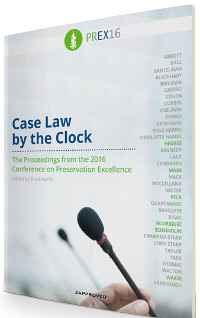
At the 2016 Conference on Preservation Excellence, Zapproved asked six judges to weigh in on 10 such cases in an hour. A complete discussion summary is available for downloading.

Their discussion dissects cases in detail and offers insights on key factors impacting trends in the e-discovery age:

  • Spoliation
  • E-discovery abuse
  • Proportionality
  • Keyword searching
  • BYOD policies

See the complete discussion summary, featuring:

Moderator:

Hon. Ron Hedges (Ret.), Senior Counsel, Dentons U.S. LLP, and former United States Magistrate Judge in the United States District Court of New Jersey

Panelists:

  • Hon. Frank Maas, U.S. Magistrate Judge, United States Southern District of New York
  • Hon. Andrew Peck, U.S. Magistrate Judge, United States District of New York
  • Hon. Xavier Rodriguez, United States District Judge for the Western District of Texas
  • Hon. Shira Scheindlin (Ret.), Stroock & Stroock & Lavan LLP, Former United States District Judge of the Southern District of New York
  • Hon. David Waxse, U.S. Magistrate Judge, United States District of Kansas

Download the discussion summary.


New Research Reveals Third-Party Risk Management Best Practices

Risk managementNavex Global has produced a benchmark report that can be used to help organizations judge how effective their third-party risk management systems are and how to make improvements.

On its website, Navex says one-third of organizations have faced recent legal action related to their third parties.

The new 2016 Third Party Risk Management Benchmark Report is available for free downloading.

Use this report to identify gaps, get buy-in for additional resources and make your program more efficient. The report discusses:

  • Trends for screening and monitoring third parties
  • About the program maturity model and how it impacts your due diligence programs
  • How automated systems help increase performance satisfaction
  • Recent developments in legal costs and number of incidents

Download the Navex report.


Clinton’s Charity Confirms Qatar’s $1 Million Gift While She Was at State Dept.

The Clinton Foundation has confirmed it accepted a $1 million gift from Qatar while Hillary Clinton was U.S. secretary of state without informing the State Department, even though she had promised to let the agency review new or significantly increased support from foreign governments, Reuters is reporting.

“Qatari officials pledged the money in 2011 to mark the 65th birthday of Bill Clinton, Hillary Clinton’s husband, and sought to meet the former U.S. president in person the following year to present him the check, according to an email from a foundation official to Hillary Clinton’s presidential campaign chairman, John Podesta. The email, among thousands hacked from Podesta’s account, was published last month by WikiLeaks,” writes reporter Jonathan Allen.

A foundation spokesman confirmed that it accepted the $1 million gift, but claimed this did not amount to a “material increase” in the Gulf country’s support for the charity. The spokesman declined to say whether Qatari officials received their requested meeting with Bill Clinton.

Read the article.


Two New Cases: Fractional Royalty, Fraction of Royalty, or Mineral Interest?

Two new opinions, one from the San Antonio Court of Appeals and one from the El Paso Court of Appeals, again tackle the task of construing mineral and royalty conveyances and reservations, reports  in his Oil and Gas Lawyer Blog.

He explains that many such cases have arisen as a result of recent shale plays, where lands never before productive have suddenly become valuable, leaving courts have to clear up muddy deed language.

In his blog post, he discusses Laborde Properties, L.P. v. U.S. Shale Energy II, LLC and Greer v. Shook.

Read the article.