Wheeling Hospital Agrees to $50M Settlement Concerning Medicare Fraud Claims

“Wheeling Hospital, Inc. has agreed to pay the United States a total of $50,000,000 to resolve claims that it violated the False Claims Act by knowingly submitting claims to the Medicare program that resulted from violations of the Physician Self-Referral Law and the Anti-Kickback Statute, the Justice Department announced Wednesday,” reports MetroNews Staff in MetroNews.

“According to the Justice Department, in this case, the United States alleged that from 2007 to 2020, under the direction and control of its prior management R&V Associates, Ltd. and Ronald Violi, Wheeling Hospital systematically violated the Stark Law and Anti-Kickback Statute by knowingly and willfully paying improper compensation to referring physicians that was based on the volume or value of the physicians’ referrals or was above fair market value.”

Read the article.


Lawyer Who Allegedly Lied About Health for Deadline Extensions Should be Suspended

“An Illinois lawyer, who reportedly lied and said he had cancer—when he did not—and instead was looking for discovery deadline extensions, is facing potential suspension from the practice of law. He also allegedly lied about having cancer on his University of Chicago Law School application,” reports Stephanie Francis Ward in ABA Journal’s News.

“In 2015, Vincenzo Field reportedly asked an assistant U.S. attorney in the Northern District of Illinois for additional discovery time because he would be out of the office for four months.”

Read the article.


AZA – Our Seven New Lawyers Hired Just Since April

Alex Dvorscak is a commercial litigator with experience handling bankruptcies, class actions, advising distressed companies facing large potential mass tort liabilities and on a variety of other disputes. A graduate of Columbia Law School, he is admitted to the New York bar.

Joshua H. Harris is a commercial litigator whose experience includes executive employment issues, securities and product liability disputes.  A University of Chicago Law School graduate, he was an associate for two years at Simpson Thacher in New York City and is admitted to the New York bar.

Alex R. Hernandez focuses on trials and appeals and has worked on constitutional challenges, environmental, energy, and securities cases. A University of Texas School of Law graduate and former Baker Botts associate, he clerked on the U.S. Court of Appeals for the Fifth Circuit.


Steve Jugle focuses on intellectual property litigation with experience in all stages of the litigation. A former Baker Botts associate, he has prosecuted patents involving wireless and telecommunications technologies, petrochemicals, and more.  A Harvard Law graduate, he has inter partes review experience.


Omar Marawi is an electrical engineer and a graduate of the University of Houston Law Center. His focus is intellectual property and analyzing the merits of patent and design infringement suits, aiding in claim construction and patent prosecution. He is not yet licensed to practice law in Texas.


Monica Moussighi focuses on intellectual property matters including patents, trademark, and copyright. An engineer, she received her law degree from University of Houston Law Center. On the Texas Rising Star list, she previously worked at several prestigious national law firms.


Colin B. Phillips focuses on patent litigation, patent licensing and transactions, inter partes reviews, trademark matters, commercial litigation and financial restructuring.  He has a law degree from the University of Houston Law Center and an aerospace engineering degree from Texas A&M University.

Read more here.


Best Lawyers in America Honors Four from Fears Nachawati

Fears Nachawati attorneys Bryan Fears, Majed Nachawati, Jonathan Novak and Brice Burris have each been selected to the 2021 edition of Best Lawyers in America.

Best Lawyers is the oldest and among the most respected peer reviewed attorney guides in the country. Selection is based on a peer-review survey that includes confidential evaluations by peer lawyers in the same and related specialties, followed by a rigorous vetting process by the Best Lawyers’ research staff. Honorees represent the top four percent of practicing attorneys in the United States.

Bryan and Majed previously earned Best Lawyers recognition for their litigation experience. Jonathan and Brice, each recognized for their work on behalf of personal injury victims, are listed among Best Lawyers’ inaugural “Ones to Watch” list recognizing attorneys early in their careers.

Fears Nachawati represents clients in a range of areas and has emerged as a leader in high stakes litigation across the country. The firm currently represents groups and individuals in matters related to the opioid crisis, environmental contamination, as well as dangerous and defective products.

Learn more about this honor.


Former KAABOO Owner Satisfies $7 Million ‘Thunder on the Mountain’ Judgement

“Kansas promoter Brett Mosiman was ready to chase former KAABOO owner Bryan Gordon to the end of the earth to collect a $7 million judgement delivered by a Kansas jury in February, but that will no longer be necessary after the men settled their claims last week over the canceled 2015 Thunder on the Mountain festival in Ozarks, Ark.,” reports Dave Brooks in Billboard’s Touring.

“Mosiman had filed a second lawsuit against Gordon in San Diego in December accusing the Madison Companies chairman of trying to hide his assets after selling KAABOO late last year. Mosiman was also working with his attorney to prepare their enforcement option for the Kansas judgment, but neither remedy will be needed after Mosiman filed a notice with the Kansas court Wednesday saying that Gordon and the companies he controls have satisfied the terms of the judgement ‘in an amount of which has been fully agreed to by the parties.'”

“Mosiman is the founder of the Wakarusa festival and had been hoping to revive the Thunder on the Mountain series when he was approached by Gordon and his business partners Seth Wolkov and Robert Walker from the Denver-based Madison Companies in 2014.”

Read the article.


In-House Counsel on the Move: Robinhood Swipes Compliance Heads from Fidelity, Wells

“In-house hiring at fintech companies is showing no sign of letting up, and Robinhood Markets Inc is doing more than its fair share to keep up the trend. The commission-free trading startup said in an Aug. 27 blog post that Norm Ashkenas is joining the company as chief compliance officer for Robinhood Financial,” reports Caroline Spiezio in Reuters’ Business News.

“General counsel appointments have slowed as summer creeps to an end, but at least three public companies – Zoom Video Communications Inc, Geico Corp and Kelly Services Inc – recently tapped top lawyers.”

Read the article.


Myrtle Beach Lawyer Disbarred After Alford Plea to Indecent Exposure, History of Similar Charges

“A Myrtle Beach lawyer is no longer allowed to practice law after entering an Alford plea on charges of indecent exposure, and a history of pleas related to assault and voyeurism,” reports Kaitlyn Luna in WSPA’s News.

“Jacob Parrott was disbarred on Aug. 13 by the state Supreme Court, backdating to June 5, 2018, when he was arrested for indecent exposure after police said he was exposing himself and masturbating by a public pool, according to the court records.”

“After the arrest, Parrott entered an Alford plea. Under an Alford plea, a defendant does not admit guilt but acknowledges prosecutors have enough evidence to gain a conviction.”

Read the article.


Trustee Looks to Question Former Leclairryan Insiders in Bankruptcy Case

“The trustee overseeing the bankruptcy liquidation of Richmond law firm LeClairRyan is starting to dig a little deeper,” reports Michael Schwartz in Richmond Bizsense.

“Lynn Tavenner, who has led the hunt for assets for creditors since the once mighty firm collapsed last year, will question and gather information from a lengthy list of LeClairRyan’s former attorneys, management and others it did business with over the years.”

“Tavenner sought and received court approval last month to begin the so-called 2004 examination process, which would give her the ability to push for the turning over of documents and conducting of depositions, including via subpoena if necessary.”

Read the article.


Lowenstein Sandler Welcomes Brent Weisenberg as Senior Counsel in the Bankruptcy, Financial Reorganization & Creditors’ Rights Department

Brent Weisenberg has joined Lowenstein Sandler as senior counsel in the firm’s Bankruptcy, Financial Reorganization & Creditors’ Rights Department.

Weisenberg’s practice focuses on advising businesses and their stakeholder constituencies during periods of financial challenge and special situations, including in the negotiation and implementation of complex commercial transactions, the acquisition and disposition of distressed assets, and the prosecution and defense of commercial litigation. He has extensive experience counseling official and unofficial committees across a wide array of industries, including retail, real estate, construction, hospitality, telecommunications, manufacturing, and technology.

Weisenberg also has particular experience in the wind-down of private equity and hedge fund vehicles. Prior to joining Lowenstein, he was selected by a court-appointed receiver to serve as General Counsel to the Platinum Partners family of hedge funds, where he worked extensively with the receiver’s outside counsel and financial advisors, as well as with Platinum’s portfolio managers, to unwind what was asserted to be a fund valued at more than $500 million.

Jeffrey Cohen, Vice Chair of the department, says, “It feels fantastic to be reuniting with Brent. Having previously been colleagues with him for more than a decade, I know the positive impact he will have on our practice. I look forward to integrating Brent into the Lowenstein platform and our white-hot debtor and committee practices.”

Kenneth A. Rosen, Chair of Lowenstein’s bankruptcy department, says, “Brent’s unique experience serving as general counsel to Platinum Partners and its receiver, the former chief judge of the Eastern District of New York’s bankruptcy court, not only helped him solidify his ability to solve the business and financial issues facing entities today but allowed him to gain an unmatched perspective on the wind-down of private equity and hedge fund vehicles, a sector where we are seeing increasing volatility.”

Lowenstein’s Bankruptcy, Financial Reorganization & Creditors’ Rights has been recognized by The Wall Street Journal as one of the country’s top 10 power players in large corporate bankruptcy matters, and it was ranked in the top five in Debtwire’s “1H19 Restructuring Advisory Mandates Report” in the category of Lead Counsel: UCC.

About Lowenstein Sandler LLP
Lowenstein Sandler is a national law firm with over 350 lawyers based in New York, Palo Alto, New Jersey, Utah, and Washington, D.C. The firm represents leaders in virtually every sector of the global economy, with particular emphasis on investment funds, life sciences, and technology. Recognized for its entrepreneurial spirit and high standard of client service, the firm is committed to the interests of its clients, colleagues, and communities.


Three-Lawyer Team Joins Akerman’s Franchise and Licensing Practice

Akerman LLP, a top 100 U.S. law firm serving clients across the Americas, is pleased to announce a three-lawyer team has joined the firm’s Franchise and Licensing Practice in Denver. Kevin Hein, Trish MacAskill, and Leilani Argersinger provide strategic guidance to franchisors, licensors, subfranchisors, and dealers regarding a range of legal and strategic business needs impacting their distribution models. The team’s experience extends to restaurant and retail development, franchise sales compliance, mergers and acquisitions, compliance with state and federal laws, corporate counseling, and dispute resolution. In his new role with Akerman, Hein will co-chair the firm’s Franchise and Licensing Practice.

Kevin Hein, Partner
For more than two decades, Hein has focused his practice on counseling companies that rely on franchising as part of their distribution models on a wide range of legal issues, including state and federal disclosure requirements, compliance with state relationship laws, franchise sales compliance, restaurant and retail development, franchising in the health and wellness industries, mergers and acquisitions, corporate counseling, bankruptcy and reorganization, and dispute resolution. Hein’s experience in the restaurant industry includes advising clients regarding corporate formation, real estate acquisition and development, leasing issues, corporate financing activities, mergers and acquisitions, dispute resolution, general corporate matters, and franchise relationship issues. In addition, he regularly counsels established and emerging healthcare and wellness clients to ensure their franchise systems and licensing programs are structured to comply with federal and state laws regarding corporate practice of medicine, fee-splitting, Stark and physician self-referral regulations, HIPAA compliance, and other healthcare related compliance issues.

Trish Barrett MacAskill, Special Counsel
MacAskill focuses her practice on franchise and business transactions. MacAskill applies her in-house experience when counseling clients on business, franchising, and licensing issues. She has experience counseling clients on franchise regulatory compliance and negotiating commercial leases and contracts in a broad range of industries, products, and services.

Leilani Argersinger, Associate
Argersinger focuses her practice on corporate transactional law, with an emphasis on U.S. and international franchising and distribution law. She represents emerging and established franchisors in corporate transactions, including M&A, corporate formation, lease negotiation, intellectual property, and capital raising. Argersinger regularly counsels clients on franchise and multi-unit development agreements, franchise registration and disclosure documents, corporate governance and formation documents, purchase, sale, and investment transactions, and franchise law and regulatory compliance matters.

About Akerman
Akerman LLP is a top 100 U.S. law firm recognized among the most forward thinking firms in the industry by Financial Times. Its more than 700 lawyers and business professionals collaborate with the world’s most successful enterprises and entrepreneurs to navigate change, seize opportunities, and help drive innovation and growth. Akerman is known for its results in middle market M&A and complex disputes, and for helping clients achieve their most important business objectives in the financial services, real estate and other dynamic sectors across the United States and Latin America.

The Akerman Corporate Practice Group advises public and private companies, including private equity funds, on M&A, capital markets transactions, financings, and other transactional matters, with a strong focus on the middle market. Akerman is top-ranked nationally for mergers, acquisitions and buyouts: middle market by The Legal 500, is recognized as a leading U.S. law firm by U.S. News – Best Lawyers for corporate, M&A, private equity, securities/capital markets, securities regulation and banking and finance law, and is listed in PitchBook league tables as among the most active law firms in the United States for M&A deals.


John J. Barnosky Joins Maurer Foundation Board of Directors

Farrell Fritz is pleased to announce that John (Jack) Barnosky has joined the Maurer Foundation’s Board of Directors.

Barnosky, a partner in the firm’s Uniondale office, practices trust and estate law, concentrating on estate planning, probate and administration of estates and trusts, and taxation. He also represents clients in litigated trust and estate matters, including will contests, disputes over the validity of trusts, contested accounting proceedings, and tax disputes before the Surrogate’s Courts and other courts throughout New York. In addition to his work at Farrell Fritz, he is a frequent lecturer at New York State Bar Association seminars on trust and estate practice and has written articles published in the New York Law Journal, The Nassau Lawyer, and the Journal of the Suffolk Academy of Law. Barnosky is a past chair of the trust and estate committee of the Nassau County Bar Association as well as Chair of the Trust and Estate section of the New York State Bar association.

Barnosky, a Halesite resident, earned his LL.M. from New York University School of Law, his J.D. from St. John’s University School of Law and his A.B. from Assumption College.

The Maurer Foundation, established in 1995, is a 501(c)(3) not-for-profit based in Melville, NY. The Foundation’s mission is to save lives through breast health education that focuses on breast cancer prevention, early detection, risk reduction and healthy lifestyle choices.


E-Signatures White Paper: Beyond Business Continuity

OneSpan has published a white paper titled “Beyond Business Continuity, The New Normal in Remote Banking and Insurance” and made it available for downloading at no charge. (See the download form below.)

The COVID-19 pandemic accelerated trends toward remote banking, digitization, and remote work as the world embraced new technologies and processes to keep our financial institutions, businesses, and society functional. Around the world, people now rely more than ever on digital solutions for interactions and transactions that have traditionally involved a visit to the branch or a face-to-face meeting with an advisor.

In this paper, we explore the top financial processes to digitize with e-signatures and digital identity verification technology – as well as key security considerations to support the rise of the digital-first financial services provider.

The new normal is here, and electronic signatures are key to continued success.

In this white paper, you will learn:

  • Global regulatory responses shaping the new normal
  • The top financial processes to digitize with e-signatures
  • How to determine your organization’s readiness to deploy e-signatures


Layoffs Hit Furloughed Staffers at Two Biglaw Firms, Lawyers and Staffers at Another

“Baker McKenzie is laying off 6% of its workforce in the United States, Canada and Mexico. Those laid off include lawyers, other timekeepers and business professionals,” reports Debra Cassens Weiss in ABA Journal’s News.

“Davis Wright is laying off 39 staff members who had been furloughed. The staff members were in office services, legal assistance and other administrative positions.”

“Venable is laying off some furloughed employees, as well as some other professional staff members. The firm did not disclose numbers.”

Read the article.


Fake Websites for Four Biglaw Firms Might Have Been Created to Get Deal Information

“Fake websites for four large law firms created in 2008 might have been part of an attempt to get insider information on pending Wall Street deals, according to newly declassified FBI documents,” reports Debra Cassens Weiss in ABA Journal’s Cybersecurity News.

“The targeted law firms were Greenberg Traurig; Sullivan & Cromwell; Wachtell, Lipton, Rosen & Katz; and Cravath, Swaine & Moore.”

“Sullivan & Cromwell told the FBI that it thought the scammer was trying to intercept email with information about mergers and acquisitions.”

Read the article.


Court-Appointed Attorney for Donziger Cites ‘Irreconcilable Conflict’

“Attorney Andrew Frisch asked a Manhattan federal judge on Wednesday to vacate an order forcing him to represent Steven Donziger, the American lawyer who spent more than two decades suing Chevron Corp over pollution in Ecuador and is now facing a trial next week for criminal contempt,” reports Sebastien Malo in Thomson Reuters Westlaw Today.

“Donziger’s ex-lawyer Frisch told the court in filings that he has had no recent contact with Donziger, their relationship is beyond repair and under such circumstances his representation could violate the defendant’s right to effective assistance of counsel.”

“On Aug. 28 senior U.S. District Judge Loretta Preska ordered Frisch of Schlam Stone & Dolan, Donziger’s former lead defense attorney, to take the reins after the court disqualified two of Donziger’s attorneys and if another two out-of-state lawyers continue to decline or are unable to appear partly at the Sept. 9 trial due to concerns over contracting COVID-19.”

Read the article.


Kelly® Announces Appointment of New General Counsel

“Kelly, a global leader in providing workforce solutions, today announced the appointment of Vanessa Williams as Senior Vice President and General Counsel,” reports Kelly in their Press Room.

“In this position, Vanessa has responsibility for leading the strategic direction of Kelly’s legal and corporate security organizations which includes managing regulatory and legal compliance for the company, directing Kelly’s strategic legal initiatives and providing senior management with actionable counsel regarding company objectives. She will also oversee Kelly’s global in-house legal team and be responsible for managing outside counsel relationships. Vanessa reports directly to President and Chief Executive Officer Peter Quigley.”

Read the article.


Express Mobile Asserts Patent Infringement Suits Against Nine Leading Technology Firms

“Express Mobile, Inc. (XMO), a pioneering leader in Web 2.0 and mobile technology, announced that today it has filed nine lawsuits against some of the biggest names in e-commerce and technology for patent infringement. The defendants include Atlassian, DropBox, eBay, Expedia, FaceBook, Google, HubSpot, Microsoft, and Squarespace,” reports Express Mobile Inc. 

“XMO’s Chair and founder Steven H. Rempell first developed the patents at issue in the late 1990s.”

“Mr. Rempell’s foundational patents are fundamental to modern solutions architecture and design, particularly for Web 2.0 applications such as mobile and desktop website generation, social media and e-commerce websites, among other industries.”

Read the article.


Three Bradley Partners Named to Benchmark Top 250 Women in Litigation 2020

Bradley Arant Boult Cummings LLP is pleased to announce that the firm’s partners Leigh Anne Hodge, Lela M. Hollabaugh and Kimberly B. Martin have been named to Benchmark Litigation’s Top 250 Women in Litigation 2020.

Leigh Anne HodgeLela HollabaughKimberly MartinHodge, Hollabaugh and Martin are among the more than 225 litigators – comprising nearly half of the firm – who make up Bradley’s Litigation Practice Group. The group’s attorneys have experience nationally and internationally and in a wide range of industries. The group has handled high-stakes and complex cases, including arbitration and litigation, in every state, as well as every federal district and appellate court, across the United States.

A member of Bradley’s Healthcare Practice Group and leader of the firm’s Litigation Practice Group, Hodge represents clients in the healthcare industry in regional and national engagements. She regularly represents and counsels clients in the healthcare industry in product liability litigation, medical malpractice litigation, peer review and staff privileges matters, administrative hearings before licensure board, ERISA litigation, Medicare Advantage plan litigation, managed care litigation, insurance disputes, and insurance fraud cases. Hodge is based in Bradley’s Birmingham office.

Managing partner of Bradley’s Nashville office, Hollabaugh has served as the lead trial lawyer in more than a dozen jury trials, as well as more than two dozen bench trials, arbitrations and administrative hearings. She advises leading natural gas pipeline companies and other infrastructure clients on issues involving location, land acquisition, construction, and operations. She also represents leading pharmaceutical, medical device and other manufacturers in matters ranging from individual lawsuits to mass tort cases around the country.

Based in Bradley’s Huntsville office, Martin is a member of the firm’s board and focuses her practice on general litigation with an emphasis on medical device and pharmaceutical products liability litigation, as well as white collar matters and False Claims Act litigation. She has tried cases in state and federal court. Most recently, she was a national team member for sales and marketing issues defending a pharmaceutical company in multi-district litigation throughout the United States. Martin has represented multi-national pharmaceutical and medical device manufacturers in litigation across the country.

Now in its ninth edition, the Top 250 Women in Litigation determines honorees through research of litigators’ professional activities as well as client feedback from surveys and individual interviews. According to Benchmark Litigation, “These women have earned their place amongst the leading female litigators by participating in some of the most impactful litigation matters in recent history as well as by earning the hard-won respect of their peers and clients.” For more information about Benchmark Litigation, visit www.benchmarklitigation.com.

About Bradley
Bradley combines skilled legal counsel with exceptional client service and unwavering integrity to assist a diverse range of corporate and individual clients in achieving their business goals. With offices in Alabama, Florida, Mississippi, North Carolina, Tennessee, Texas, and the District of Columbia, the firm’s nearly 550 lawyers represent regional, national and international clients in various industries, including banking and financial services, construction, energy, healthcare, life sciences, manufacturing, real estate, and technology, among many others.


6 Proven Steps to Maximize Insights from Your Legal Spend Data

Improving rate management to optimize cost-effectiveness of your legal department operations.

By Kris Satkunas, director of strategic consulting of LexisNexis CounselLink

As businesses of all sizes scramble to cut costs and reformulate budgets during today’s economic uncertainty, corporate legal departments are under immense pressure to smartly manage outside legal spend. In turn, this pressure is prompting inside counsel to examine the rates they pay outside counsel and raising questions about what rates are justified. But to properly determine rates they should pay outside counsel, corporate legal departments must use their enterprise legal management (ELM) systems to mine data, analyze it, and make wise decisions.

How do you optimize ELM data to get the answers to your business questions? Below are six essential steps to take.

Step 1: Choose Your Metrics
Consider the questions you need to answer to choose the best metrics. In this case, the goal is to identify where the greatest opportunities are to negotiate lower rates. What metrics will help you best? I’d suggest three are highly relevant:

• Current year timekeeper billed rates – for obvious reasons. This is the current state.
• Change (increase) in timekeeper rates over the last two years – Firms that have increased rates more significantly are likely ones where there is greater leverage to negotiate. Evaluating the percentage change over a two-year period will help to normalize for firms that may have increased rates by a significantly higher amount in one year, but minimally or not at all in another.
• Two-year hours billed – It’s important to focus analytic efforts on areas likely to yield the greatest results. There may be a partner that bills $2,000/hour, but only is engaged on your matters for a couple of hours per year. Bringing a volume metric into this analysis helps keep the focus on what’s most relevant.

Step 2: Organize Your Data
Legal departments pay widely disparate rates for different types of legal work, e.g. work that is largely commoditized vs. work that is unique or requires specialized legal skills. Therefore, when comparing rates paid to multiple firms, it’s critical to look at comparable types of legal work. Most organizations classify legal work by matter type, which will help with this step of segmentation.

Additionally, it’s worth considering whether particular matters have greater strategic value or a larger potential impact on the organization. You may decide that you’re willing to pay premium rates for this type of work, so you want the ability to filter them in/out of your data set and look at them independently.

Step 3: Filter
The matter segmentation referenced in step 2 is one important way to filter data. Additionally, for a billable rate analysis, it’s going to be important to filter data based on timekeeper title (eg. distinguishing between rates paid to partners versus various levels of associates).

Step 4: Analyze & Visualize
In this stage, you’ll evaluate the data you’ve collected to look for the stories it tells. The analytic process typically starts at a higher, aggregate level and then drills down to lower levels of detail to identify patterns vs. outliers. It can be very helpful to have a business intelligence tool that supports data visualization to perform such analysis.

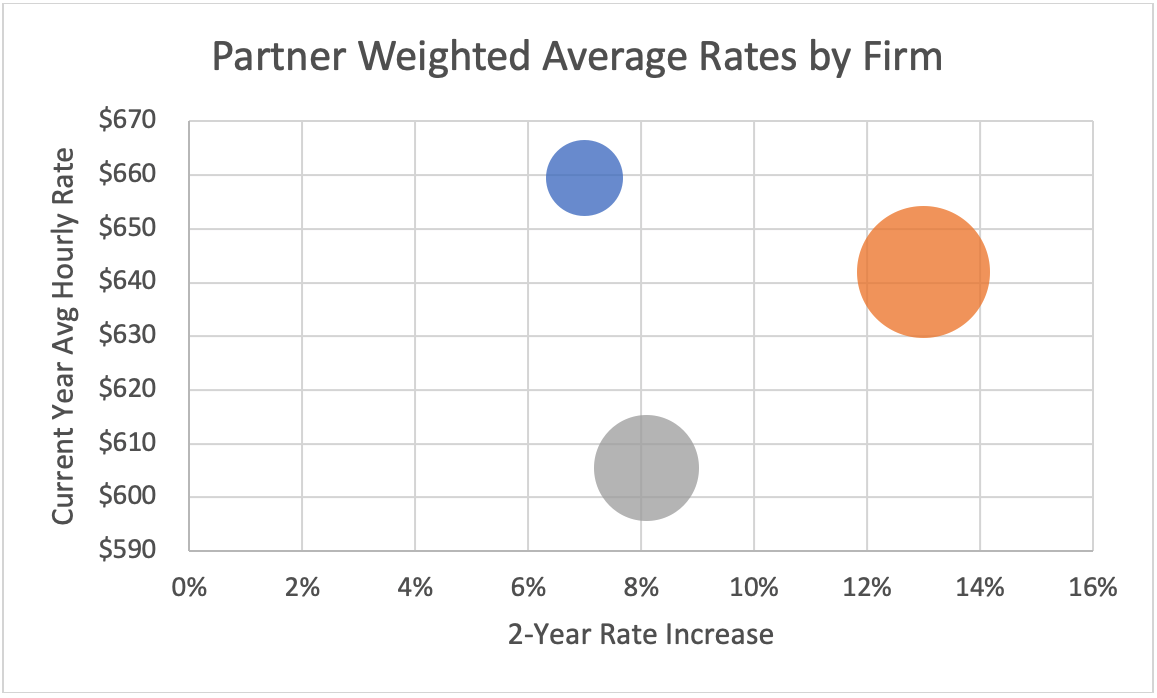
A bubble chart is a useful type of visualization to show the interrelationship of three metrics. In this example, the X-axis represents the two-year percentage increase in rates, the Y-axis represents the hourly rate billed, and the size of each circle represents the volume of hours billed. At an aggregate level, this analysis might start by comparing law firms. Each circle is plotting the weighted average hourly rate (weighted on hours billed) of partners billing from different firms.
Partner Weighted Average Rates by Firm

Using a chart like this clearly paints the story that the law firm handling the highest volume (the largest bubble) has increased partner rates the most, and bills average rates that are materially higher than the firm handling the second highest level of volume (the mid-sized bubble). This firm may be a good candidate for rate negotiation.

A subsequent natural step would be to drill to the individual timekeeper level where each bubble would represent an individual partner, colored by law firm. Remember, start at the aggregate level for analytic purposes, and gradually peel back the onion to probe more deeply. Starting at a more granular level can lead to losing sight of the big picture.

Step 5: Benchmark
The analysis up until now has been based on a given corporation’s legal data. Bringing in external benchmarks at this stage will enrich the analysis and potentially help to validate the conclusions drawn from internal data. ELMs such as CounselLink incorporate benchmarking modules into their platforms for just this purpose.

When leveraging benchmark data, it is critical to be discerning in the filtering process so that external data is as comparable to your legal work as possible. The two most important filters to apply to benchmark data are matter type and law firm size. These are the most highly correlated attributes to hourly rates. For example, if in Step 2 when you organized your own data, one of your material buckets of legal work was immigration-related employment matters, you want to look at benchmarks of what other companies pay for immigration work, not the broader bucket of employment work. Further, if you are using mid-size, regional firms to handle immigration matters, make sure that’s what your benchmark data represents as well. There is a tendency to gravitate toward geographic filters when benchmarking rates billed by law firm, but size of firm has a greater correlation to rates than does geography.

Step 6: Leverage
Once you have categorized, filtered, and analyzed your data from your ELM, it’s time to leverage the output to answer the original question – “Where are the greatest opportunities to negotiate lower hourly rates?” Rather than taking a scattershot approach, you’re now armed with data to target firms with the greatest savings opportunities.

These six steps will set you well on your way to determining what your legal department should be paying, and which vendors will help you meet your budget goals. Remember, it all starts with the right questions. Your data will give you the answers, it’s just a matter of tapping into your ELM in the smartest way.



Latest Developments in the Patentability of AI- and Software-Based Inventions

Fitch, Even, Tabin & Flannery LLP will present a free webinar, “Latest Developments in the Patentability of AI- and Software-Based Inventions,” featuring Fitch Even attorneys Thomas F. Lebens and Zachary Van Engen.

The webinar will take place on Thursday, September 24, 2020, at 9:00 am PDT / 10:00 am MDT / 11:00 am CDT / 12 noon EDT.

The changes in subject matter eligibility prompted by the Supreme Court’s decision in Alice v. CLS Bank and subsequent Federal Circuit and district court cases have continued to make it challenging to patent inventions tied to artificial intelligence and other types of software. The legal analysis often turns on how the software interacts with the outside world and the nature of the problems it solves.

During this webinar, we will provide an update on the latest legal developments in computer software patentability along with guidance on best practices for protecting software-related innovations, covering these topics and more:

  • Ramifications of recent post-Alice Federal Circuit cases
  • Updated USPTO guidelines
  • Tips for patent application drafting
  • Tips for responding to office actions

CLE credit has been approved for California and Illinois and is pending in Nebraska. Other states may also award CLE credit upon attendee request.

Following the live event, a recording of the webinar will be available to view for one year at www.fitcheven.com.

Register for the webinar.